
What’s the difference between a high-converiting email and a generic AI template?
Not clever subject lines or perfect timing alone. The emails that break through demonstrate strategic relevance, business alignment, and credibility from the first line.
This article written from Be Executive Events’ expertise working with C-Level executives, shows you how to stand out in a CEO’s inbox through positioning, timing, and trust signals that executives actually respond to.
You’ll learn practical strategies based on how CEOs filter messages, what triggers their attention, and why most outreach fails before they ever see it.
Why Most Messages Never Reach a CEO
The average CEO receives 120 emails daily. Some tech industry leaders handle 700-800 messages per day. That volume forces aggressive filtering at every level.
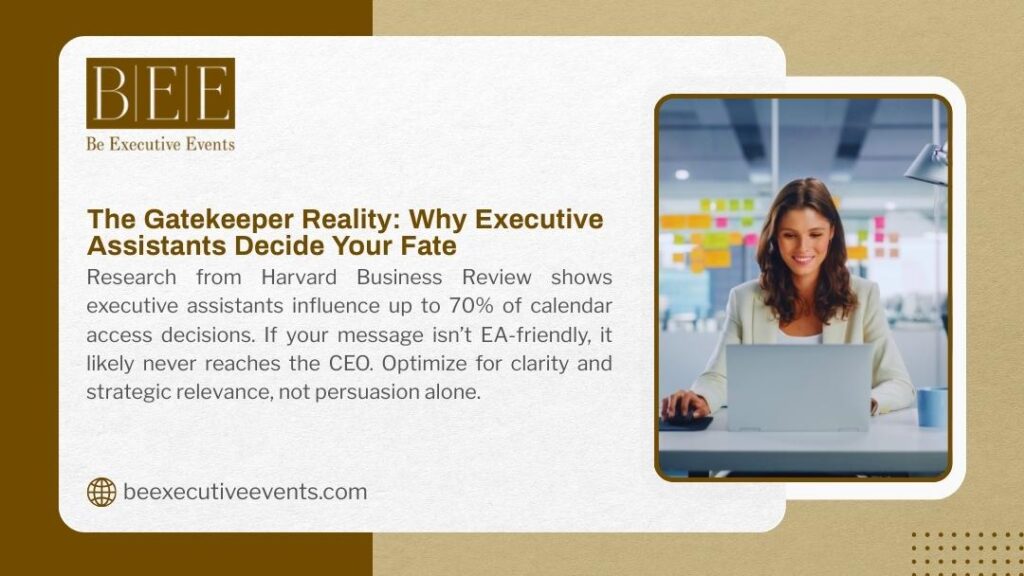
Executive assistants screen first. They delete obvious sales pitches, filter low-priority messages, and only forward emails that clearly align with current business priorities. Messages that lack strategic context never make it past this initial barrier.
CEOs who do see messages spend an average of 10 seconds scanning them. They look for sender recognition, strategic relevance, and clear business value. Generic outreach gets archived without a second thought.
CEO Inbox Behavior Snapshot:
| Behavior | Reason | Strategic Implication |
| Scan in 10 seconds | High volume requires rapid filtering | First sentence must signal strategic value |
| Prioritize recognized names | Trust and credibility matter more than message quality | Build visibility before direct outreach |
| Focus on business priorities | Everything competes with board-level concerns | Align with growth, risk, or competitive issues |
| Delegate tactical queries | CEOs handle strategy, not operations | Position at business impact level, not feature level |
The consequences of generic outreach extend beyond ignored messages. CEOs remember companies that waste their time with irrelevant pitches. Poor positioning damages your reputation and makes future outreach even harder.
From our experience, the biggest mistake sales teams make is treating CEO outreach like any other email campaign. Executives operate in a completely different decision-making environment than department managers.
Your approach needs to match that reality.
Strategy #1: Align Your Message With a Current Business Priority
CEOs open emails that directly connect to growth, risk, or competitive advantage. They ignore everything else.
Research shows that 62% of CEOs selected growth as their top business priority for 2024, the highest level in a decade. Cost management, talent retention, and AI adoption also rank high across industries.
Your message needs to connect to these actual priorities, not assumed pain points.
Tie your outreach to recent company announcements. Did they just close a funding round? They’re focused on scaling operations and hitting growth targets. Leadership change?
The new executive is establishing priorities and building their team. Product launch? They’re watching market response and competitive reaction closely.
CEO Priority Alignment Examples:
| Business Priority | Example Timing | Message Approach |
| Growth and expansion | Post-funding, new market entry | Connect to scaling challenges and revenue targets |
| Cost management | Economic uncertainty, margin pressure | Focus on operational efficiency and risk reduction |
| Talent retention | High turnover, competitive hiring | Address workforce productivity and culture |
| AI adoption | Digital transformation initiatives | Link to competitive advantage and market position |
Different CEO types focus on different growth contexts:
- Tech startup CEOs prioritize user acquisition and product-market fit
- Enterprise CEOs focus on market share and operational scale at volume
- SaaS CEOs center on retention metrics and expansion revenue growth
Understanding why executives ignore sales outreach helps you avoid the common mistakes that kill response rates before your message even gets read.
Strategy #2: Lead With Business Impact, Not Your Product
CEOs don’t care what you sell. They care about what you deliver to their business results.
The framework that works: Outcome → Value → Ask. Start with the business outcome they need, explain the value you create, then make a small ask. Never lead with product features or company background.
Types of impact that resonate with CEOs:
- Revenue growth that affects top-line numbers and market expansion
- Cost reduction that improves margins and operational efficiency
- Risk mitigation that protects the business from competitive or regulatory threats
- Competitive advantage that changes market position and customer perception
Frame everything at this strategic level, not at the departmental or tactical level.
Impact vs Feature Messaging:
| Feature Statement | Reframed as Business Impact | Expected CEO Response |
| “Our platform improves team collaboration” | “Reduce project delivery time by 40% while cutting coordination overhead” | Potential interest (affects operational metrics) |
| “We offer advanced analytics” | “Identify margin leaks costing you $2M+ annually across your product lines” | High interest (direct P&L impact) |
| “Easy integration with your existing tools” | “Deploy without disrupting current operations or requiring IT resources” | Removes barrier to consideration |
For example, instead of “We help companies manage customer data better,” say “CFOs in your industry are cutting customer acquisition costs by 35% while expanding into enterprise accounts. The common pattern involves data infrastructure that most companies overlook.”
The shift from product features to business outcomes requires different research. You need to understand their financial model, competitive pressures, and strategic goals. This takes more time but generates exponentially better response rates.
Strategy #3: Borrow Credibility
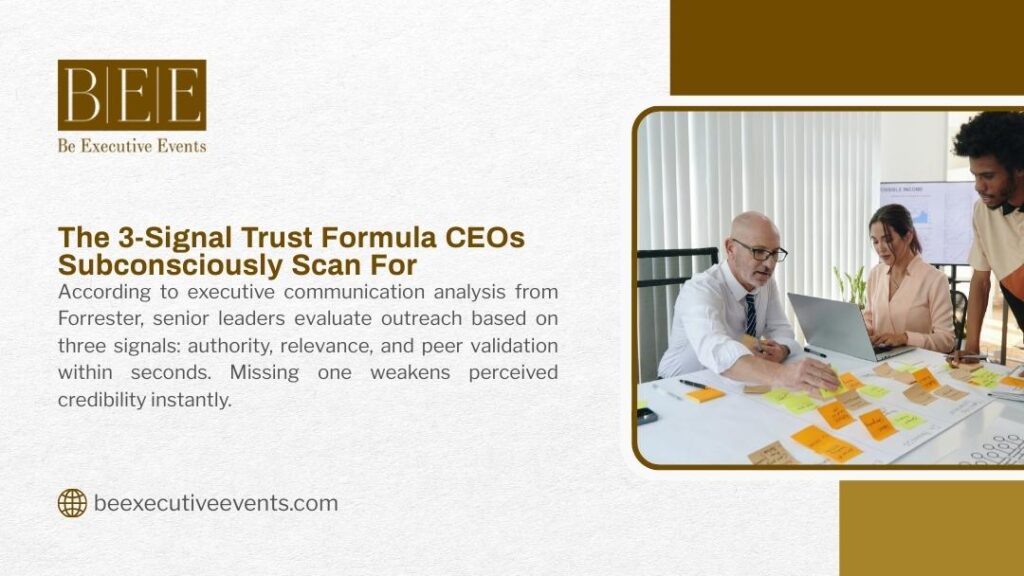
CEOs respond to authority, peer validation, and recognized names. Use these credibility signals to overcome the trust barrier that blocks most cold outreach.
Mention mutual contacts when they exist. “Sarah Chen suggested I reach out” opens doors that cold emails never will. Name recognizable clients in similar industries. “We work with three other companies in your space facing similar unit economics challenges” establishes immediate relevance.
Industry references matter more than company size. A CEO cares more about what their direct competitors are doing than about Fortune 500 logos from unrelated industries. Use social proof that matches their specific context.
Credibility Signals and CEO Perception:
| Signal Type | How to Include | Why It Matters |
| Peer referral | “John Davis mentioned you’re looking at solutions for…” | Transfers trust from known contact |
| Industry recognition | “We spoke at [Industry Conference] about…” | Demonstrates subject matter expertise |
| Relevant clients | “Companies like [Competitor] use this to…” | Shows proven results in their space |
| Advisory relationships | “We advise [Industry Leader] on…” | Positions as strategic partner, not vendor |
Building credibility takes time. Participate in industry events, publish strategic analysis, and develop relationships with the advisors and board members who influence your target executives.
The benefits of executive networking extend far beyond immediate sales opportunities.
Many successful approaches to how to get a meeting with a CEO, starts with building this credibility foundation months before any direct outreach happens.
Strategy #4: Time Your Outreach Around Business Moments
Even perfect messages fail when they arrive at the wrong moment. CEOs have predictable periods when they’re more receptive to strategic conversations.
Optimal CEO Email Timing:
| Business Event | Why It Matters | Recommended Action |
| Funding announcement | Capital deployment and growth focus | Align with scaling challenges and resource allocation |
| Leadership change | New executive establishes priorities | Offer strategic insight, not product pitch |
| Product launch | Market positioning and competitive response | Connect to go-to-market execution |
| Earnings release | Strategic review and board scrutiny | Reference disclosed priorities and challenges |
| Market expansion | Geographic or segment growth | Address specific expansion risks and opportunities |
Timing mistakes to avoid:
- End-of-quarter when CEOs face intense internal pressure and board reporting
- Major industry events when they’re traveling and focused on conference commitments
- Crisis periods when external vendors are the absolute last priority
- Holiday seasons when decision-making slows and key stakeholders are unavailable
The combination of right timing and strategic relevance multiplies your response rates. A mediocre message at the perfect moment outperforms a great message at the wrong time.
Strategy #5: Make the Questions Smaller and In a Low-Friction
Request a 10-minute call instead of an hour meeting, ask for brief feedback on a one-page analysis instead of a full presentation.
Offer to send a specific resource instead of scheduling a demo and lower the initial commitment barrier.
High-Reply CTA Examples:
| CTA Type | Recommended Context | CEO-Friendly Framing |
| Brief call | Initial outreach with strong relevance | “10 minutes to discuss [specific challenge]” |
| Feedback request | Offering strategic analysis | “Quick reaction to this one-page framework” |
| Resource share | Providing value first | “Send you the analysis we did for [peer company]” |
| Event invitation | Natural engagement context | “Join [Industry Leader] at [Executive Roundtable]” |
Micro-commitments work because they respect CEO time constraints while allowing them to evaluate your strategic value. A successful 10-minute call leads to longer conversations. A helpful resource shared leads to future engagement.
Many CEOs prefer alternatives to cold outreach for executives that provide value before asking for their time. This approach aligns with how they actually evaluate potential partners.
The Reality: The Best Way to Stand Out is Not Being a Stranger
Email alone rarely builds executive relationships. Connections do.
Warm introductions from trusted peers generate response rates 10-15 times higher than cold outreach. When another CEO vouches for you, that referral transfers credibility immediately. The introduction bypasses trust barriers that take months of cold outreach to overcome.
Executive events and executive roundtables create natural engagement environments. CEOs attend these gatherings expecting substantive business discussions.
The context pre-qualifies both parties and removes the cold outreach stigma entirely.
Shared networks and communities provide ongoing visibility. When executives see you contribute to industry discussions, speak at conferences, or publish strategic analysis, subsequent direct outreach feels natural rather than intrusive.
Thought leadership to attract executives builds this recognition over time.
Key relationship-building channels that work:
- Industry conferences where CEOs speak or attend as participants
- Private roundtables focused on specific strategic challenges
- Advisory boards where you demonstrate expertise before selling
- Professional associations in their specific industry vertical
- Executive education programs at major business schools
Be Executive Events creates curated environments where C-suite leaders engage with potential partners through focused discussions on strategic challenges. These programs work because they respect executive time while creating genuine opportunities for relationship development.
Understanding how to get executives to attend events helps you create the right context for these high-value connections to develop naturally.
The most effective approach combines multiple channels:
- Build visibility through thought leadership and industry participation
- Gain introductions through shared networks and mutual contacts
- Participate in events where your target executives already engage
- Use direct outreach as one touchpoint in an ongoing relationship process
Frequently Asked Questions on How To Stand Out In a CEO’s Inbox
How long should a CEO email be?
Keep CEO emails under 150 words. Busy executives scan messages in 10 seconds. Long emails signal that you don’t respect their time. Get to the strategic point immediately, demonstrate relevant business impact, and make a simple ask. Save detailed explanations for follow-up conversations after you’ve earned their initial interest.
When is the best time to email a CEO?
Align outreach with key business moments rather than calendar dates. Post-funding periods, leadership changes, product launches, and strategic review cycles all create natural windows. Avoid end-of-quarter pressure, major travel periods, and obvious crisis situations when external vendors are low priority.
How often should I follow up with a CEO?
Send 2-3 follow-ups maximum, spaced 5-7 days apart. Each follow-up must add new strategic value, not repeat the same message. If you get no response after three attempts, your positioning or timing is wrong. More follow-ups damage credibility rather than improve response rates.
Should I use humor in a CEO email?
Clarity and relevance win over cleverness with executive audiences. Humor works only when you already have an established relationship. In cold outreach, executives want strategic insight and business value, not entertainment.
Can social proof improve CEO response rates?
Yes significantly, mentioning mutual contacts, relevant clients, or industry recognition improves credibility immediately. CEOs respond to peer validation and recognized authority. Just make sure your social proof matches their specific industry and business context rather than using generic Fortune 500 logos.
Final Thoughts on How to Stand Out in a CEO’s Inbox
Learning how to stand out in a CEO’s inbox requires strategic positioning, not email optimization tactics. Most outreach fails because it demonstrates zero understanding of how executives filter information and make decisions.
The strategies that work all share common elements:
- They align with current business priorities rather than assumed pain points
- They lead with business impact instead of product features
- They borrow credibility through peer validation and industry recognition
- They time outreach around strategic business moments
- They make small asks that respect executive time constraints
But the most effective approach recognizes that email is just one touchpoint in relationship development. Build visibility before you need it. Gain introductions through shared networks. Participate in the forums where your target executives already engage on strategic challenges.
The question isn’t just whether executives read cold emails. It’s whether your message demonstrates the strategic relevance and credibility that makes reading it worth their limited time.
Focus on becoming a recognized voice in your industry before sending that perfect email. When CEOs already know your company as credible and relevant, your outreach succeeds because it’s not truly cold anymore.