
Executive attention is expensive. The average C-suite leader receives over 120 emails daily and faces constant demands on their time.
Yet research from Edelman-LinkedIn shows that 54% of C-suite executives spend an hour or more each week reading thought leadership content.
This presents a clear opportunity. When you create the right type of content, executives will actually pay attention. The challenge is that most companies fail to deliver what executives value.
This article provides proven strategies to build thought leadership to attract executives, drawn from Be Executive Events’ 10+ years of experience working with companies and C-level decision-makers across the world.
Why Thought Leadership Matters for Executives
Executive leaders face complex decisions with limited time to gather information. They need insights that help them solve problems, not marketing disguised as expertise.
The data shows thought leadership has real business impact. 60% of decision-makers are willing to pay a premium to work with companies that demonstrate strong thought leadership.
This isn’t about brand awareness alone. Quality thought leadership directly influences purchasing decisions and partnership choices.
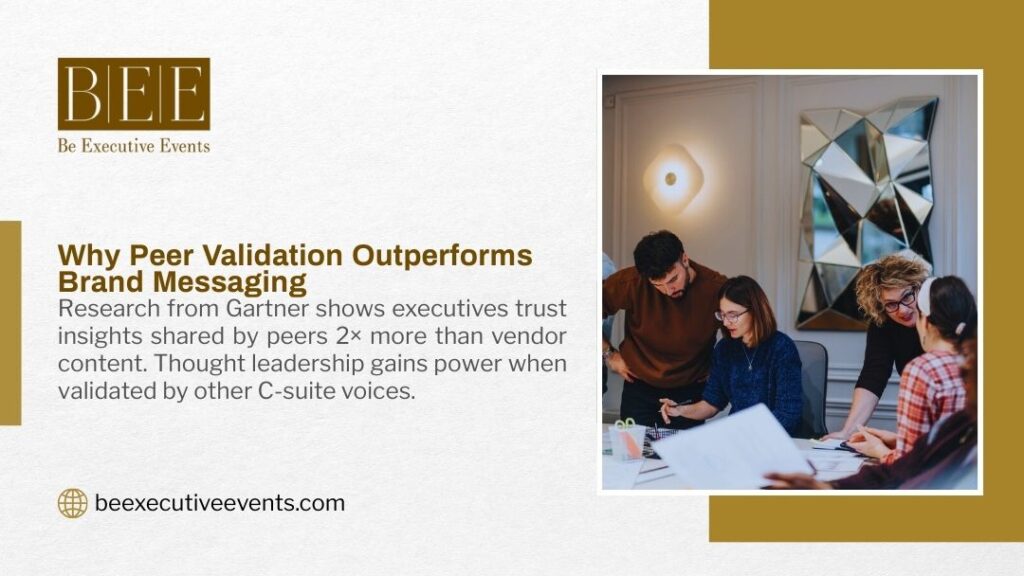
Most decision-makers say an organization’s thought leadership content is a more trustworthy basis for assessing its capabilities than its marketing materials.
When executives evaluate potential partners, they look at ideas and insights before product sheets.
| Impact Area | Percentage | Source |
| C-suite executives who read thought leadership 1+ hours weekly | 54% | Edelman-LinkedIn 2024 |
| Executives who trust thought leadership over marketing materials | 73% | Edelman-LinkedIn 2024 |
| Decision-makers willing to pay premium for strong thought leadership | 60% | Edelman-LinkedIn 2024 |
| Executives who researched new products after reading thought leadership | 75% | Edelman-LinkedIn 2024 |
The business case is clear. Decision-makers and C-suite executives say that a particular piece of thought leadership has led them to research a product or service they were not previously considering.
Thought leadership opens doors that direct sales tactics cannot.
How Executives Consume Content
Executive content consumption differs sharply from mid-level professionals. Time constraints force executives to be selective. They scan headlines, read executive summaries, and abandon content that wastes their time.
Executives prefer content that gets to the point. Long preambles and generic background information cause them to move on. They want the insight upfront, with supporting evidence available if they choose to go deeper.
Format matters too. Executives consume content across multiple formats based on context. Quick insights work for mobile reading between meetings.
Deeper reports get attention during dedicated research time. Executive networking events provide face-to-face access to ideas and the people behind them.
The most effective approach recognizes these patterns. Lead with your core insight. Support it with evidence. Make it easy to scan. Respect their time.
But before any of that matters, you need to be creating for the right audience, knowing how to identify executive decision-makers ensures your thought leadership reaches the people with actual authority to act on it.
Common Mistakes in Executive Thought Leadership
Most thought leadership aimed at executives fails because it makes predictable errors. These mistakes signal that you don’t understand your audience.
Generic content that applies to everyone speaks to no one. Executives need insights specific to their industry, role, or challenge. Broad observations about “digital change” or “the future of work” get ignored.
Sales-heavy messaging destroys credibility instantly. The moment executives detect you’re trying to sell rather than educate, they stop reading. Thought leadership builds trust. Marketing materials make offers. Mix them together and you lose both benefits.
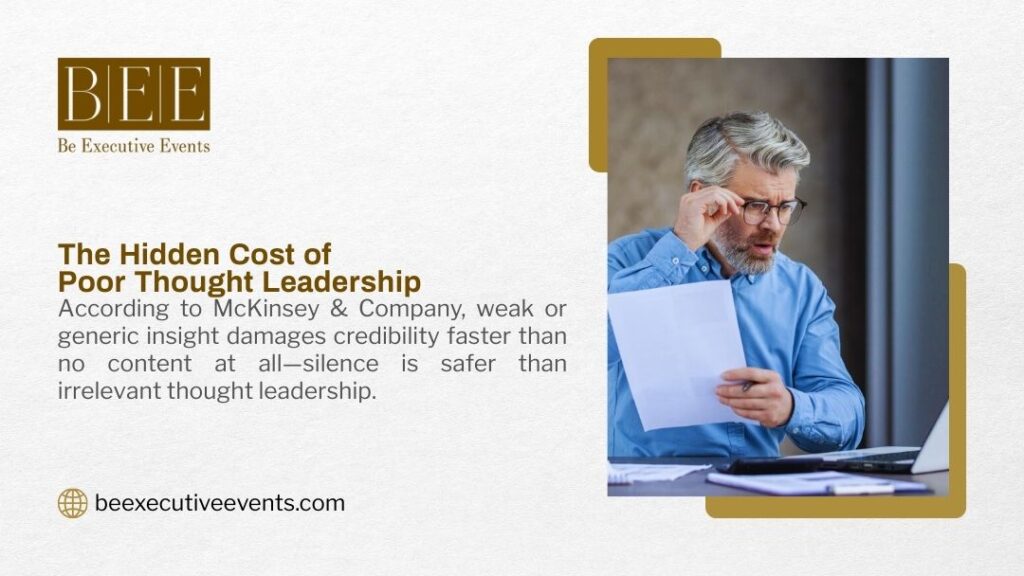
Poor quality damages your reputation. 66% of buyers say they won’t work with a provider who produces poor thought leadership.
One weak piece can cost you more than producing no content at all.
| Mistake | Why It Fails | Better Approach |
| Generic insights | Executives need specific, applicable ideas | Focus on narrow, deep topics relevant to their role |
| Sales messaging | Breaks trust immediately | Separate thought leadership from product promotion |
| No data backing | Loses credibility with analytical executives | Support claims with research and evidence |
| Excessive length | Executives won’t invest time without clear value | Front-load value, make content scannable |
| Irregular publication | Can’t build audience without consistency | Commit to sustainable frequency |
Another common error is the lack of original perspective. Repeating industry consensus adds no value. Executives already know the conventional wisdom. They pay attention to thought leadership that challenges assumptions or reveals new angles.

Types of Thought Leadership Content That Attract Executives
Not all content formats deliver equal results with executive audiences. The format must match both your message and how executives consume information in their specific context.
Different formats serve different purposes. Written content works for detailed analysis. Interactive experiences create deeper engagement. The key is matching format to objective.
- Written Content (Blogs, Whitepapers, Reports)
Research reports and whitepapers remain powerful tools for thought leadership to attract executives when they deliver genuine insights. Executives value original research that helps them understand market shifts, competitive dynamics, or operational improvements.
The most effective written content leads with findings, not methodology. Executives care about what you discovered, not how you discovered it. Put methodology in an appendix for readers who want those details.
| Content Type | Best Use Case | Typical Length | Executive Value |
| Research reports | Share original data and analysis | 10-20 pages | High – provides decision support |
| Whitepapers | Deep dive on specific challenges | 8-15 pages | High – offers detailed solutions |
| Articles | Quick insights on trends | 800-1200 words | Medium – builds awareness |
| Case studies | Demonstrate proven approaches | 1000-1500 words | Medium – shows real results |
Data quality matters more than data volume. A single surprising statistic can be more valuable than twenty predictable ones. Executives remember insights that challenge their assumptions.
Keep language clear and direct. Jargon signals you’re trying to sound smart rather than be helpful. Technical terms are fine when necessary, but prefer plain language when it communicates equally well.
- Interactive & Experiential Content (Webinars, VIP Events)
Live formats create engagement that written content cannot match. Webinars, roundtables, and executive events enable real-time discussion and peer learning that executives value highly.
From our experience working with C-suite leaders, small-group formats outperform large broadcasts. A 15-person executive roundtable generates deeper insights than a 500-person webinar. Executives contribute when they’re part of a conversation, not an audience.
VIP events work because they combine thought leadership with strategic relationship development. When executives attend curated gatherings with peers, they gain insights from both the content and the people in the room.
Be Executive Events has seen this dynamic play out across hundreds of executive gatherings. The formal content provides the framework, but peer discussion often delivers the breakthrough insights that executives take back to their organizations.
Making that dynamic work consistently comes down to design, understanding creating executive events with great outcomes means structuring every element so peer discussion happens naturally, not by accident.
| Event Format | Participant Count | Primary Value | Best For |
| Executive roundtable | 10-20 | Peer discussion and relationship depth | Strategic topics requiring multiple perspectives |
| VIP dinner | 15-25 | Intimate networking and idea exchange | Relationship development with select group |
| Virtual roundtable | 12-18 | Flexible participation with focused topics | Global participants, tactical discussions |
| Industry summit | 50-150 | Broad networking and trend exposure | Market-level insights and wide network building |
Webinar quality depends entirely on substance. Executives will give you 45 minutes if you deliver value throughout. They’ll leave after 10 minutes if you waste time with fluff.
The best virtual events feature moderated discussions among multiple executives, not solo presentations. Panel formats work when you have genuinely different perspectives. Avoid panels where everyone agrees and just repeats the same points.
Strategies to Build Executive Thought Leadership
Creating thought leadership that actually attracts executives requires more than good writing. You need a strategic framework that ensures consistent quality and clear business connection.
The most effective approach focuses on four core elements: credibility, contrarian perspective, concrete evidence, and consequential impact. This framework helps separate meaningful thought leadership from content that executives ignore.
53% of buyers say thought leadership has directly influenced a purchasing decision. This influence comes from consistently delivering these four elements across your content.
- Creating Credible Content
Credibility starts with author expertise. Executives pay more attention to content from people who’ve actually solved the problems they discuss. Theoretical knowledge matters far less than practical experience.
Author credentials signal whether the content deserves time. A CFO writing about financial strategy carries weight. A marketing person writing about CFO challenges does not, unless they bring specific research or collaborate with finance executives.
| Credibility Factor | How to Demonstrate | Impact on Executive Trust |
| Author expertise | Real experience in the domain | Critical – establishes right to speak |
| Original research | Data collection and analysis | High – shows investment in insight |
| Named examples | Specific companies and results | High – proves concepts work in practice |
| Peer validation | Quotes from other executives | Medium – confirms relevance |
| Third-party data | Citations from research firms | Medium – supports claims objectively |
Data quality matters as much as author credentials. Vague statements like “many companies” or “industry experts say” lack the precision executives expect. Specific numbers from named sources build trust.
From the experience we have, executives can definitely spot weak evidence. They deal with data daily. Hand-waving and generalizations signal you haven’t done the work.
- Distribution Channels & Timing
Even excellent content fails if executives never see it. Distribution strategy determines whether your thought leadership reaches the right audience.
LinkedIn remains the primary platform where executives consume content for professional topics. But LinkedIn works only when you build an audience over time. One-off posts get lost in the feed.
Email works for executive audiences when you’ve earned permission. A monthly email to opted-in executives performs far better than cold outreach. The key is value so consistent that people want to receive your messages.
Events provide the highest-value distribution channel for thought leadership to attract executives. When you host or sponsor relevant gatherings, you get extended time with executives who’ve chosen to attend because the topic matters to them.
At its core, this is the discipline of curating prestige leadership conversations in a noisy world, creating spaces where your thought leadership isn’t competing with a hundred other messages for attention.
| Distribution Channel | Best Content Type | Frequency | Primary Benefit |
| Quick insights, article links | 2-3x weekly | Build ongoing visibility | |
| Email newsletter | Research summaries, reports | Monthly | Direct delivery to opted-in executives |
| Executive events | Live discussions, report launches | Quarterly | Extended engagement and relationship building |
| Industry publications | Deep analysis pieces | 2-4x yearly | Third-party credibility |
| Webinars | Topic deep-dives | Monthly-quarterly | Interactive format for complex topics |
Timing matters more than most people realize. Executives plan around business cycles. Financial topics get more attention near quarter-end. Strategy content works better at year-start when planning happens.
Tuesday through Thursday mornings work best for email distribution. Executives check email early before meetings consume their day. Friday afternoons and Monday mornings typically see lower engagement.
From our experience running global executive programs at Be Executive Events, content that aligns with business cycles gets 2-3x more engagement than randomly timed material. Know your audience’s calendar and plan accordingly.
Measuring Impact and ROI of Executive Thought Leadership
You cannot improve what you don’t measure. Thought leadership aimed at executives needs concrete metrics that show business impact, not just content consumption.
Most companies track the wrong numbers. Page views and downloads show reach but not value. The metrics that matter connect thought leadership to business outcomes.
90% of decision-makers and C-suite executives say they are moderately or very likely to be more receptive to sales or marketing outreach from a company that consistently produces high-quality thought leadership.
This receptivity translates to faster sales cycles and higher win rates when you track it properly.
| Metric Category | What to Measure | Why It Matters | How to Track |
| Engagement quality | Time spent, sections read, downloads of appendices | Shows content value | Analytics platforms, content tracking |
| Lead generation | Contact information exchanges, meeting requests | Indicates commercial intent | CRM attribution |
| Sales influence | Deals where prospects cited thought leadership | Proves revenue impact | Sales team interviews, CRM notes |
| Reputation indicators | Speaking invitations, media quotes, peer references | Demonstrates authority building | Manual tracking |
| Network growth | New executive connections, event attendance | Shows audience expansion | LinkedIn analytics, event registration |
The best measurement approach combines quantitative and qualitative data. Numbers show what’s happening. Conversations with your sales team explain why.
Ask your sales people which content prospects mention. Track which pieces get shared most often in executive conversations. These informal indicators often matter more than formal analytics.
For events, measure both attendance and post-event engagement.
- Did attendees return for subsequent programs?
- Did relationships formed at events lead to business discussions?
Quality events create ongoing connections, not one-time interactions.
Many organizations struggle to connect thought leadership spend to revenue. The connection exists, but it’s indirect. Think of it as relationship capital that makes every other sales activity more effective.
The executives who engage deeply with your thought leadership become easier to reach, more receptive to meetings, and more likely to view you as a trusted advisor. These advantages compound over time.
Common Pitfalls and How to Avoid Them
Even well-intentioned thought leadership programs make predictable mistakes. These errors waste resources and damage credibility with the exact executives you’re trying to reach.
The most common pitfall is inconsistency. Companies launch thought leadership initiatives, publish for a few months, then disappear. Executives notice. Inconsistency signals lack of commitment and makes it impossible to build an audience.
| Pitfall | Consequence | Solution |
| Irregular publication | Impossible to build audience | Commit to sustainable frequency and stick to it |
| No executive involvement | Lacks credibility and authority | Get senior leaders to contribute and sign content |
| Ignoring feedback | Keeps producing content executives don’t value | Track engagement and ask executives what they need |
| Pure self-promotion | Executives immediately disengage | Separate thought leadership from sales materials |
| Generic insights | Fails to differentiate from competitors | Develop specific perspectives based on real experience |
| Wrong distribution | Content never reaches target executives | Research where your specific audience pays attention |
Another major error is the failure to involve actual executives in content creation. Marketing teams cannot write authentic executive thought leadership alone. The voice is wrong, the insights lack depth, and executives can tell.
Get your C-suite to contribute. Even if they don’t write every word, their review and input makes content genuinely reflect executive perspective. This authenticity shows in the final product.
Quality always beats quantity with executive audiences. One exceptional piece per quarter outperforms weekly mediocre content. Executives remember quality. They ignore volume.
Create Executive Connections Through Strategic Content and Events
Be Executive Events has been bringing together senior decision-makers for high-impact discussions that combine thought leadership with relationship development.
We’ve seen how the right content, delivered in the right format, creates opportunities that traditional marketing cannot match.
Our global executive gatherings attract CFOs, CEOs, CIOs, and other C-suite leaders from enterprise organizations across North America, Europe, and Asia. These curated experiences provide the foundation for relationships that extend far beyond a single event.
When you combine strong thought leadership with well-designed executive experiences, you accelerate relationship development and establish credibility that drives business results.
The executives who engage with quality content become the executives who take your calls, attend your events, and ultimately become partners.
If you want to reach senior decision-makers through thought leadership to attract executives, learn how to get meetings with executives through strategic content and curated experiences.
Contact Be Executive Events to explore how our executive programs can help you build relationships with the C-level decision-makers who matter most to your business.
Frequently Asked Questions About Thought Leadership to Attract Executives
What content formats do top executives engage with most?
C-suite leaders engage most with research reports backed by original data, peer discussion events like executive roundtables, and concise articles that deliver specific insights without fluff. Format matters less than substance and respect for their time.
How can I measure ROI of thought leadership aimed at executives?
Track sales influence by asking which content prospects mention, measure meeting requests that reference your thought leadership, monitor speaking invitations and media citations, and analyze how thought leadership affects sales cycle length and win rates with executive buyers.
How often should I publish executive-focused content?
Consistency matters more than frequency. Monthly high-quality pieces outperform weekly mediocre content. The key is a sustainable rhythm that lets you maintain quality while staying visible to your target executive audience.
Should thought leadership be personal or organizational?
Both work when done well. Personal thought leadership from named executives builds individual authority. Organizational thought leadership demonstrates company expertise. The strongest programs combine both, with executives as authors of company-backed content.
What mistakes repel executive audiences?
Sales-heavy messaging, generic insights that apply to everyone, inconsistent publication that breaks trust, excessive length without clear value, and lack of original perspective all cause executives to ignore your content and damage your credibility.
How do VIP events support thought leadership strategy?
Executive events create face-to-face time where thought leadership comes alive through discussion. How to market to c-level executives effectively often requires the relationship depth that only in-person experiences provide.