
Most B2B companies fail when they try to reach C-level executives so it is very important to know how to market to c-level executives. They send generic emails, call during lunch hours, and pitch features that don’t matter to senior decision-makers.
The problem is that most marketing treats them like mid-level managers with more budget.
C-suite leaders think differently, operate on different timelines, and respond to completely different messages.
Learning how to market to c-level executives requires a shift in approach. This guide covers what works, what fails, and how to build marketing strategies that actually get executive attention.
Here’s what this article covers:
- Why traditional B2B marketing fails with executives
- Communication channels C-suite leaders actually use
- Content formats that capture executive attention
- Event strategies that build real relationships
- Measurement tactics that prove ROI
Why Traditional Marketing Fails with C-Level Executives
Most marketing campaigns target the wrong pain points with the wrong messages through the wrong channels.
Middle managers care about features, implementation, and team adoption. Executives care about business outcomes, competitive advantage, and risk mitigation.
When your marketing talks about “seamless integration” or “user-friendly dashboards,” executives tune out. Those details matter to the people who use your product, not the people who approve the budget.
| Audience Level | What They Care About | What Marketing Usually Says |
| C-Level Executives | Revenue impact, strategic advantage, risk | Feature lists, ease of use, support quality |
| VPs and Directors | Team performance, process efficiency | Implementation speed, training, integration |
| Managers and Users | Daily workflow, ease of use | Interface design, features, shortcuts |
The gap between what executives need and what marketing delivers creates the disconnect. Bridge that gap and you get their attention.
Before you can bridge it, you need to understand the other side, know why executives ignore sales outreach explains the filtering habits that cause most marketing to fail before it’s even read.
Know What Drives Executive Decisions
C-suite leaders evaluate everything through a business impact lens. They ask themselves if something will increase revenue, reduce costs, mitigate risks, or create competitive advantage.
Your marketing needs to answer these questions upfront. Skip the feature tour and lead with business outcomes. That framing shifts again when procurement joins the deal, so plan a separate message for the team that negotiates terms.
For example, don’t say “Our platform processes data 3x faster.” Say “Finance teams close books 5 days earlier, freeing up resources for strategic planning.”
One statement describes a feature. The other describes business value an executive understands immediately how to market to c-level executives.
From our experience in executive engagement, we can say that the companies that win C-suite attention frame everything in business language, not product language.
How to Write Emails Targeted For C-Level Executives
Mastering how to market to C-level executives means knowing exactly what messaging grabs their attention — and that starts with writing emails they actually want to read.
Keep subject lines under 6 words. Get to the point in the first sentence and reference something specific about their company or recent announcement.
- Bad email example: “Excited to share our new platform that helps companies like yours transform operations and achieve better results.”
- Good email example: “Your Q3 earnings call mentioned supply chain delays. We’ve helped 3 logistics companies reduce delivery times by 22%.”
The second email shows you did research and leads with value relevant to their current challenges.
Send emails Tuesday through Thursday between 6-8 AM or after 6 PM. Executives check email early morning and evening when they have time.
How To Use LinkedIn for Executive Outreach
Most LinkedIn outreach to C-level executives feels spammy because it is.
Connection requests with long sales pitches get ignored. Generic messages about “exploring synergies” get deleted.
What works:
- Comment thoughtfully on their posts (not “Great post!” but actual insights)
- Share their content with your network when it’s genuinely valuable
- Send connection requests with no pitch, just a simple professional introduction
- Wait 2-3 weeks after connecting before any outreach
Building relationships comes before asking for meetings. Executives can tell when you’re patient versus desperate.
Phone Calls and Direct Outreach
Cold calls rarely work with C-suite leaders because assistants filter them out.
Warm introductions through mutual connections work much better. If someone in your network knows the executive, ask for an introduction instead of trying to go direct.
When you do get phone time, respect their schedule. Ask if they have 10 minutes, not 30. Get to your point in the first minute.
Content Formats That Capture Executive Attention
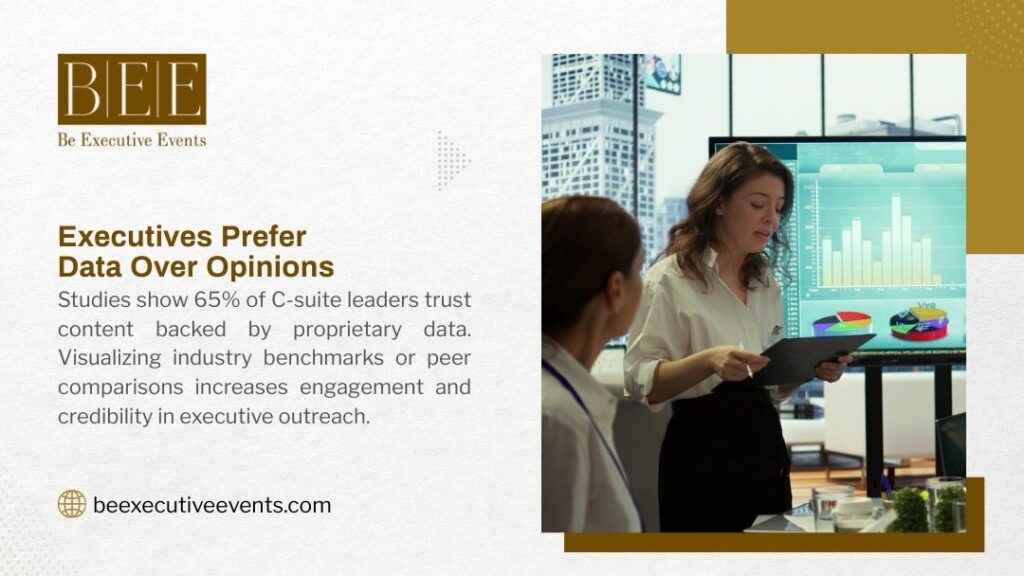
Executives consume content differently than other audiences. They skim, delegate, and look for quick insights they can act on.
- Research and Industry Reports
Original research gets executive attention because it provides competitive intelligence they can’t find elsewhere.
Publish industry benchmarks, trend reports, or survey data that helps them make decisions. When your content becomes a reference tool, executives save it and share it internally.
For example, a report titled “How CFOs at Fortune 500 Companies Are Restructuring Tech Budgets in 2025” provides actionable intelligence. A whitepaper about your product features doesn’t.
- Executive Briefings and One-Pagers
C-level leaders don’t read 10-page documents. They read one-page summaries.
Create executive briefings that fit on a single page and cover the business problem, your solution approach, expected outcomes, and success examples.
Use bullet points, clear headings, and plenty of white space. Make it easy to scan in 2 minutes.
| Content Type | Length | Best Use |
| Executive briefing | 1 page | Quick decision overview |
| Case study | 2-3 pages | Proof of success |
| Industry report | 10-15 pages | Thought leadership |
| Webinar recording | 20-30 minutes | Education and demos |
- Video Content and Webinars
Executives watch video content, but only if it respects their time.
Keep videos under 3 minutes for product overviews. If you host webinars for senior leaders, make them 30 minutes maximum and include interactive Q&A.
Skip the 10-minute introduction and company history. Get to the value in the first 60 seconds or lose them.
Event Strategies That Build Executive Relationships
Events remain one of the most effective ways to reach C-suite leaders when done right. Generic conferences don’t work, but focused executive gatherings do.
Why Executive Events Work
Face-to-face interaction builds trust faster than any other channel. When executives meet peers and discuss real challenges, they form relationships that email campaigns never create if you want to know how to market to c-level executives.
The key is creating genuine value, not disguised sales presentations. Working with experienced c-suite event planners who understand executive expectations makes the difference between events people attend and events people skip.
Knowing how to create executive events with great outcome goes beyond logistics; it means designing every element around the business conversations your audience actually wants to have.
Roundtable Discussions for Senior Leaders
The executive roundtable brings 12-20 senior decision-makers together for focused discussion on specific business challenges.
These intimate gatherings work because they offer peer learning, not vendor pitches. Executives share experiences and strategies with others facing similar challenges.
When you host these events, your role is to facilitate great conversation, not sell. If a technology partner is co-funding your next gathering, our guide to paying for roundtables with partner MDF covers approvals and claims. The relationships and credibility you build lead to business opportunities later. To apply this same host-not-sell approach over a meal, see our playbook on dinner marketing for enterprise sales.
| Event Format | Group Size | Time Commitment | Best For |
| Executive roundtable | 12-20 people | 90-120 minutes | Deep discussion, relationship building |
| Executive dinner | 8-15 people | 2-3 hours | Intimate networking, trust building |
| VIP reception | 25-40 people | 1-2 hours | Broader networking, brand visibility |
| Executive summit | 50-100 people | Half or full day | Thought leadership, multiple sessions |
Be Executive Events leverages over 10 years of experience and has hosted more than 250 high-impact events, helping organizations create and execute marketing strategies that effectively reach C-level decision-makers to understand how to market to c-level executives.
We work with global enterprises, SaaS companies, and consultancies to deliver strategic programs that build meaningful executive relationships.
Virtual Executive Events That Work
Virtual events for executives require different approaches than in-person gatherings. Attention spans are shorter and distractions are everywhere.
Keep sessions to 60 minutes maximum. Use breakout rooms for smaller discussion groups. Include interactive elements every 10 minutes to maintain engagement.
The best virtual executive events feel exclusive even online. Limit attendance, require cameras on, and facilitate active discussion rather than passive listening.
How to Get Executives to Attend Your Events
Busy C-level leaders decline most event invitations. Getting them to say yes requires strategy.
Send invitations 6-8 weeks in advance because executive calendars fill up fast. Make the value clear in the first sentence of your invitation. List who else is attending by title and company type, not names.
Personal phone calls work better than email for top-priority invites. When someone the executive knows makes the invitation, response rates jump significantly.
Knowing how to get meetings with executives starts with offering something valuable, not asking for something from them.
How To Build Long-Term Relationships with C-Suite Leaders
Single touchpoints rarely close deals with executives. Relationship development takes time and multiple interactions to understand how to market to c-level executives.
- Create Ongoing Engagement Opportunities
After initial contact, create reasons to stay in touch that provide value. Share relevant industry news or research. Invite them to future events and introduce them to other executives in your network who could help them.
Every interaction should give more than it asks and this patience builds trust that eventually leads to business conversations.
- Focus on Peer Introductions
Executives trust recommendations from other executives far more than they trust vendor claims.
Build a network of C-suite advocates who can introduce you to peers. These warm connections convert at much higher rates than cold outreach.
Ask satisfied executive customers if they’re willing to have brief calls with prospects in similar roles. Most are happy to help when you approach respectfully to know how to market to c-level executives.

Strategies for Different C-Level Roles
Different executive roles care about different outcomes. Tailor your approach based on who you’re reaching. If the budget holder is the company’s finance chief, our walkthrough on how to market to CFOs covers that buyer in depth.
| Executive Role | Primary Concerns | Marketing Focus |
| CEO | Company growth, market position, long-term strategy | Big picture impact, competitive advantage |
| CFO | Financial performance, cost control, risk | ROI, cost savings, financial metrics |
| CTO/CIO | Technology strategy, innovation, security | Technical roadmap, integration, security |
| COO | Operational efficiency, process improvement | Workflow optimization, productivity gains |
| CMO | Brand growth, customer acquisition, market share | Marketing ROI, customer insights, growth metrics |
Research the specific executive’s background before outreach. A CFO who came up through operations cares about different things than one who came from investment banking.
How to Generate Quality C-Level Leads
Lead generation targeting executives requires different tactics than mid-market campaigns.
- Use Account-Based Marketing to Target High-Value Executives
ABM works well for C-suite outreach because it focuses resources on specific high-value accounts rather than broad campaigns.
Identify your top 20-50 target companies. Research the executives at each. Create personalized outreach plans for each account.
This focused approach costs more per lead but generates higher quality opportunities. One meeting with the right CEO can generate more revenue than 100 mid-level leads.
- Create Content That C-Level Executives Will Exchange Contact Info For
Gated content works when the value justifies the exchange. Executives won’t give their contact information for generic whitepapers.
Offer industry benchmarking reports, executive compensation studies, or proprietary research that provides competitive intelligence. Make it clear the content is specifically for C-level leaders.
- Follow Up Strategically to Build Relationships Without Being Spammy
After an executive downloads content or attends an event, follow up within 48 hours while interest is fresh.
Reference the specific content or event. Offer additional resources related to their interests. Ask if they’d like to continue the conversation rather than pushing for an immediate meeting.
Persistence matters, but so does patience. Space follow-ups 2-3 weeks apart. Provide value in each touchpoint rather than just asking for their time.
When learning how to generate c-level leads, remember that quality beats quantity at the executive level. Ten engaged C-suite prospects create more value than 1,000 unqualified leads.
Measuring Success in Executive Marketing
Traditional marketing metrics don’t tell the full story with C-level campaigns. Open rates and click rates matter less than meeting rates and deal size.
| Metric Type | What to Track | Why It Matters |
| Engagement | Response rate to outreach | Shows message resonance |
| Meetings | Executive meetings booked | Indicates genuine interest |
| Pipeline | Deal value and close rate | Measures business impact |
| Relationship | Repeat interactions over time | Shows trust development |
Track how long it takes from first contact to first meeting to first deal. Executive sales cycles run longer than mid-market cycles, often 6-12 months or more.
Presenting this data to leadership in a compelling way matters too, understanding the power of AI in data visualization can help you turn complex campaign metrics into clear executive-ready reports that justify continued investment.
To understand how to market to c-level executives – don’t judge campaign success after 30 days. Give executive marketing programs at least 90 days to show results.
Common Mistakes in C-Level Marketing
| Mistake | Why It Fails | Better Approach |
| Generic messaging | Executives ignore irrelevant content | Personalize based on role and company |
| Feature-focused content | Doesn’t connect to business outcomes | Lead with business impact |
| Aggressive follow-up | Damages relationship before it starts | Space outreach, provide value each time |
| Long-form content | Executives don’t have time | Keep it brief and scannable |
| Hidden sales agenda | Breaks trust | Be transparent about goals |
The biggest mistake is treating C-level marketing like volume business. You can’t scale personal relationships the same way you scale mid-market campaigns.
Another common error is giving up too soon. Executive relationships take months or years to develop. Companies that commit to long-term relationship development see much better ROI than those chasing quick wins.
Partner with Executive Event Specialists
With over 10 years of experience and 250+ successful events hosted, Be Executive Events helps you create and run marketing strategies that connect with C-level executives.
We work with global companies, SaaS businesses, and consultancies to build strong relationships with senior leaders through focused programs.
We also work closely with 50+ trusted vendor partners to make sure every event runs smoothly, from planning to follow-up. Get in touch with us today to discuss your executive marketing strategy and see how we can help you create events that C-suite leaders truly appreciate after understanding how to market to c-level executives.
Frequently Asked Questions About On How to Market to C-Level Executives
Whether you’re new or experienced, understanding how to market to C-level executives is key to developing successful outreach campaigns and building long-term partnerships to know how to market to c-level executives.
What’s the best way to get a C-level executive’s attention?
Lead with business outcomes relevant to their current challenges. Reference something specific about their company or recent announcement. Keep messages brief and focused on value they’ll receive, not what you want to sell.
How long does it take to close deals with C-suite buyers?
Executive sales cycles typically run 6-12 months or longer. The relationship development phase alone often takes 3-6 months before any serious buying conversation begins. Plan for longer timelines than mid-market deals.
Should I use LinkedIn to reach C-level executives?
LinkedIn works for executive outreach when done thoughtfully. Build relationships gradually through valuable comments and content sharing before making any sales approach. Avoid generic connection requests and immediate pitches.
What type of events do C-level executives actually attend?
Executives attend intimate roundtables, executive dinners, and focused summits where they can learn from peers and discuss real challenges. They skip large conferences unless speaking or their presence serves a strategic purpose.
How do I measure ROI on executive marketing programs?
Track executive meetings booked, pipeline created, deal size and close rates, and relationship development over time. Don’t judge success on short-term metrics like email opens. Focus on business outcomes generated over 6-12 months.