
Quick Take: How to Market to CFOs
A campaign built for a CIO can be reworked for a CTO with modest effort. Point the same campaign at a CFO and it stalls. The creative is fine, the offer is fine, and the response rate is close to zero. That gap is not a copywriting problem. It is a difference in how the finance function evaluates anything that costs money.
This is written for demand-generation and field-marketing leaders in Technology and SaaS, and for their counterparts in BFSI, who have been handed a target account list where the deciding voice sits in finance. The question is not how to write a cleverer subject line. It is how to earn attention from an executive whose job is to say no to most proposals that reach them.
Why CFOs Are the Hardest Executive Audience to Reach
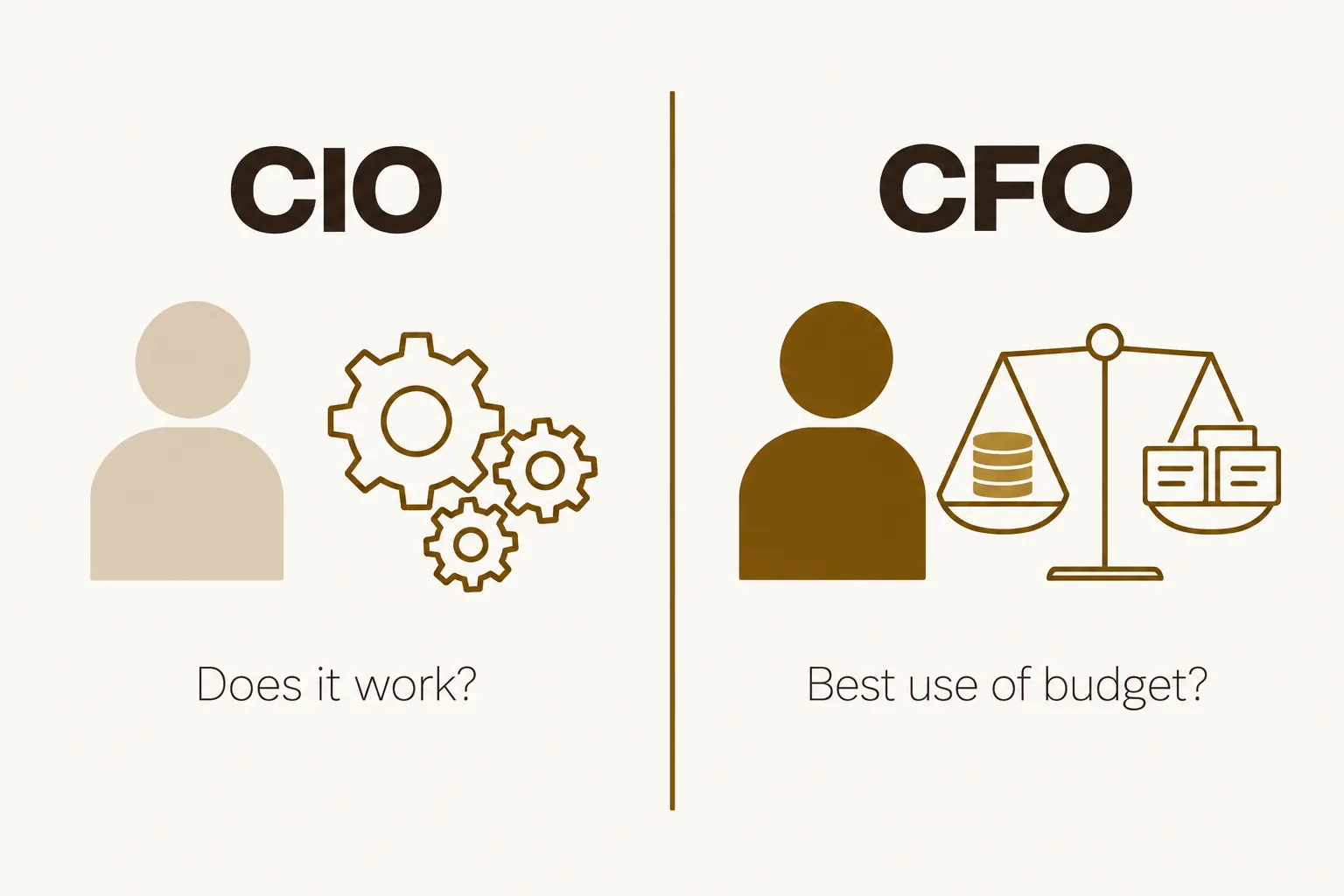
The CFO’s remit has widened well past reporting and treasury. Technology spend, AI investment, platform consolidation, and transformation budgets now route through finance for approval, sequencing, or outright veto. A marketer who once sold entirely to IT is now selling to two audiences with different evaluation criteria, often without realising the second one exists until late in the cycle.
The playbooks do not transfer. Content built for a CIO argues capability: what the platform does, how it integrates, why the architecture is sound. A CFO applies a capital allocation lens instead.
The question is not whether the technology works, it is whether this is the best available use of a constrained budget against every competing request on the desk, and what happens to cash and risk if the answer is yes.
Finance leaders are also structurally difficult to reach through standard outbound. Many maintain a minimal social presence and post rarely. Executive assistants filter inbound aggressively. The inbox is dense with vendor emails that all open the same way. Nothing in a CFO’s working week rewards engagement with unsolicited marketing, so the ordinary channels produce ordinary silence.
What CFOs Actually Care About
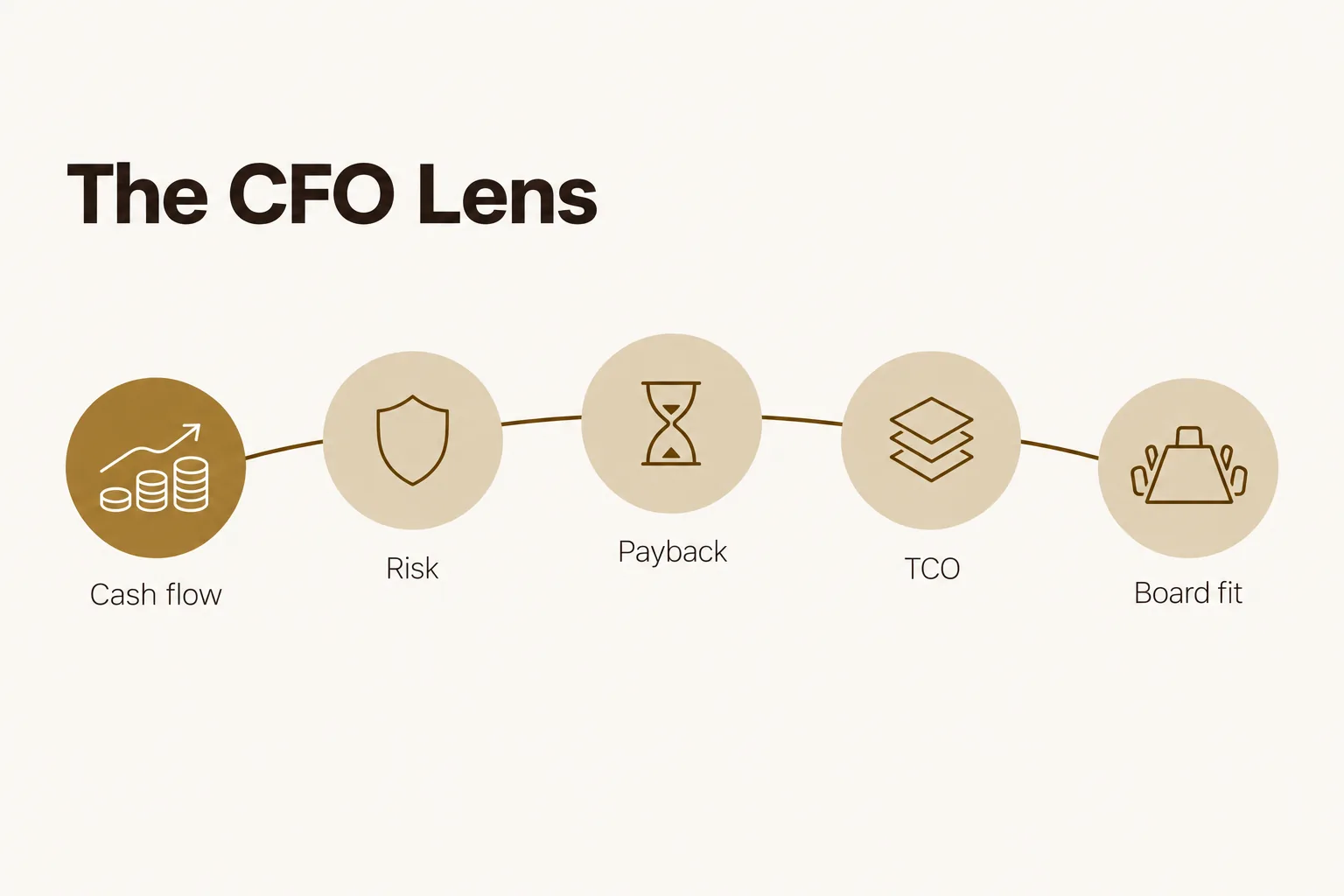
CFOs are not simply there to block spending. Their role is to evaluate whether an investment can meet the business’s financial requirements and, if so, under what conditions it makes sense to move forward. As Marjorie Lao, former CFO of LEGO Group, explains:
> “Our job in a meeting is not necessarily to be the person who says no but to say, ‘Yes, as long as we do this’ or ‘Yes, under these conditions.’ That’s a mindset change from finance as resource guardian to finance as business enabler.”
Before reworking a single asset, be honest about the evaluation criteria a finance leader brings to a vendor conversation.
Cash flow and margin protection. Feature depth and innovation narratives sit below the effect on working capital and operating margin. A proposal that improves capability while worsening cash position needs a very good story.
Risk posture. Regulatory exposure, audit trail, data protection liability, and vendor concentration are live concerns, particularly in banking, insurance, and healthcare. A CFO will often accept a smaller return in exchange for a defensible risk profile.
Payback period and time to value. Aspirational multi-year returns are treated with suspicion. Where the payback lands, and what the business sees inside twelve months, carry far more weight.
Total cost of ownership. Licence cost is the visible part. Implementation, integration, internal headcount, change management, and the cost of running the thing in year three are the parts a CFO will reconstruct whether or not you supply them.
Board and investor reporting pressure. CFOs champion initiatives they can explain upward. If a purchase supports a metric already committed to the board, it has an internal advocate. If it does not, it competes from a standing start.
| Format | Best For |
|---|---|
| Virtual executive roundtables and webinars | Lowest-friction commitment and widest reach; the easier yes for a finance leader who doesn’t know your brand yet |
| Executive dinners and in-person roundtables | Highest trust density, right when the target account list is concentrated in one city |
| Curated one-to-one follow-up meetings | Turning a good group discussion into a pipeline conversation while the relationship is still warm |
| Audience acquisition for an in-house event | When the format and content already exist but the room lacks finance seniority |
| Post-event content | Extending the discussion to CFOs who couldn’t attend, and giving your champion something credible to circulate internally |
Translating Your Value Proposition Into Finance Language
Most value propositions are capability statements wearing a business-outcome jacket. Translation means replacing the claim with unit economics: cost per transaction, cost avoided, hours redeployed, headcount reallocated rather than removed. Concrete units survive scrutiny, adjectives do not.
Show the assumptions behind any model. A finance leader does not want a finished number, they want a model they can stress-test with their own inputs. Publishing the assumptions (adoption rate, ramp time, baseline cost) signals confidence and invites the CFO to engage with the maths instead of dismissing it.
Unverifiable benchmark claims have the opposite effect: numbers a CFO cannot audit get discounted to zero, and they damage the credibility of everything around them.
Quantify the cost of inaction alongside the cost of purchase. Standing still is a decision with a price, and it is the option your proposal actually competes against.
Name the line item as well. Whether the spend lands as capex or opex determines how it is routed, who approves it, and which budget cycle it belongs to. Marketers who address this directly make the internal path easier for their champion, and CFOs notice when a vendor understands their approval process.
Message and Channel: Where CFO Marketing Breaks Down
Open with something that could only have been written for this sector and this company size: a relevant data point, a regulatory shift, a peer benchmark. Generic introductions get deleted before the value proposition is reached.
Email and LinkedIn remain the workable direct channels. Both should be executed as GDPR-compliant outreach through owned lists, LinkedIn, and trusted B2B data providers, with consent and suppression handled properly. In UKI, DACH, and BENELUX in particular, sloppy data practice is not just a compliance exposure, it is a credibility problem with the exact audience you are courting.
Format preference skews short and evidence-dense. Briefing notes, peer benchmark summaries, and scenario models outperform long gated ebooks with a finance audience. Paid advertising builds recognition but rarely produces direct CFO response on its own, so treat it as air cover that makes a personal invitation land warmer rather than as a response channel.
Then there is multi-threading. The CFO frequently enters a deal late, brought in by a champion in IT, operations, or procurement. Complex purchases are rarely a single signature: a buying group forms, and each member arrives with separate research and separate priorities.
The mechanics of that are covered more broadly in reaching decision makers in B2B; this article applies it specifically to the CFO’s entry point into that group.
That means two asset tracks, one written for the champion in capability terms and one written for finance in economic terms, deliberately consistent with each other so the champion is not left translating on your behalf.
Where the CFO Enters the Buying Group
The CFO is almost never the first person you talk to. Someone in IT, operations, or procurement identifies the problem and builds the initial case; the CFO is brought in once real money is on the table.
That sequencing changes what “reaching the CFO” actually means. Writing only to finance skips the person who invited them into the conversation. Writing only to the champion leaves the champion to translate your pitch into financial terms on your behalf, badly, and without your input.
The practical response is two consistent asset tracks: one for the champion in capability terms, one for the CFO in economic terms, saying the same thing in two languages rather than two different things. When the CFO asks the champion “does this actually do what they claim,” the answer needs to match what you told the CFO directly.
Why Peer Access Outperforms Persuasion With CFOs
Ask a finance leader where their best information about a category comes from and the answer is usually another finance leader at a comparable company. Vendor material is treated as advocacy. Peer input is treated as evidence.
Vendor material is treated as advocacy. Peer input is treated as evidence.
That is the structural reason executive roundtables convert where content syndication stalls. We cover why the peer format works where vendor format fails in curating prestige leadership conversations in a noisy world.
A closed-door conversation with a dozen finance peers offers something no campaign can reproduce: benchmarking against organizations carrying the same balance sheet pressures, the same regulatory load, and the same board questions.
A CFO who hears how three comparable companies handled a migration is getting information that is genuinely unavailable elsewhere.
The exchange has to be real. A CFO’s scarce asset is time, and an agenda that turns out to be a pitch in a nicer room burns the relationship and the referral network attached to it. The value exchange, not the hospitality, is what gets a finance leader to accept.
The same preference for substance applies to how finance leaders engage with other senior executives. As Arun Nayar, former Executive Vice President and CFO of Tyco International, has explained:
> “A good CFO is a business partner to the CEO. The finance leader should fully support the chief executive in public but be willing to offer frank criticism in private.”
Best Practices for Inviting Senior Executives to Events and Peer Groups
- Invite on the topic and the room, not the sponsor brand. State who else will be at the table by seniority and sector. Peer composition is the offer.
- Pre-approve every attendee against the target profile. One irrelevant or junior participant changes the register of the whole discussion, and senior executives notice that immediately.
- Keep formats tight. Six to twenty-six executives depending on format, with dinners and roundtable discussion working best at the lower end. A strict no-pitch rule, an independent moderator, and Chatham House style discretion are what make candor possible.
- Respect calendar realism. Finance leaders commit four to eight weeks ahead and become unreachable during quarter-end and year-end close.
- Send personal, named outreach from a credible sender. Mass invitation sequences read as mass invitation sequences.
- Use virtual sessions to lower the threshold. A well-produced branded virtual event removes travel from the decision and works across UKI, DACH, BENELUX, and NAMER in a single sitting.
Timing: The Finance Calendar Governs Everything
Quarter-end and fiscal year-end close remove CFOs from the calendar completely. Plan around those windows rather than hoping to survive them. Budget-setting periods are the opposite: the highest-leverage moment to be in the room, because the conversation shapes allocations that have not yet hardened.
Executive engagement demand rises from late February through July, as fresh budgets are released and diaries are still open ahead of summer. September to early December is the busiest executive events window in Europe, with a sharp post-summer rebound in DACH and UKI and North American clients pushing to spend before year-end.
August in Europe and the stretch from late December into early January are effectively dead for in-person executive gatherings, though they remain sensible planning and production windows.
Formats That Work for a CFO Audience
Virtual executive roundtables and webinars. The lowest-friction commitment and the widest geographic reach. For a first engagement with a finance leader who does not yet know your brand, ninety minutes at their desk is a far easier yes than an evening across town.
Executive dinners and in-person roundtables. The highest trust density available, and the right instrument when the target account list is concentrated in one city. Conversation quality at a table of a dozen executives is difficult to replicate any other way.
Curated one-to-one follow-up meetings. The step that turns a good discussion into a pipeline conversation, arranged after the group session while the relationship is warm.
Audience acquisition for an in-house event. When the format and content already exist but the room lacks finance seniority, targeted registration support solves the actual gap.
Post-event content. On-demand recordings and briefing summaries extend the discussion to CFOs who could not attend, and give your champion something credible to circulate internally.
Measuring CFO Marketing Without Vanity Metrics
Registration volume is the wrong headline number for this audience. Title-level accuracy comes first: verified CFO, VP Finance, or Finance Director seniority, confirmed against the target profile rather than inferred from a form fill. Fifteen verified finance decision makers beat two hundred mixed registrations on every measure that matters later.
After that, look at account penetration into named target accounts, meeting acceptance rate in the weeks following the event, and time to first qualified conversation. Post-event reporting should carry attendee detail, engagement insight, and recommended next steps, so progression can be attributed rather than assumed.
Be careful how outcomes are framed internally. Well-run executive events create the conditions for trust, access, and pipeline. They do not guarantee deals, and promising otherwise damages the program when the first quarter’s numbers arrive.
See our C-level lead generation strategies guide for how this fits into the rest of the funnel.
A CFO-targeted program is also the one investment whose own business case will be read by finance-literate colleagues, so the marketer’s ROI model needs to survive the same scrutiny the CFO would apply.
Common Mistakes When Marketing to CFOs
| Mistake | Why It Backfires |
|---|---|
| Leading with product capability instead of financial impact | A capability pitch reads as a vendor briefing, and a CFO delegates vendor briefings |
| Treating the CFO as a signature at the end rather than an evaluator from the start | By the time finance sees it, the frame is already set by whoever got there first |
| Filling seats with finance-adjacent titles and calling it a CFO audience | A real CFO who finds the room isn’t peer-level won’t accept a second invitation |
| Vague ROI claims with no visible assumptions | A number a CFO can’t audit gets discounted to zero, and it damages everything around it |
| Ignoring the close calendar and losing an otherwise strong invitation to quarter-end | Finance leaders are structurally unreachable during close, no matter how strong the topic is |
Frequently Asked Questions
Related readingHow To Identify Executive Decision Makers: Strategies & InsightsRead the guide →Frequently asked questions
What matters most to a CFO in a vendor pitch?
How do you get a CFO to attend an event?
How do you market to CFOs?
Do virtual or in-person events work better for finance leaders?
How many executives make a productive roundtable?
How do you reach CFOs compliantly?
Getting the Right Finance Leaders in the Room
Marketing to CFOs is less about persuasion than about access to the right peers, on the right topic, at a moment in the finance calendar when the conversation is useful. Everything above is achievable in-house by a disciplined team. What tends to be difficult is the audience: getting verified, pre-approved finance decision makers to accept, and keeping the room free of anyone who does not belong there.
If the constraint is genuine access to verified, pre-approved finance decision makers, not just topic or content, Be Executive Events builds the room around exactly that. We pre-approve every attendee against your target profile before an invitation goes out, so the CFO who accepts finds a room of real peers, not a mix of finance-adjacent titles filling seats.
Here’s what a program with Be Executive Events gets you:
- A guest list of verified CFOs, VP Finance, and Finance Directors, confirmed against your target accounts rather than inferred from a form fill
- A strict no-pitch agenda with an independent moderator and Chatham House discretion, so the room stays candid
- Reach across UKI, DACH, BENELUX, and NAMER through a virtual session, then trust density through an in-person dinner or roundtable for concentrated account lists
- Scheduling built around the real finance calendar, clear of quarter-end and year-end close
- Post-event reporting with attendee detail and account penetration, so the program’s own business case survives the scrutiny a CFO would apply to it
Talk to Be Executive Events about the accounts you’re trying to open and the finance seniority you need in the room.