
The question of whether B2B events are worth the investment comes up in nearly every senior marketing planning cycle, and the honest answer is: it depends on factors most organizations never fully examine before committing the budget.
This article breaks down when events deliver real ROI, when they don’t, and how to evaluate them with the same rigor you’d apply to any high-stakes marketing channel.
Are B2B Events Worth the Investment? The Direct Answer
Yes, B2B events are worth the investment when strategy drives execution.
86% of B2B organizations report positive ROI from events, and in-person formats rank as the most effective B2B marketing channel, cited by 60% of professionals in LinkedIn’s B2B research, ahead of video and thought leadership content.
The data is clear: events work. What fails is executing them without audience precision, pipeline targets, or post-event attribution.
| Scenario | Worth It? | Key Reason |
| High ACV deals with long sales cycles | Yes | Deal size justifies event cost |
| C-suite target audience | Yes | Executive leads produce stronger pipeline |
| Low-ticket products, short cycles | No | CPL too high relative to deal value |
| No post-event follow-up system | No | ROI becomes impossible to attribute |
| Strong sales-marketing alignment | Yes | Events directly feed revenue targets |
| Broad, unfiltered audience | No | Attendee volume hides low commercial quality |
When B2B Events Deliver Strong ROI
High-value sales environments are where events prove their case most consistently. Enterprise SaaS companies, consulting firms, and technology businesses with extended sales cycles all see strong returns.
Strong executive networking at well-curated events builds the kind of trust that no digital channel replicates at scale.
For companies selling to C-suite buyers, one well-designed in-person interaction can compress months of email sequences into a single focused conversation.
When B2B Events Are a Waste of Budget
Events become expensive brand exercises when the product has a low average contract value, the audience is not pre-qualified, or no pipeline target is defined ahead of the event.
Without a follow-up system tied to CRM, even well-executed events produce no measurable commercial result.
Why Most B2B Events Fail to Deliver ROI
Event failure rarely comes from a weak speaker lineup or a poor venue. It comes from systemic gaps that exist long before anyone walks through the door.
| Common Mistake | Impact on ROI |
| No ICP-defined guest list | Low-quality leads, wasted budget |
| Events treated as brand-only moments | No pipeline targets; no follow-up |
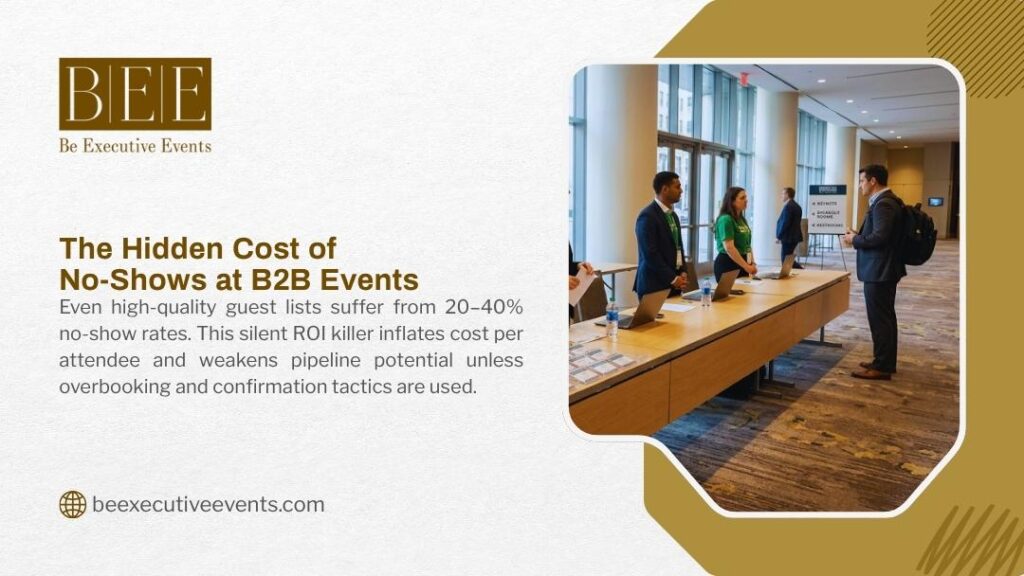
| Post-event silence from the sales team | Leads go cold within 72 hours |
| No CRM tagging or attribution model | Impossible to prove value to leadership |
Wrong Audience, Not Senior Enough
Research made from Cvent, shows that 54% of marketers don’t track event registrations and 53% don’t track opportunities created. When ICP filtering is skipped in guest selection, you fill the room with attendees who carry no budget authority.
A curated dinner of 25 pre-vetted decision-makers produces a stronger pipeline than a hall of 200 mixed-seniority attendees. Headcount is not a ROI metric.
No Clear Business Objective
Events that run without a defined pipeline target operate as marketing exercises. Every event program needs a commercial objective set before the invite list is built.
Weak Post-Event Follow-Up
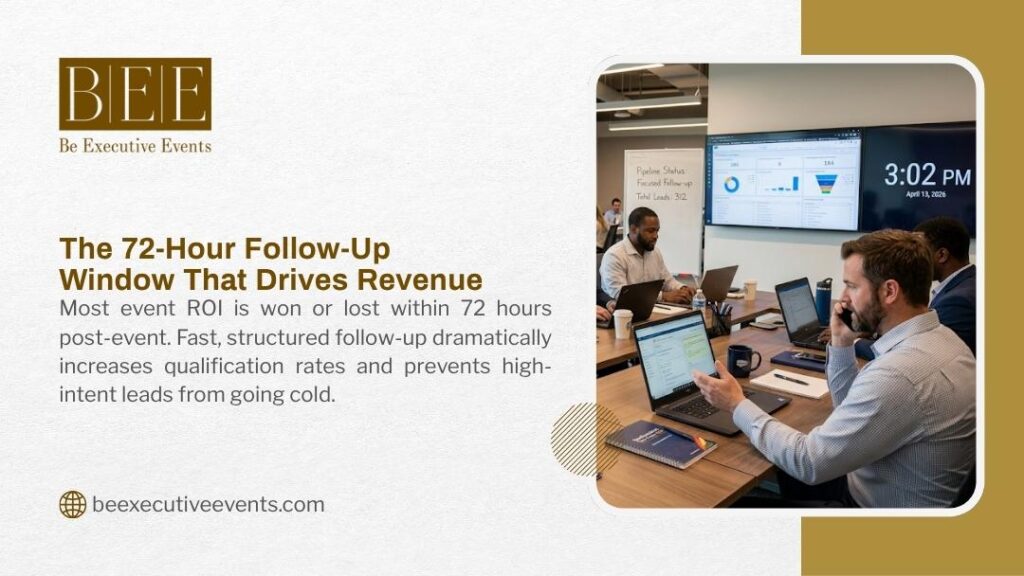
A lead contacted within 5 minutes is 21x more likely to qualify than one reached after 30 minutes. That benchmark applies directly to post-event outreach. Most of the revenue potential from a well-run event is lost in the 72 hours after it closes.
No ROI Tracking or Attribution
Only 31% of event teams use revenue attribution as an ROI metric, and only 19% track cost per acquisition. Without those numbers, justifying event spend to a CFO becomes an exercise in opinion rather than evidence.
How to Measure ROI from B2B Events
Measuring executive event ROI starts before the event opens. Define commercial objectives, tag every relevant account in your CRM, and establish what a qualified outcome looks like before anyone arrives.
| Cost Category | Example Amount |
| Venue and catering | $15,000 |
| Speaker fees | $5,000 |
| Outreach and production | $7,000 |
| Staff and logistics | $8,000 |
| Total Event Cost | $35,000 |
Key Metrics That Actually Matter
Attendance and satisfaction scores are useful indicators, but they are not what leadership needs at a budget review. The metrics that matter are:
- Pipeline generated from event touchpoints
- Revenue directly attributed to event relationships
- Cost per opportunity, not just cost per lead
- Deal velocity: did event-influenced accounts close faster than non-event accounts?
The ROI Formula Explained
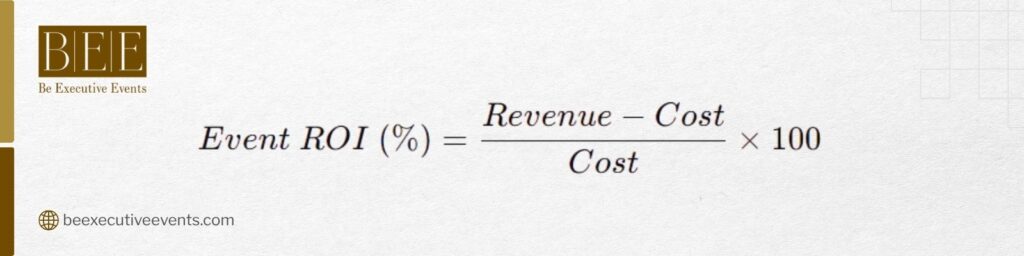
According to FortuneBusinessInsights, 48% of brands achieve between 300% and 500% ROI from event marketing.
That is the realistic benchmark range for a well-run program.
Attribution Models for Events
Three models apply to B2B events:
- First-touch credits the event as the original lead source
- Multi-touch distributes credit across all touchpoints in the buyer journey
- Influence-based assigns value wherever the event accelerated a deal
For executive events with long sales cycles, a weighted multi-touch model gives the most reliable picture without over-claiming the event’s contribution.
A Real-World Example
For instance, a company hosting an invitation-only executive forum for 40 senior decision-makers with a total cost of $85,000 tracked $620,000 in pipeline influenced by conversations that started at the event, with $210,000 in revenue directly attributed to deals where the event was a documented touchpoint.
That is the kind of result that makes executive event ROI a defensible line item in any budget conversation.
B2B Event Types Compared by ROI Potential
Format selection is one of the highest-leverage decisions in event strategy. Not all formats produce equal returns, and the cost-per-outcome gap between them is significant.
| Event Type | Cost Level | Audience Quality | ROI Potential |
| Large Conferences | High | Mixed | Low to moderate |
| Trade Shows | High | Mixed | Moderate |
| Webinars / Virtual Events | Low | Variable | Awareness-focused |
| Executive and VIP Events | Medium-High | Very High | Strong |
Large Conferences and Trade Shows
These formats reach broad audiences, but broad audiences produce low conversion rates. Mid-market companies report just a 1% in-person conversion rate from trade show leads, according to HockeyStack 2025.
High production costs combined with low personalization make cost-per-opportunity difficult to defend.
Webinars and Virtual Events
Virtual roundtable attendance fell from 66.9% in 2020 to 58.5% in 2025, a clear signal that the novelty phase is over. These formats serve awareness goals well, but they rarely produce the relationship depth needed to close enterprise deals.
53% of attendees plan to attend more webinars in 2026. Reach is not the issue. Pipeline conversion from virtual formats remains the consistent challenge — which is why understanding when to use each format matters. Our guide to virtual vs in-person events breaks down exactly where each format drives real results.
Executive and VIP Events
Small, curated groups of pre-vetted decision-makers consistently produce the strongest commercial outcomes. The executive roundtable format creates focused discussion conditions where commercial conversations develop naturally, without a visible sales agenda in the room.
When we plan executive-only dinners for 20 C-suite attendees, they outperform a 500-person conference on every deal-per-attendee metric. For a closer look at intimate events versus conferences for B2B, we compare how each format competes for an executive's limited attention. The investment is higher, but so is every downstream commercial result. Our dinner marketing playbook for enterprise sales walks through exactly how those seatings are engineered to convert.
Key Factors That Determine Event ROI
| Factor | Impact Level | What It Controls |
| Audience quality and seniority | Very High | Lead quality and conversion rate |
| Sales and pipeline alignment | High | Direct contribution to revenue targets |
| Personalization | High | Engagement depth and commercial progression |
| Post-event follow-up speed | Very High | Pipeline capture rate |
| Technology and data integration | Medium-High | Attribution accuracy and optimization |
Audience Quality Over Quantity
90%+ of senior marketers say events deliver the most value in mid-to-late funnel stages, according to IDC’s 2026 Sponsor Survey.
That only activates when the room has the right seniority. The shift from attendee count to attendee quality is the single highest-leverage ROI driver available in event strategy.
Alignment with Sales Strategy
Events disconnected from sales pipeline targets operate as marketing exercises. Events tied to named accounts, open opportunities, and specific deal stages operate as revenue tools. The distinction is structural, not cosmetic.
Personalization and Experience Design
Only 23% of B2B marketers use personalization tactics in their event marketing, according to Content Marketing Institute 2026 data. That gap is a direct competitive advantage for organizations that invest in tailored agendas and curated guest experiences.
Technology and Data
80% of event teams see AI as valuable for personalized event experiences, and 61% of event technology companies already offer at least one AI-powered feature.
Teams that connect event data directly to their CRM consistently outperform those relying on manual post-event processes.
B2B Events vs Digital Marketing: Which Delivers Better ROI?
From hosting more than 250+ events, we can say that organizations with the strongest event ROI treat events and digital as complementary channels, not competing ones. Each has a distinct role in the buyer journey.
| Channel | Cost | Scalability | Engagement Quality | Best Funnel Stage |
| In-person Events | High | Low | Very High | Mid-to-late funnel |
| SEO | Low | Very High | Medium | Top of funnel |
| Email Marketing | Low | High | Medium-High | Mid funnel |
| LinkedIn Ads | Medium | High | Medium | Top-to-mid funnel |
| Webinars | Low-Medium | High | Medium | Top-to-mid funnel |
Strengths of Digital Channels
Digital channels deliver scale, attribution clarity, and consistent lead volume at a lower cost per contact. SEO produces a 748% ROI, and email returns $36 for every $1 spent.
These are channels built for top-of-funnel reach and repeatable lead generation. The limitation is engagement depth.
A form fill, a click, or an email open does not produce the same commercial trust as a focused conversation at a well-run executive dinner.
Strengths of B2B Events
Events accelerate decisions and build relationships that digital simply cannot replicate at scale. 80% of marketers identify in-person events as the most trusted marketing channel.
The average B2B buyer journey now lasts 272 days with 88 touchpoints across four channels. Events do not replace that process. They compress it at the moments that matter most to a deal.
When to Use Each
Use digital channels for consistent pipeline volume at the top of the funnel. Use events to accelerate mid-to-late funnel deals with high-value accounts.
For organizations actively evaluating in-person vs digital for executive engagement, the most effective model is a sequenced approach: digital attracts and nurtures; events convert and accelerate.
How to Decide If B2B Events Are Worth It for Your Business
Before committing a budget, evaluate your situation against four criteria. The fit on each criterion tells you more than any industry benchmark.
| Criteria | Strong Fit | Weak Fit |
| Deal size and ACV | High-value enterprise contracts | Low-ticket transactional products |
| Sales cycle length | Long, relationship-driven | Short, self-service |
| Target audience seniority | C-suite and VP-level buyers | Mass market or SMB audiences |
| Internal follow-up capability | CRM, sales alignment, nurture sequences | No post-event infrastructure |
Are B2B Events Worth the Investment for Your Deal Size?
A 300% to 500% ROI benchmark is realistic for well-run executive events, but only when deal size supports the cost structure.
A $35,000 event needs to influence a six-figure pipeline to produce a defensible return. For low-ticket products, that math rarely works in the event’s favor.
Sales Cycle and Deal Size
Events work best when they shorten long sales cycles. If your average deal closes in two weeks with minimal relationship-building, events offer less incremental lift than for companies managing six-figure enterprise contracts over several months.
Target Audience Accessibility
The key question is whether you can actually get the right people in the room. Knowing how to get executives to attend events is a discipline of its own.
It requires personalized outreach, executive-relevant agendas, and a value proposition that respects the time constraints of senior decision-makers.
Internal Capabilities
Events are only as strong as what follows them. Teams with strong sales and marketing alignment are 80% more likely to hit pipeline goals than misaligned teams, according to B2B benchmarking research.
C-level lead generation strategies that connect event activity directly to CRM tracking, structured follow-up sequences, and opportunity tagging convert far more pipeline than events that close with a handshake and no next step.
Frequently Asked Questions
Are B2B events actually worth the investment in 2026?
Yes, for most B2B companies with mid-to-large deal sizes. 86% of B2B organizations report positive ROI from events, and in-person formats rank as the most trusted marketing channel globally.
The critical variable is whether strategy, audience quality, and post-event attribution systems are in place.
How do you measure ROI from B2B events accurately?
Use the formula: (Revenue – Cost) / Cost x 100. Include all cost components, such as venue, staff, outreach, and technology. Track pipeline influenced, revenue attributed, and cost per opportunity.
For longer sales cycles, a weighted multi-touch attribution model gives the most reliable picture.
What types of B2B events generate the highest ROI?
Executive and VIP events consistently outperform large conferences and webinars on a per-attendee commercial basis. Small, curated groups of pre-vetted decision-makers produce stronger deal velocity and higher conversion rates than broad-audience formats.
How do B2B events compare to digital marketing channels?
Digital wins on scale and cost efficiency at the top of the funnel. Events win on trust, relationship depth, and deal acceleration at mid-to-late funnel stages. The strongest marketing programs combine both in a sequenced approach.
What is the average ROI of corporate events?
According to FortuneBusinessInsights, 48% of brands achieve between 300% and 500% ROI from event marketing. Actual returns vary significantly based on event format, audience seniority, deal size, and post-event follow-up systems.
Build Events That Produce Real Business Outcomes
Be Executive Events has spent over 10 years planning and delivering executive events that produce measurable commercial results.
With more than 250 events hosted across Europe, North America, and Asia, the team brings end-to-end expertise to every stage of the process, from guest list design and personalized outreach through on-site facilitation and post-event ROI reporting.
If your organization is ready to treat events as a revenue tool rather than a marketing expense, reach out to the Be Executive Events team today.