
The format you choose for an executive event directly affects relationship quality, attendance, and the business outcomes you take away from it.
Senior event planners and C-suite decision-makers often arrive at the same question: when comparing in-person vs digital for executive engagement, which one actually delivers?
The honest answer depends on your goals, your audience, and the depth of interaction your event needs to produce.
This article covers:
- The strategic value of executive engagement
- How in-person and digital formats compare across key factors
- What hybrid events offer and when they make sense
- A practical framework for choosing the right format
If you are in the early stages of event planning, understanding executive networking at the senior level is the right starting point before any format decision gets made.
Why Executive Engagement Matters at the Strategic Level
Senior executives do not attend events out of obligation. They attend because the event promises something a scheduled call cannot deliver: peer-level conversation, strategic insight, and connections that actually move their business forward.
The question of in-person vs digital for executive engagement is not just an operational one. It shapes the quality of every interaction that happens at your event and the business value that comes out of it afterward.
| Engagement Outcome | In-Person | Digital |
| Trust development | High | Moderate |
| Relationship depth | High | Low to moderate |
| Global reach | Low | High |
| Follow-up action rate | High | Moderate |
| Knowledge transfer | Moderate to high | Moderate to high |
Research published by Harvard Business Review has shown that face-to-face requests are significantly more persuasive than digital communication. That pattern carries real weight in executive contexts where decisions involve serious commitments.
The ROI of Executive Networking
Events that bring senior leaders together around a focused agenda do not just produce goodwill. They accelerate pipeline, open partnership conversations, and in many cases resolve decisions that had been delayed for months.
The executive networking benefits at this level include direct access to decision-makers, peer validation of business strategies, and the kind of relationship capital that digital touchpoints rarely build on their own.
Key Goals for Senior Executives at Events
When executives choose to attend, they typically arrive with a clear set of expectations:
- Peer discussion on shared business challenges
- Access to thought leadership from credible voices
- Informal conversations that formal settings do not allow
- New connections with specific organizations or leaders
- Insight that directly supports decisions already in progress
Design your event format around these expectations, and attendance quality improves.
In-Person Events: Benefits and Challenges
In-person executive events produce the deepest relationships of any format. The physical setting creates conditions that are difficult to replicate elsewhere: shared meals, unscripted conversations between sessions, and the non-verbal signals that build trust fast.
| Benefits | Challenges |
| Deep trust and relationship quality | High cost per attendee |
| Full attention from participants | Geographic and travel limits |
| Informal networking moments | Complex logistics |
| Immersive brand experience | Limited scalability |
| Stronger commitment and follow-through | Scheduling complexity |
Advantages of In-Person Executive Engagement
As Keith Ferrazzi, Chairman of Ferrazzi Greenlight and author of Never Eat Alone, put it in an interview with Marketplace:
“The physical meeting should only be preserved for when we really need to go deeper than we would have been able to get otherwise emotionally.”
The strongest argument for in-person vs digital for executive engagement comes down to relationship depth. When executives share physical space, conversations happen at a different level. There is more candor, more presence, and more genuine connection.
For high-stakes discussions, confidential strategy sessions, or events where long-term partnerships are the primary goal, in-person delivers outcomes that digital formats consistently fall short on.
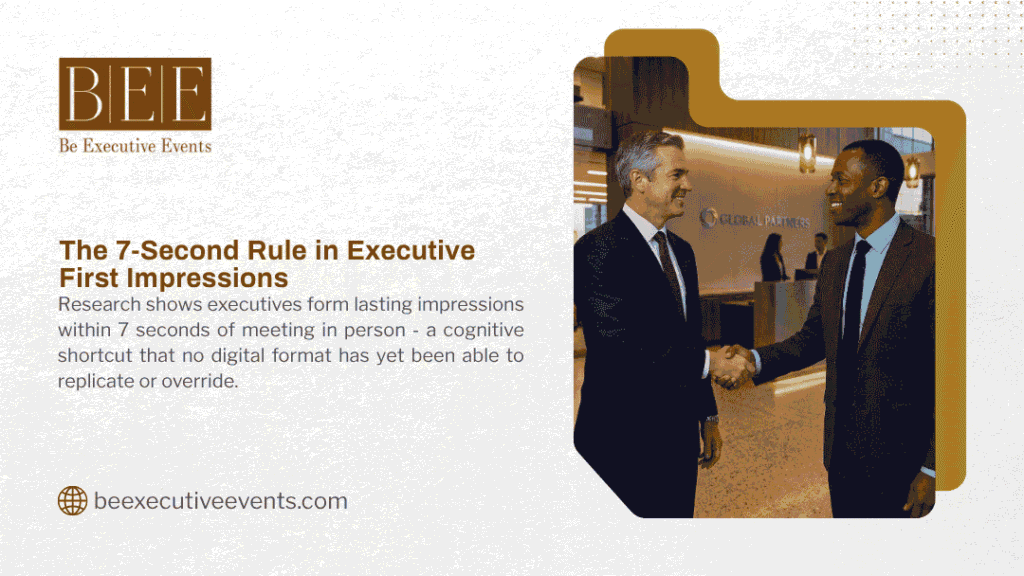
The data behind why in-person meetings close more deals points to a consistent pattern: physical presence raises the social stakes of a conversation, which leads to stronger commitment and faster action after the event.
Common Challenges and Costs
The cost of in-person executive events is real. Venue, catering, travel logistics, production, and staffing all contribute to a per-attendee figure that varies widely depending on location and scale.
| Cost Category | Estimated Range Per Attendee |
| Venue and catering | $500 – $2,000+ |
| Travel and accommodation support | $1,000 – $5,000+ |
| Production and staffing | $200 – $800 |
| Speaker fees | $500 – $10,000+ |
| Approximate total | $2,200 – $17,000+ |
General industry estimates. Actual costs vary based on event scale and location.
Geographic limits add another layer. Even with strong logistical support, executives from distant markets face real barriers to attendance, and this is exactly where digital formats offer a genuine advantage.
Digital/Virtual Events: Opportunities and Limitations
Digital formats expanded what was possible in executive events. A senior leader in Asia can join a strategic discussion hosted in Europe without leaving their office.
That level of access changes the audience profile significantly.
| Digital Feature | Engagement Impact |
| Breakout rooms | Moderate to high |
| Live polling and Q&A | High |
| AI-driven matchmaking | High |
| Chat and direct messaging | Moderate |
| On-demand content access | Low for live engagement |
Benefits of Digital Executive Engagement
The primary advantage is reach. Digital events remove geographic and logistical barriers, making it possible to assemble global audiences that would be impractical to bring together in person.
Cost efficiency is the second major factor. A virtual event for 40 executives costs a fraction of what an equivalent in-person event would require. For organizations with tight event budgets and international audiences, this difference carries strategic weight.
Digital platforms also provide strong analytics. Attendance, session engagement, participation patterns, and post-event follow-up activity can all be tracked, which makes ROI measurement more precise than most in-person formats allow.
Limitations and Engagement Gaps
The gap between in-person vs digital for executive engagement becomes most visible when it comes to relationship depth. Video calls do not produce the informal moments where real trust forms.
There are no hallway exchanges, no shared meals, and no spontaneous conversations that deepen a connection beyond its formal scope.
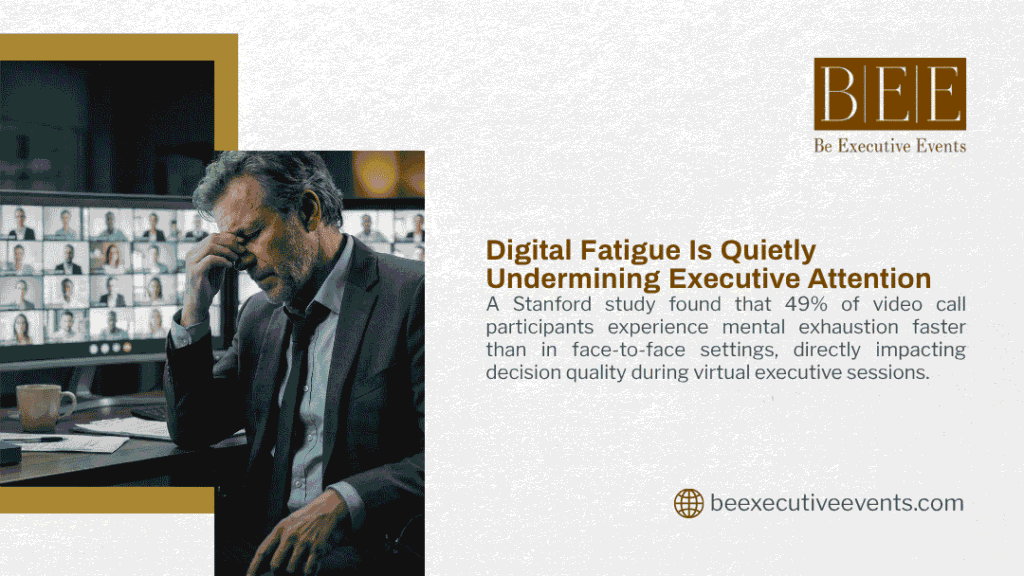
Attention is also harder to hold. Executives on virtual calls face constant competing demands from email, internal messages, and other priorities. A 90-minute digital session rarely commands the same quality of focus that a well-designed in-person format produces.
For event formats like the executive roundtable, which depend on candid peer discussion and real-time group dynamics, virtual delivery requires much more deliberate session design to reach a comparable depth of conversation.
Hybrid Events: The Strategic Middle Ground
Hybrid events bring together the reach of digital formats and the relationship quality of in-person gatherings. When designed well, they let organizations serve both local and global audiences without sacrificing depth for either group.
| Format | ROI Potential | Networking Quality | Global Reach | Cost |
| In-person only | High | Very high | Low | High |
| Digital only | Moderate | Moderate | Very high | Low |
| Hybrid | High | High | High | Medium to high |
Adam Grant, organizational psychologist at the Wharton School and one of the most cited researchers in workplace relationships, has noted that “there’s a critical mass of in-person time that makes it easier to bond,” adding that both peer and hierarchical relationships benefit from it.
When Hybrid Works Best
Hybrid formats work best for large-scale events where audience geography is diverse.
Global summits, investor forums, and cross-region leadership meetings benefit most because the in-person group gets the full relational experience while remote attendees still participate in structured sessions.
For events where exclusivity is the draw, working with executives-only summit planners ensures the attendee list stays tightly curated even as the format scales to accommodate remote participants.
For organizations focused on executive event ROI, hybrid events offer a practical advantage: they expand audience size without a proportional rise in cost, which improves the return per attendee across the full event.
Best Practices for Hybrid Event Success
A hybrid event that neglects its virtual audience creates a two-tier experience. That gap damages both engagement quality and brand perception.
Key practices for hybrid success:
- Design separate but parallel engagement paths for in-person and virtual attendees
- Use AI matchmaking to connect attendees across both groups
- Keep virtual sessions focused and shorter than in-person segments
- Appoint a dedicated moderator specifically for the virtual cohort
- Record key sessions for on-demand access after the event
Technology selection is critical. Platforms with built-in networking tools, live polling, and real-time analytics give organizers the infrastructure to manage both audiences effectively.
Choosing the Right Format for In-Person vs Digital for Executive Engagement
Choosing between formats should follow a structured process, not a gut feeling. The right call depends on four core variables: audience location, event objectives, available budget, and the depth of interaction your event requires.
| Goal | Best Format | Reason |
| Deep relationship development | In-person | Physical presence builds trust faster |
| Global audience participation | Digital or hybrid | Removes geographic barriers |
| Confidential strategic discussion | In-person | Higher candor and sustained focus |
| Cost-efficient content delivery | Digital | Lower operational overhead |
| Balanced reach and depth | Hybrid | Serves both audience types effectively |
| High-stakes deal conversations | In-person | Stronger commitment and follow-through |
Once you’ve settled on a format, the next step is execution, understanding how to create executive events with great outcomes ensures the format you chose actually delivers on its potential.
Key Questions to Ask Before Planning
Before locking in a format, work through these questions:
- Where is the majority of your target audience located?
- What level of relationship depth does this event need to produce?
- Does the agenda include sensitive or high-stakes discussions?
- What is the realistic per-attendee budget?
- How will you define and measure success?
Decisions made without this clarity tend to produce format choices that underperform against their own stated objectives.
Step-by-Step Format Selection Process
- Define the primary outcome. Relationship development? Content delivery? Strategic decision-making? The answer shapes everything else.
- Map your audience geography. Majority local? In-person is viable. Globally distributed? Digital or hybrid.
- Set a realistic budget. In-person typically costs 5 to 10 times more per attendee than digital.
- Assess the depth of engagement required. High-trust and sensitive discussions favor in-person strongly.
- Build your measurement framework first. Define what success looks like before selecting the format.
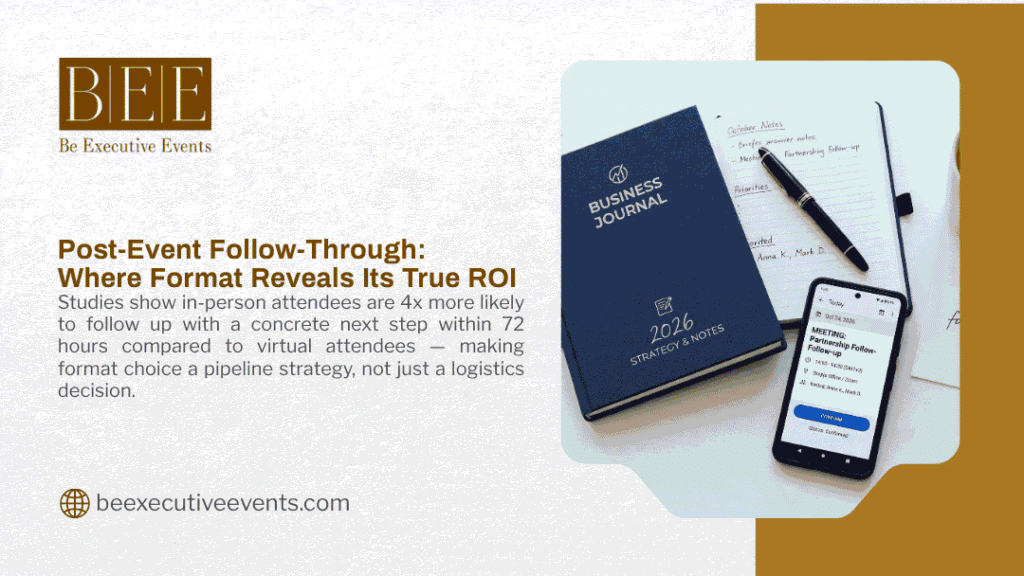
Knowing how to get executives to attend events in the first place often comes down to format alignment with what senior leaders actually value. The wrong format choice reduces response rates before planning has even started.
Frequently Asked Questions
What format maximizes networking depth for senior executives?
In-person events produce the highest quality relationships. Physical presence supports trust, candor, and informal conversation in ways digital formats currently cannot match. For strategic partnership goals, in-person is the clear choice.
How do hybrid and digital formats affect post-event accountability?
Digital platforms capture detailed engagement data, session attendance, and follow-up activity. This makes it easier to track accountability and measure action after the event compared to in-person formats where tracking is more manual.
Which metrics matter most for executive engagement?
The most meaningful indicators are relationship quality measured by follow-up meetings, post-event pipeline activity, active participation rate, and net promoter score from attendees.
When should in-person be prioritized over digital?
In-person is the right choice for confidential discussions, high-stakes relationship development, senior leadership retreats, and any event where long-term trust-building is the primary objective.
Can technology improve engagement for virtual attendees?
Yes, AI matchmaking, structured breakout sessions, live polling, and real-time analytics all raise the quality of virtual executive events when used with intentional session design.
Final Note
The comparison between in-person vs digital for executive engagement does not have one universal answer.
- In-person events produce the deepest relationships and the highest-quality conversations.
- Digital events offer scale, access, and cost efficiency.
- Hybrid formats can deliver both when the design is right.
Format should always follow strategy. Decide what the event needs to produce first, then choose the format that gives it the best chance of achieving it.
Plan Your Next Executive Event With the Right Team
Be Executive Events works with global enterprises, SaaS firms, and consultancies to design and deliver high-impact executive experiences across all formats.
From exclusive in-person summits to fully managed virtual sessions and hybrid events, BEE handles every stage with the same attention to detail.
For organizations at the planning stage, working with experienced c-suite summit planners who understand both the strategic and operational dimensions of executive events makes a measurable difference in outcomes.
Contact the Be Executive Events team to discuss your format objectives and build an executive event experience that delivers at the level your audience expects.