
Dinner marketing for enterprise sales is the practice of using a small, invitation-only meal to reach senior buyers and move large deals forward. It is not restaurant promotion. It is a deliberate go-to-market channel where a host gathers eight to fourteen decision makers around one table for honest, peer-level conversation.
Search results for this term still favour restaurant tips, yet the real reader is a B2B revenue, field-marketing, or ABM leader. This playbook speaks to that reader: who to invite, how to run the room, and how to prove the return.
What Dinner Marketing for Enterprise Sales Actually Means
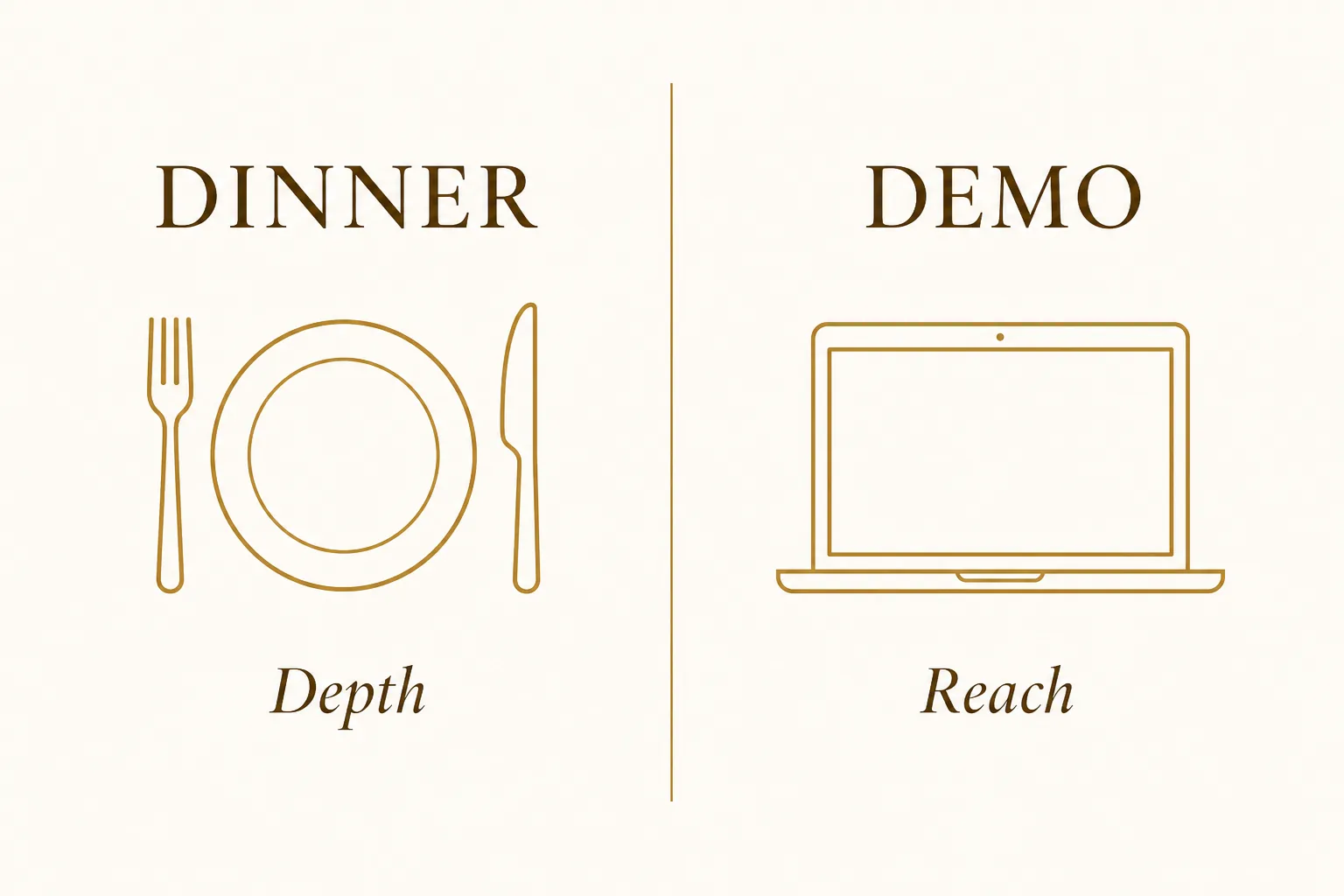
Dinner marketing for enterprise sales is a targeted, account-based tactic: a host invites a defined set of senior buyers from priority accounts to a private meal built around a peer discussion rather than a sales pitch. The mechanics are specific. One host convenes eight to fourteen guests, sets a single business theme, moderates a structured conversation, and follows up against named accounts in the CRM afterwards. Every element (the guest list, the discussion theme, the seating plan, the follow-up) is chosen to advance a real opportunity, which is what separates it from a hospitality thank-you.
The measure of success is pipeline, not covers served.
Buying committees have grown, and much of an enterprise purchase now takes shape before a rep is ever in the room. More stakeholders sit behind every large deal, each with a quiet veto. A dinner reaches several of them at once, on neutral ground, before the pitch begins.
This is what people mean by enterprise sales marketing: the coordinated effort to win high-value accounts and their buying groups, with dinners as one precise instrument inside it.
Why the Dinner Table Outperforms the Demo
At a demo, the buyer expects a pitch and keeps their guard up. At a well-run dinner, the host is a convener, not a seller, and the guest relaxes. That shift is the entire point.
The setting also opens doors to executive decision makers who never accept a first sales call. Peer-reviewed work in Industrial Marketing Management on the role of customer entertainment in B2B sales strategy found that shared hospitality helps sellers build trust and access that formal meetings do not reach. Quality of the room, not headcount, drives the outcome.
Throw private dinners and events. At Mid-Market or Enterprise deals, very effective acquisition cost. Dinners cost about $3-5K plus travel and …Read on LinkedIn ↗
The Enterprise Dinner Funnel: From Target List to Pipeline
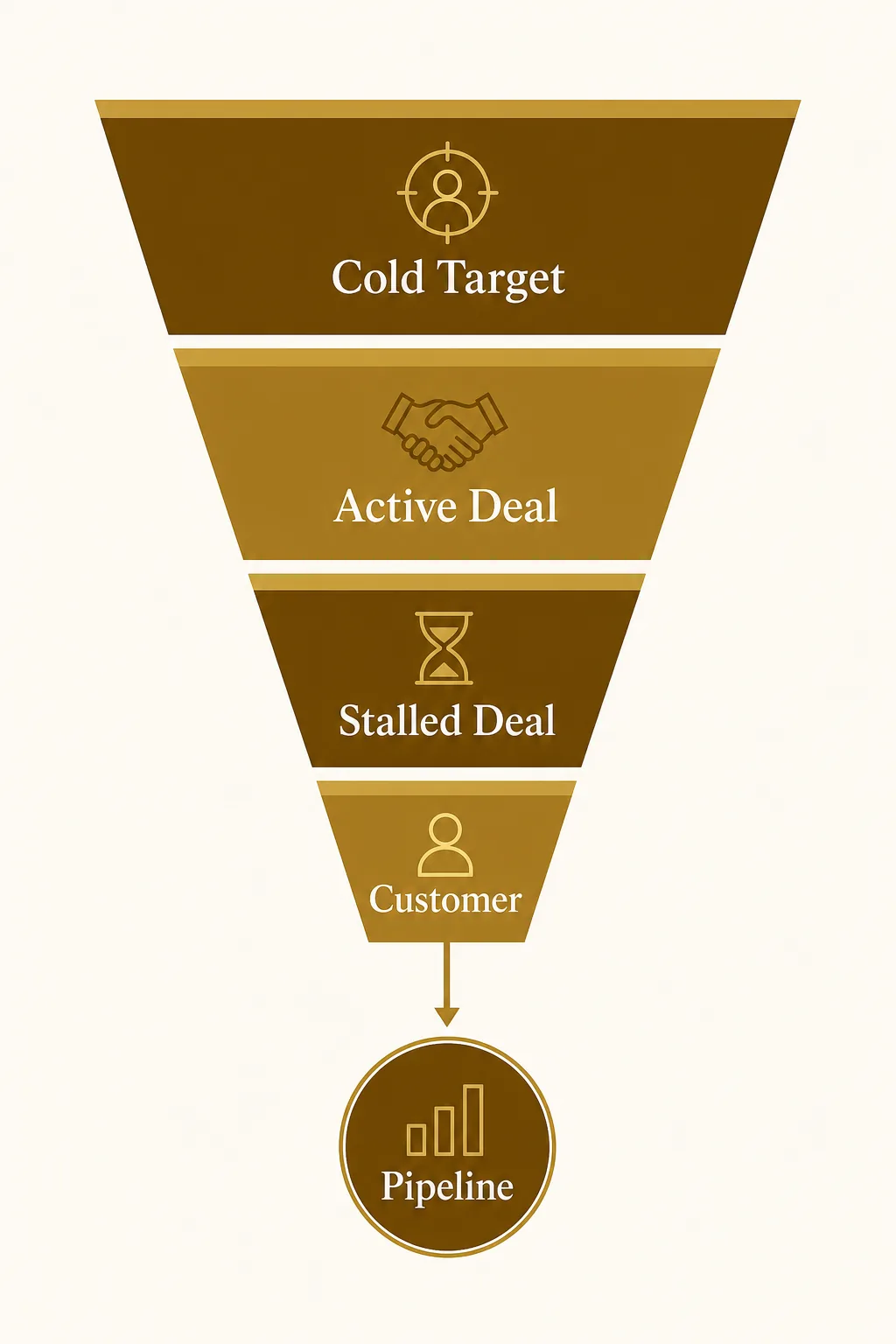
Done well, dinner marketing for enterprise sales is an accelerator, not a top-of-funnel scoop. It works best for accounts already on your list, where a warmer relationship shortens the path to a real opportunity. Treat it as part of a wider executive events strategy, tied to specific deals.
| Deal stage | What the dinner does | Signal to watch |
|---|---|---|
| Cold strategic target | Opens a peer relationship before any pitch | Guest accepts and engages |
| Active opportunity | Builds multi-threaded trust across the committee | New stakeholders join calls |
| Stalled deal | Resets the conversation in a neutral setting | Momentum returns, next meeting booked |
| Existing customer | Deepens the account and surfaces expansion | Referral or new business unit |
Those relationships carry real weight. Strong executive networking at the table often does more for a stalled deal than three follow-up emails ever will, because buyers move faster with sellers they already know.
Finding the Right Decision Makers to Invite
Guest quality decides the return. The work starts with account selection, then a clear map of the most senior decision-maker at each company and the peers who shape the budget alongside them.
Research matters here. Reliable methods to find company decision makers combine intent data, LinkedIn, and a careful read on each executive: role, professional background, and recent news that gives the invite a genuine hook. A Walden University study on marketing strategies to increase sales found that targeted, relationship-led marketing outperforms broad, generic tactics. Precision beats volume.
The same lead generation work feeds both the guest list and the wider pipeline.
As Head of Marketing at Capsule, she built their entire enterprise GTM around one format: intimate VIP dinners for 12-16 creative leaders.
Best Practices for Inviting Senior Executives to Events
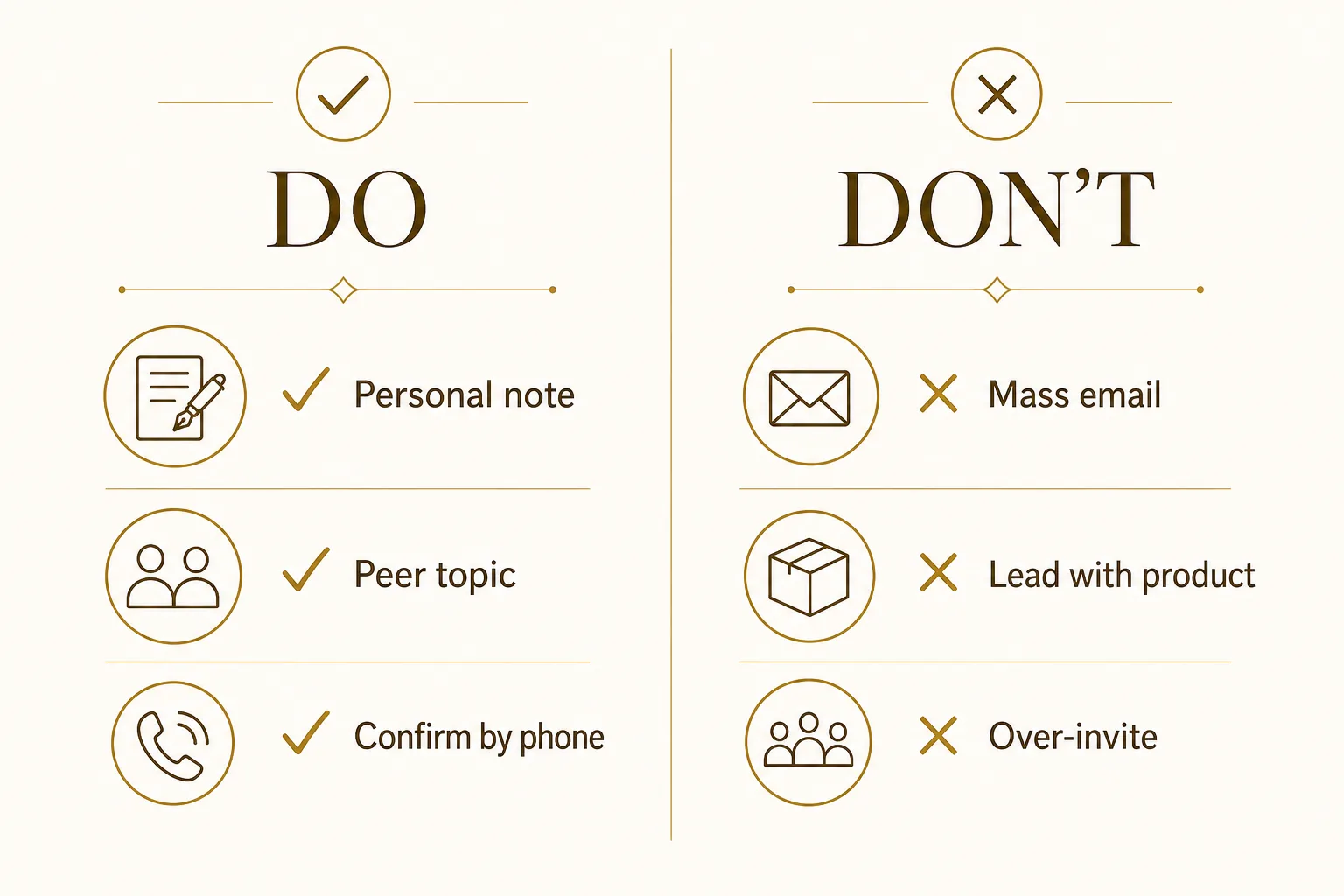
The invitation is the hardest part of the process. A mass email to a CxO gets deleted. The practices that work all point one way: make it personal, peer-led, and about them.
Invitations land when a senior host reaches out directly with a real reason to gather peers, not a product agenda. A short, specific note about the discussion theme beats a branded invite every time.
| Do | Don’t |
|---|---|
| Send a personal note from a senior host | Blast a generic mailing list |
| Lead with a peer discussion topic | Lead with your product |
| Confirm by phone or a warm introduction | Rely on one email |
| Manage RSVPs and a small waitlist | Over-invite and lose control of the room |
Allow six to eight weeks of lead time for executive roundtables and dinners, and follow up twice before you write anyone off.
Choosing the Format: Dinner, Roundtable, or Peer Group
Not every goal needs the same room. A dinner suits relationship-building; a structured executive roundtable suits a sharp agenda; an ongoing peer group suits long-term positioning.
| Format | Best for | Group size |
|---|---|---|
| Private dinner | Trust and first access | 8–14 |
| Executive roundtable | Focused debate on one theme | 10–20 |
| Ongoing peer group | Long-term authority | 15–30 |
Virtual formats extend the same idea across regions when travel is hard, and sponsorship packages for virtual events can share the cost across partners without diluting the audience.
Running the Dinner: Agenda, Moderation, and Flow

Content design separates a memorable evening from an awkward one. A light discussion theme, a skilled moderator, and seating that mixes accounts keep the talk honest. The one firm rule: no hard pitch at the table.
Solid event production management sits behind all of it, from venue and menu to run-of-show and name cards. A simple flow works best.
| Stage | Purpose |
|---|---|
| Arrival and drinks | Warm introductions |
| Host framing question | Set the theme in two minutes |
| Guided discussion | Peer exchange, moderator steers |
| Open networking | Relationships form naturally |
The host speaks least. Guests should leave feeling heard, not sold to.
Measuring ROI: Proving the Dinner Was Worth It
This is where dinner marketing for enterprise sales parts ways with restaurant marketing. A restaurant measures covers and food cost. An enterprise host measures pipeline.
Leading vs. Lagging Metrics
Track leading indicators first, then lagging ones. Post-event reporting should name every attendee, capture engagement, and set the next step for each account.
| Metric | What it tells you | How to capture |
|---|---|---|
| Meetings booked | Immediate intent | CRM within 48 hours |
| Opportunities influenced | Mid-funnel impact | Attribution on target accounts |
| Deal velocity | Cycle acceleration | Compare stage dates before and after |
| Closed and expansion revenue | Final return | Account review at 6–12 months |
A clear report turns a pleasant evening into a defensible line in the marketing budget.
We just hired an Enterprise AE from Salesforce. I learned that they have an unlimited client dinner budget… I wanted all the details.Read on LinkedIn ↗
Seasonality and Global Rollout: Timing Your Executive Dinners
Executive availability follows a calendar. Spring and autumn are strong; August and late December go quiet across Europe and North America. Regional nuance matters too: the DACH summer slowdown, the North American fourth-quarter budget push, Ramadan and Eid in the Middle East, and Lunar New Year across APAC.
A calendar-aware plan lifts both attendance and return. A single dinner can also grow into a regional series, for example London, then Frankfurt, then Amsterdam, so the format matches a global go-to-market plan without losing consistency.
In-House vs. a Specialist Partner
An internal team can run a good dinner. The real question is what it costs in time, and whether the room is truly senior.
| Task | In-house | Specialist partner |
|---|---|---|
| Guaranteed senior audience | Hard to promise | Pre-approved, client-aligned |
| Venue and logistics | Extra workload | Handled end to end |
| Moderation and flow | Variable | Experienced facilitators |
| ROI reporting | Often skipped | Built in |
Two problems sink most in-house dinners: the wrong people accept, and no one can prove what the evening returned. At scale, dinner marketing for enterprise sales lives or dies on solving both, and that is where Be Executive Events fits. It confirms a guest list that is genuinely CxO level before you commit budget, so a marketing lead is not gambling six weeks of work on who shows up. It runs the venue, moderation, and run-of-show end to end, so your team stays on pipeline instead of logistics. And it hands back a post-event report tied to named accounts that a CFO will read as influenced pipeline, not entertainment spend. If you have strategic accounts stalled above the director line and a number to hit this quarter, book a planning call with Be Executive Events and map a dinner to those specific deals.
Frequently asked questions
What is enterprise sales marketing?
How many executives should you invite to a sales dinner?
How do you measure the ROI of an executive dinner?
When is the best time of year to host executive dinners?
Final Note
The table remains one of the few settings where a senior buyer gives a host their full attention for two hours. Cold channels rarely buy that. Run with the right guests, a genuine premise, and measured follow-up, dinner marketing for enterprise sales earns pipeline that email and ads cannot. A partner that can guarantee the room and prove the return simply makes that outcome more repeatable.