
Quick Take: Who Influences C-Suite Buying Decisions
For a demand generation lead in Technology and SaaS, the target account list usually starts with titles: CIO, CTO, CFO, CDO. Final budget authority does sit there. The decision itself, in most enterprise deals, is shaped long before it reaches that desk.
Campaigns aimed only at CxO titles reach the person who signs and miss the people who framed the problem, built the shortlist, and wrote the business case. Here is that influence network, layer by layer, and what it actually takes to reach decision makers in B2B, not just the one who signs.
The C-Suite Signs, But Rarely Decides Alone
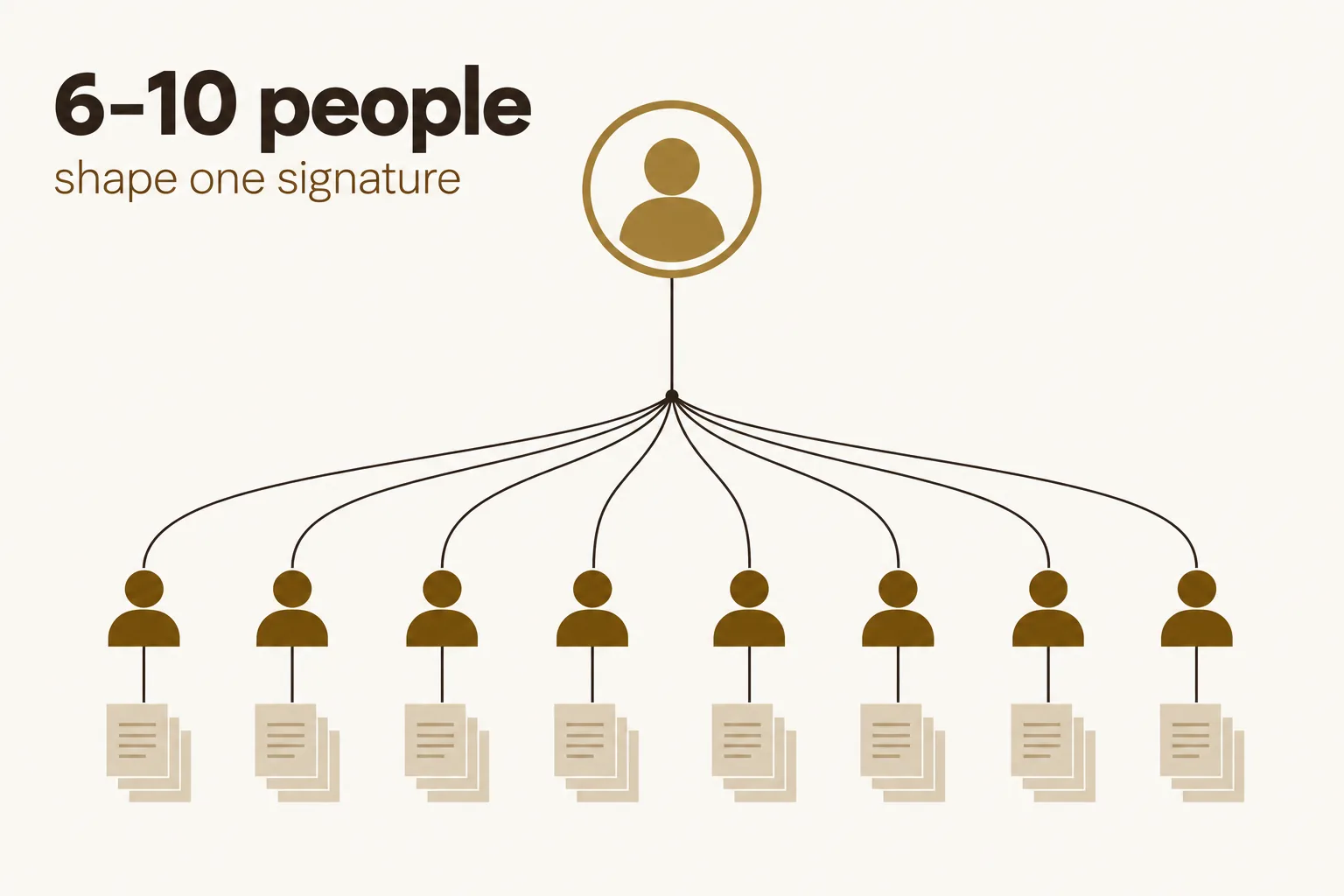
Complex purchases in SaaS, BFSI, and manufacturing pass through a group before they reach approval. Research finds that a typical buying committee for a complex B2B solution includes six to ten decision-makers, each independently gathering four or five pieces of information before the group ever reconciles its research.
A single enterprise deal typically involves technical evaluators, a finance owner, a risk or security reviewer, and one or more executive sponsors, each arriving with separate research and separate priorities. By the time a CxO signs, they are largely ratifying work done underneath them.
A campaign that speaks only to the economic buyer arrives at the final step of a process it never joined.
The practical response is to map the influence network account by account, then assign a channel and a message to each layer.
The Internal Influencers Who Shape the Decision
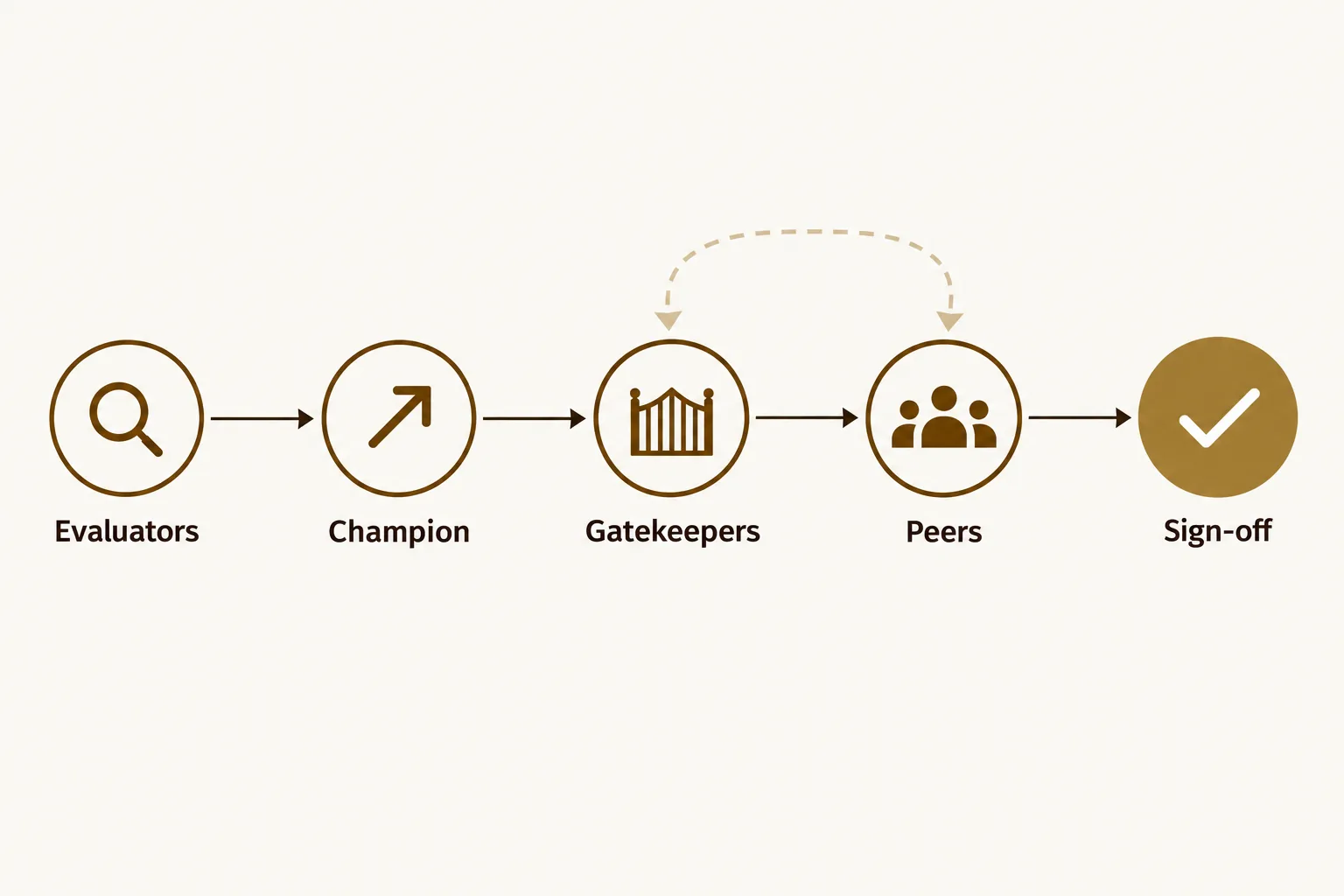
Four internal roles move a deal before anyone signs. They rarely sit on the same target list, and they respond to different things.
Department Heads and VPs: The Technical Evaluators
VPs and Directors of IT, Data, Cybersecurity, Cloud, Transformation, and Operations run discovery. They score vendors, define requirements, and stress-test architecture. They also translate a product into language a CFO or CEO accepts: cost of the status quo, integration risk, timeline, headcount impact.
These titles are what make executive roundtables work. Our dinner marketing for enterprise sales playbook shows how to turn that same dynamic into closed contracts, not just good conversation.
A room of senior evaluators debating a shared operational problem produces detail no vendor webinar generates, and it puts your team in front of the people writing the business case rather than the person receiving it.
Internal Champions: The People Who Carry Your Case Upward
Champions are usually senior managers or Directors already living with the problem your product solves. They present internally, in meetings you are not invited to, using material you did not write.
Give them ammunition rather than brochures: peer proof from a comparable organization, ROI framing they can defend in a finance review, and clear language on risk reduction. Post-event follow-up decides this. A summary of what peers in the room said about a shared challenge travels upward far better than a product one-pager.
Gatekeepers: Procurement, Legal, Executive Assistants
Procurement controls commercial terms. Legal and security control vendor risk review. Executive assistants control the calendar, which in practice means they decide whether a senior executive ever hears your name. Any of the three can stall a strong deal indefinitely.
Invitation quality is the lever. Our guide to getting meetings with executives covers this from the outreach side; the traits that survive assistant screening converge on a specific agenda, a defined time commitment, a named peer profile in the room, and a clear reason this particular executive belongs there. Generic outreach reads as a sales attempt and gets filtered accordingly.
The Overruling Layer: Other C-Suite Peers
A CIO’s preferred vendor can be overturned by a CFO on cost, a CISO on risk, or a CEO on strategic fit. Depth with one sponsor is not cross-functional buy-in, and single-threaded deals die quietly at the final stage.
Formats that put several functions in one room surface those objections early, while you can still answer them. It is also why the best channel for reaching decision makers in B2B depends on the role: a mixed CIO, CFO, and CHRO roundtable on AI governance exposes internal friction that three separate single-function campaigns never reveal.
The External Forces Executives Trust More Than Vendors
Executive decision makers also weigh inputs you do not control:
| External Input | Why It Carries Weight |
|---|---|
| Peers | A counterpart at a comparable company carries more weight than any vendor claim, since it carries no commercial motive |
| Analysts and third-party research | Independent validation works as risk cover inside the business case and gives the champion something objective to point at |
| Prior experience | An existing relationship with a vendor shortens evaluation; a bad one ends it |
| Consultants and system integrators | They often shape the shortlist before a vendor knows the opportunity exists |
Why Peer Influence Outperforms Direct Outreach
Direct outreach builds awareness and should continue. What it cannot do is manufacture trust between shortlist and signature. Executives run much of their evaluation through their own research and their own network before a vendor conversation starts, so vendor-led contact arrives late to a discussion already in progress.
A curated dinner or roundtable of six to twenty-six executives changes that, because the value is horizontal. We break down how intimate events compare to conferences for B2B if you want the format argument in full. Executives attend for the other executives present, not for the sponsor’s slides.
Candor appears when nobody in the room is selling, and the sponsor hears the real objections.
A branded virtual event extends the same dynamic across UKI, DACH, BENELUX, and NAMER without travel, which matters when the buying group sits in three countries.
Mapping the Influence Network for Your Own Deals
| Role | Where They Sit | What They Control | How to Reach Them |
|---|---|---|---|
| Economic buyer (CxO) | Final sign-off | Budget release | A peer-level roundtable or dinner where they hear other executives, not a vendor pitch |
| Technical evaluator | VP or Director of IT, Data, Cybersecurity, Cloud, Transformation, or Operations | Vendor scoring, requirements, architecture | An executive roundtable debating a shared operational problem |
| Internal champion | Senior manager or Director already living with the problem | Presents the case internally | Peer proof and ROI framing they can carry into a meeting you’re not in |
| Gatekeeper | Procurement, legal, executive assistant | Whether your name ever reaches the executive | A specific, time-bound, peer-named invitation, not a generic pitch |
| Peer or analyst | Outside the account entirely | Trust the account already extends | Third-party validation and comparable-company proof |
This is how you turn a general picture of who influences C-suite buying decisions into an account-by-account plan. For each priority account, name five roles: the economic buyer, the technical evaluator, the champion, the gatekeeper, and the peer or analyst that account already trusts. Assign a channel to each instead of running one blanket campaign.
Match depth to role. Evaluators want architecture, integration detail, and benchmarks. CxOs want risk, cost, and strategic outcome in a form they can repeat to the board. Champions want something portable they can forward. Then track which roles actually attended, not headcount. Twelve attendees means little; four evaluators and two economic buyers from target accounts means a great deal.
Designing Engagement That Reaches Every Layer
- Pre-approved attendee lists. Every registration checked against the client’s target profile keeps junior stand-ins out of the room. Audience quality is the whole value of the format.
- An agenda built on a live problem. Moderated discussion of a challenge the audience already owns, not a product demonstration. The sponsor earns credibility by framing the conversation, not by presenting through it.
- Post-event reporting. Which influencer roles engaged, what each raised, and what goes to each one next.
- Sequencing. A virtual executive session for reach across regions, then a dinner or roundtable for depth with priority accounts.
- Timing. European executive availability drops sharply in August and again from late December. Demand concentrates from late February through July and rebounds from September through early December, when calendars fill fastest.
Frequently Asked Questions
Related readingC-Level Lead Generation Strategies That Work in 2026Read the guide →Frequently asked questions
Who has final authority on a C-suite purchase?
Should you market to the C-suite directly or through influencers?
How do you reach decision makers in B2B?
How do you reach gatekeepers without antagonizing them?
What size executive gathering works best for influence?
Starting a Conversation
If you’re ready to stop chasing stakeholders one at a time, Be Executive Events designs and runs the curated gatherings that help you reach decision makers in B2B without relying on a single signature.
We build invitation-only executive events, VIP dinners, and branded virtual sessions for enterprise and SaaS organizations that need peer-level access to the whole buying group, not just another line on a title list.
Here’s what a program with Be Executive Events gets you:
- A curated guest list built around your actual target accounts, screened against your ICP so a junior stand-in never takes a seat that should go to an economic buyer or technical evaluator
- An agenda built on a live industry problem, moderated so your team earns credibility by framing the conversation rather than pitching through it
- Reach across UKI, DACH, BENELUX, and NAMER through a branded virtual session, then depth with priority accounts through an in-person dinner or roundtable
- Post-event reporting on which roles engaged, what each raised, and what goes to them next
- Measurable ROI reporting, so the event proves out as a pipeline touchpoint, not just a networking cost
Talk to Be Executive Events about your target account list and the title profile you need in the room, and we’ll work out which format fits.