
Learning how to get meetings with executives requires different tactics than reaching mid-level managers. Executives operate in a different world with different priorities, and generic outreach that works for other contacts fails completely at the C-suite level.
In this article, you’ll discover 7 proven strategies that actually get responses from busy executives, including templates you can use today, timing tactics that increase open rates, and advanced approaches.
Why Getting Meetings with Executives Is Challenging?
Executives face inbox overload that makes your message one of 200+ they receive daily. A typical CEO gets 120-150 emails per day, plus countless LinkedIn messages, phone calls, and meeting requests from their own team.
Their time is their most valuable asset. Every hour an executive spends in meetings costs the company thousands in opportunity cost, so they protect their calendars fiercely.
Three main barriers block your access:
Executive assistants filter requests and delete anything that looks like a sales pitch. They’re trained to protect their boss’s time and say no to almost everything.
Executives themselves have seen every pitch and approach. They’ve developed strong filters for what deserves attention and what gets ignored immediately.
Understanding why executives ignore sales outreach reveals the specific triggers that cause instant deletion, and knowing those triggers is the first step to avoiding them.
Your message competes with urgent internal priorities. Even if an executive sees your outreach, it competes with board meetings, strategic planning, crisis management, and direct reports who need decisions.
| Challenge | Why It Matters | What You’re Up Against |
| Volume | 200+ daily messages | Your email is one of hundreds |
| Gatekeepers | Assistants filter aggressively | 80-90% of outreach gets blocked |
| Competing Priorities | Internal needs come first | External meetings are lowest priority |
According to cold outreach benchmarks, the average reply rate for cold emails is generally in the low single digits, and C‑suite executives often respond at rates of around 4–6% — making initial outreach to senior leaders significantly harder than less senior targets.
This doesn’t mean getting meetings with executives is impossible. It means you need strategies specifically designed for senior-level access rather than hoping generic tactics will work.
7 Proven Strategies for How to Get Meetings with Executives
1. Start with Warm Introductions and Referrals
The single most effective way to get meetings with executives is through mutual connections who make introductions on your behalf. Warm referrals convert at 10-15x higher rates than cold outreach.
Think about your existing network. Who do you know that also knows your target executive? Former colleagues, board members, advisors, investors, and industry peers all represent potential bridges.
How to ask for introductions:
| Step | Action | How to Do It Effectively |
| Identify a mutual connection | Find shared contacts who may know the executive | Use LinkedIn or ask your network directly. Don’t assume you already know all overlapping connections. |
| Reach out to your contact first | Explain your reason for wanting the introduction | Briefly share why you want to meet the executive and what value you can offer. |
| Make it easy to help | Provide a short forwardable message | Include a concise blurb your contact can easily send to the executive. |
| Ask clearly and specifically | State exactly what you want | Use a direct ask like: “Would you be comfortable introducing me to Sarah?” instead of vague questions. |
The key is making the introduction low-effort for your contact while clearly stating why the executive would benefit from the conversation. Learn more about alternatives to cold outreach for executives that leverage existing relationships.
2. Offer Value First Instead of Pitching
Executives respond when you offer something useful rather than trying to sell immediately. Research shows that value-first outreach generates 3-5x more responses than pitch-focused messages.
Types of value that work:
| Approach | What to Offer | Why It Works |
| Share industry research or data | Lead with relevant insights on their market, competitors, or industry trends | Shows you understand their business environment and speak at an executive level |
| Offer company-specific insight | Share a useful observation about their operations, strategy, or market position | Feels personalized and value-driven, not generic outreach |
| Make a high-value introduction | Connect them with senior leaders, partners, or key talent in your network | Executives value access to people as much as information |
| Invite participation in research or a roundtable | Offer involvement in peer discussions or industry research | Positions the meeting as contribution, not a sales pitch |

3. Timing Matters More Than You Think
When you reach out affects response rates as much as what you say. Data from 97th Floor shows that mid-week mornings (Tuesday-Thursday, 8-10 AM) generate 40% more responses than other times.
Executives check email early before meetings consume their day. Monday mornings are too chaotic. Friday afternoons mean messages get buried over the weekend.
Optimal timing patterns:
The best days are Tuesday, Wednesday, and Thursday. These days avoid the Monday rush and Friday wind-down.
Best times are 8-10 AM in their local timezone. Executives often process email before back-to-back meetings start.
Worst times include Monday before 10 AM, Friday after 2 PM, and anything outside business hours. Messages sent at these times get buried under other priorities.
Consider quarterly business cycles too. Most executives are more available mid-quarter than during month-end close periods or quarter-end reviews.
| Day/Time | Response Rate | Why |
| Tuesday-Thursday 8-10 AM | Highest (baseline 100%) | Fresh inbox, before meetings start |
| Monday morning | 60% of baseline | Too chaotic, firefighting mode |
| Friday afternoon | 45% of baseline | Weekend mode, low attention |
| Outside business hours | 30% of baseline | Gets buried, seems desperate |
4. Craft Email Structure That Gets Read
The format of your message matters as much as the content when you’re learning how to get meetings with executives. Senior leaders scan rather than read, so structure must support quick comprehension.
Key elements of effective executive emails:
| Email Element | Best Practice | Example / Guidance |
| Subject line | Be specific and relevant, not clever | “Q4 treasury optimization data” instead of “Quick question” |
| Opening sentence | Hook attention immediately in ≤10 words | State exactly why you’re reaching out |
| Email body | Keep it 4–6 short sentences max | Executives won’t read long paragraphs |
| Clarity & focus | Get to the point fast | One idea, one value, no filler |
| Call-to-action | Clear and low-commitment | “Would 15 minutes Tuesday or Wednesday work?” |
5. Use Multi-Channel Outreach for Better Visibility
Reaching executives through multiple channels increases your chances of getting noticed without seeming desperate. LinkedIn research shows that prospects contacted through 3+ channels respond at 2x the rate of single-channel outreach.
Effective channel combinations:
| Outreach Step | What to Do | Key Best Practice |
| Initial email | Send a brief, value-focused email to the executive | Keep it concise and aligned with executive priorities |
| LinkedIn follow-up | Follow up after 2–3 days referencing the email | Add a new insight; don’t repeat the same message |
| Assistant call | Call the executive’s assistant about a specific topic | Be professional, clear, and respectful of their role |
| Content engagement | Engage with the executive’s LinkedIn posts or event appearances | Leave thoughtful, relevant comments to build visibility |
| Multi-touch strategy | Space out outreach and vary messaging | Aim for professional persistence, not over-contacting |
| Channel optimization | Review which outreach channels perform best | Use data-driven channel selection for C-suite engagement |
6. Master the Follow-Up Without Being Annoying
Research shows that 80% of sales to executives happen after at least 5 follow-up touches. But most people give up after one or two attempts.
The challenge is following up enough times without damaging your reputation or annoying the executive. The solution is adding value with each touch rather than just “checking in.”
Follow-up framework that works:
| Follow-Up Stage | Timing | What to Do | Goal |
| First follow-up | 3–4 days later | Reference your original message and add one new piece of value (article, data point, or insight) | Reinforce relevance without repeating yourself |
| Second follow-up | 1 week later | Switch channels (email → LinkedIn or phone) | Increase visibility through a different touchpoint |
| Third follow-up | 2 weeks later | Reference a trigger event (funding, product launch, exec hire, market news) | Create a timely, legitimate reason to re-engage |
| Fourth follow-up | 1 month later | Share valuable content with no ask (research, intro, business insight) | Build goodwill and trust |
| Final follow-up | 6–8 weeks later | Send a direct close with a clear opt-out or future timing option | Respect their time and get clarity |
7. Position Yourself as a Peer, Not a Vendor
How you position yourself dramatically affects whether you get meetings with executives. Leaders respond to other leaders and experts, not salespeople asking for time.
Ways to improve your positioning:
| Credibility-Building Strategy | How It Helps You Get Executive Meetings |
| Share original research or insights | Demonstrates expertise and positions you as a knowledge contributor executives respect |
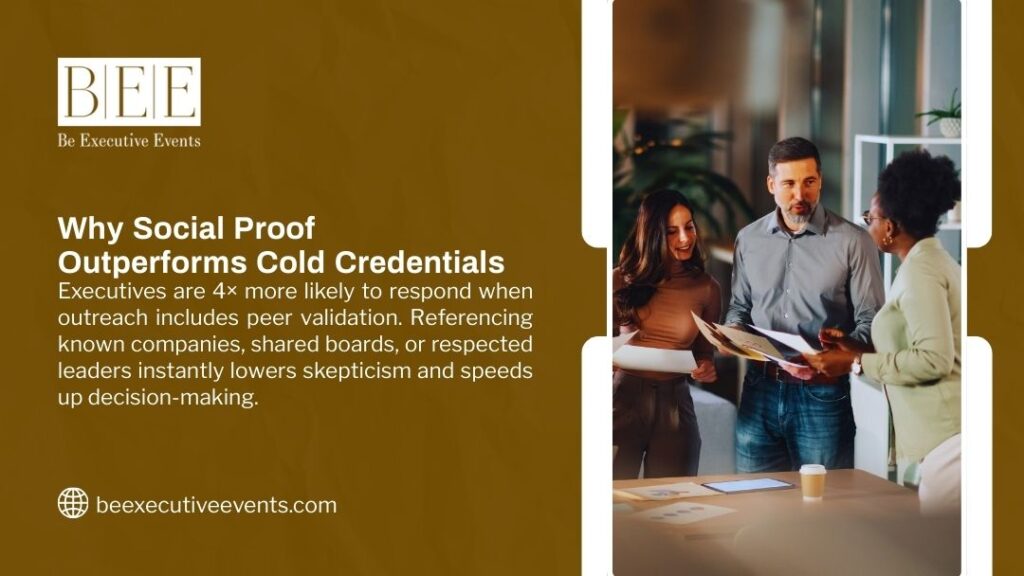
| Reference senior leaders you work with | Provides social proof and peer validation that builds immediate trust |
| Speak at industry events or publish thought leadership | Establishes you as a peer rather than a vendor |
| Participate in executive roundtables and forums | Creates face-to-face access that often outperforms cold outreach |
| Get featured in media or industry publications | Third-party validation elevates authority and credibility |
For additional strategies on reaching senior leaders, explore our guide on how to market to c-level executives effectively.
At the highest level, executive access comes down to curating prestige leadership conversations in a noisy world, when you’re associated with those conversations, meetings happen naturally.
Email and LinkedIn Templates You Can Use Today
Template 1: Value-First Email
Subject: [Specific data/insight relevant to their role]
[First Name],
[One sentence about relevant research/insight you have]. [One sentence about a specific finding that affects their business].
[Offer to share full data/research]. Would [specific day/time] work for a brief call?
Best, [Your name]
Template 2: Mutual Connection Introduction
Subject: Introduction from [Mutual Connection Name]
[First Name],
[Mutual connection] suggested I reach out. [One sentence about what you do]. [One sentence about specific values for their situation].
Would you be open to a 15-minute conversation about [specific topic]?
Best, [Your name]
Template 3: LinkedIn Follow-Up
Hi [First Name],
I sent you a note last week about [topic]. Since then, I came across [new relevant insight/data] that relates to [their company’s situation].
Would you be open to a brief call to discuss? I think you’d find the [research/data] useful for [specific business objective].
Common Mistakes That Kill Your Chances
| Mistake | Why It Fails | What to Do Instead |
| Generic mass outreach | Executives spot templates instantly | Personalize each message with specific research |
| Pitching products immediately | Signals you want to sell, not help | Lead with value or insights |
| Vague subject lines | Gets ignored or filtered | Be specific about the topic |
| Long, detailed emails | Executives won’t read paragraphs | Keep it to 4-6 sentences maximum |
| Single touchpoint | 98% of executives need multiple touches | Plan 5-7 touch sequence |
| Asking for “time to talk” | No clear value proposition | State specific topic and benefit |
The “just checking in” trap kills more potential meetings than any other mistake. Following up with no new information or value signals you have nothing important to say.
Focusing on your solution instead of their problem makes executives tune out immediately. They don’t care about your features. They care about outcomes for their business.
Giving up after one or two attempts means you miss the 80% of opportunities that require 5+ touches to convert. Persistence with value wins at the executive level.
Turn Executive Access Into Strategic Relationships
Getting that first meeting represents just the beginning. The real value comes from converting initial conversations into strategic relationships that generate opportunities over time.
After successful first meetings, focus on continued value delivery rather than immediate transactions. Share relevant insights when you find them. Make introductions to people in your network. Become a resource executives appreciate rather than a vendor they avoid.
Track your outreach systematically to understand what works. Measure response rates by message type, timing, channel, and offer. Double down on approaches that generate results and eliminate tactics that waste time.
Build relationships before you need them. The best time to reach out to executives is before you have an urgent need. Regular value contribution creates relationship capital you can draw on when opportunities arise.
Partner with Experts in Executive Access
Be Executive Events specializes in creating environments where senior leaders connect for strategic discussions. Our executive roundtables and curated gatherings bring together carefully selected C-suite leaders for focused conversations on critical business topics.
We handle all aspects from participant recruitment and topic development to expert moderation and post-event follow-up. This approach ensures executives extract maximum value from their time investment while creating natural opportunities for relationship development.
Our events attract CFOs, CEOs, and other senior decision-makers from global enterprises, technology firms, and consultancies. Participation provides access to executive networks that traditional outreach methods can never replicate.Contact us today to learn how executive event participation can accelerate your access to senior decision-makers and create relationships that drive business results.
Frequently Asked Questions (FAQ) About How to Get Meetings with Executives
How many touchpoints does it take to get a meeting with an executive?
Most successful executive outreach requires 5-7 touches over 6-8 weeks. Research shows 80% of executive meetings happen after at least 5 attempts. The key is adding value with each touch rather than just “checking in” repeatedly.
What’s the best time of year to reach executives?
Mid-quarter periods work best, particularly February, May, August, and November. Avoid month-end, quarter-end, and year-end periods when executives focus on internal reviews and board meetings. January and September also tend to be busy with planning cycles.
Should I use cold outreach or focus on referrals?
Warm referrals convert 10-15x better than cold outreach, so always start with your network. But a more balanced approach uses referrals when possible while building systematic cold outreach for executives outside your current network.
What’s the best day and time to email executives?
Tuesday through Thursday mornings between 8-10 AM in their local timezone generate the highest response rates. These times catch executives before their calendars fill with meetings. Avoid Mondays (too chaotic) and Fridays (weekend mode).