
If you run demand generation for a SaaS or enterprise technology business, the enterprise IT account is where the pipeline model breaks. The mid-market motion works: content, nurture, an SDR sequence, a demo. Point the same machine at the CIO of a 12,000-person insurer or the CTO of a payments platform, and nothing comes back. Not rejection. Silence.
That silence is not a subject-line problem. It is the predictable output of a role whose inbound volume, calendar structure, and screening layers are all built to make unsolicited contact fail. Reaching CIOs and CTOs requires different assumptions about what you are asking for, who else is involved, and how long it takes.
What follows is the operational view: how these roles differ, which channels realistically produce contact, how to work with gatekeepers rather than around them, and why peer-format events change the nature of the ask.
Why CIOs and CTOs Are the Hardest Audience in B2B
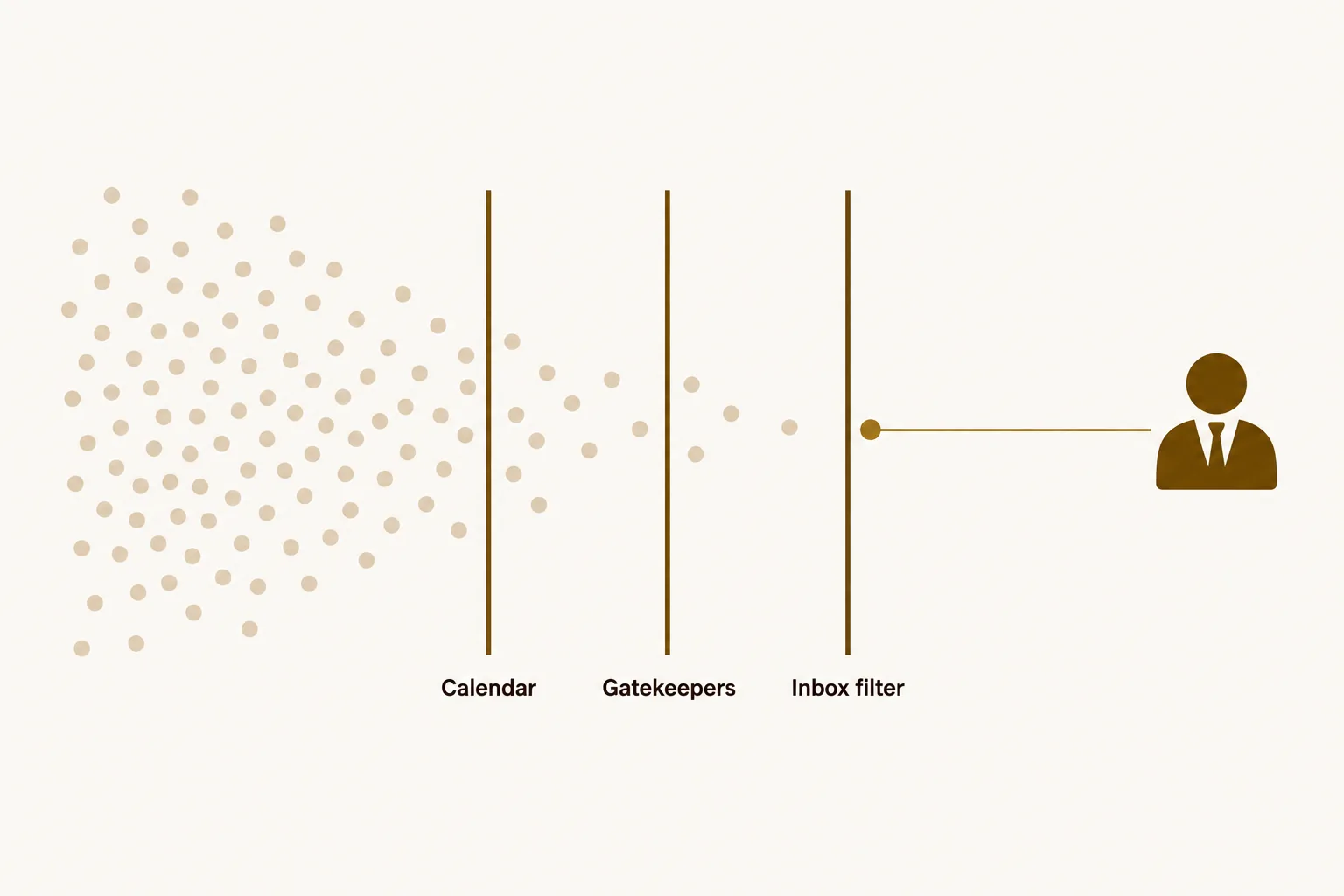
Enterprise IT leaders sit at the convergence point of nearly every vendor category in the market. Cloud, AI, cybersecurity, data platforms, ERP, observability, low-code, procurement tooling: all of it routes to the same two or three inboxes. A CIO is not ignoring you specifically. They are applying a filter to a category that has consistently produced low-value contact.
Three structural realities shape this.
Their calendar belongs to the business, not to vendors. Board reporting cycles, annual budget planning, audit and regulatory deadlines, and incident response take precedence. An open slot in a CIO’s week is not an invitation. It is the gap where a critical escalation will land.
Gatekeeping is designed, not personal. Executive assistants, chiefs of staff, procurement, and formal vendor-management functions exist to triage inbound. Being screened is the system working as intended. Treating the screener as an obstacle is the most common and most expensive mistake in the whole motion.
Generic outreach is filtered before a human evaluates it. Templated personalization, category-level claims, and vague meeting requests get pattern-matched and discarded. The bar is not “is this well written.” The bar is “does this reference something real about my organization right now.”
Related reading7 Insights on Why Executives Ignore Most Sales OutreachRead the guide →CIO vs CTO: Know Who You Are Actually Writing To
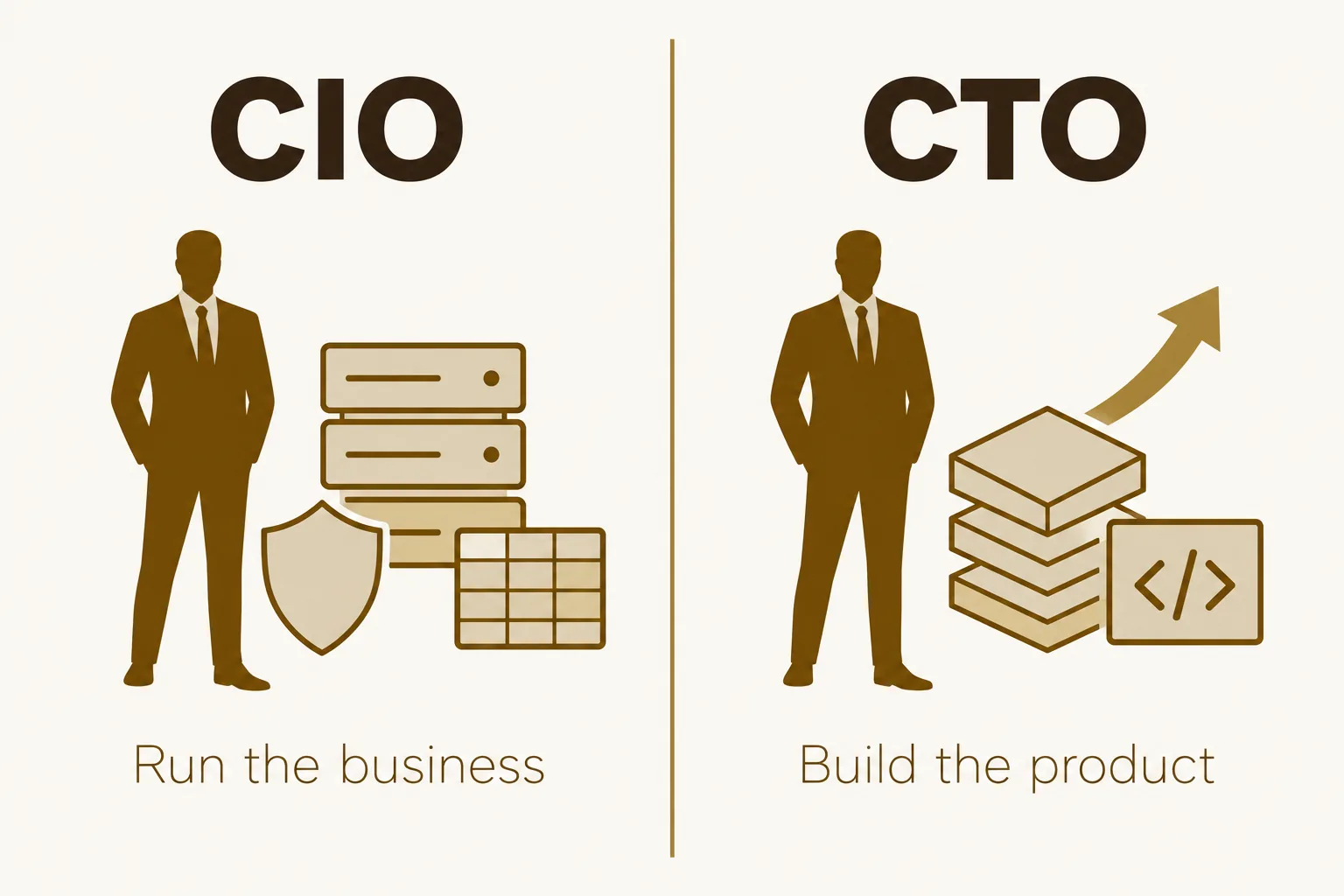
Almost every failed campaign to enterprise IT starts here, with a message written to a role the recipient does not hold.
CTO stands for Chief Technology Officer. CIO stands for Chief Information Officer. The distinction is not cosmetic. In most organizations, CIOs focus on internal systems and IT infrastructure that support operations, while CTOs are externally focused on products and services for customers.
In practice:
| CIO | CTO | |
|---|---|---|
| Owns | Run-the-business technology: enterprise systems, IT operations, service delivery, security posture, employee productivity, IT spend, technology staffing | Build-the-product technology: architecture, engineering, R&D, platform scalability, the technology the company sells |
| Pressures | Cost transparency, technical debt, resilience, compliance, a flat budget | Release velocity, engineering capacity, platform reliability, technical differentiation |
Is a CIO higher than a CTO? Neither title outranks the other by definition. Seniority follows organizational design and, more reliably, budget. In a software or digital-native company, the CTO usually carries the larger mandate because technology is the product.
In a bank, insurer, hospital group, or manufacturer, the CIO typically controls the larger budget and broader remit, because technology is the operating backbone.
Can a CIO report to a CTO? Yes, and the reverse is also common. Both configurations occur, depending on whether the organization treats technology as a product function or an operational one. Some enterprises have both reporting to a CEO. Others place one under the other, and a growing number layer a Chief Digital Officer or Chief AI Officer across both.
The consequence for outreach: a message about reducing IT run-cost and consolidating vendor sprawl is credible to a CIO and irrelevant to a CTO. A message about engineering throughput and platform architecture is the reverse. Sending the same email to both, on the same day, from the same sequence, signals you have not done the work.
While you map, map the adjacent titles too: CDO, CAIO, CISO, VP Infrastructure, VP Engineering, Head of Digital Transformation. That is often where the conversation actually starts.
Map the Buying Committee Before the First Touch
Enterprise technology decisions rarely rest with one person, and the signer is rarely the initiator. The broader mechanics of this are covered in reaching decision makers in B2B; this section applies that specifically to enterprise IT.
As Forrester VP and Principal Analyst Kerry Cunningham explains, enterprise purchasing has long been a group decision rather than an individual one:
“Buyers are nearly always groups, not individuals, this has been true for as long as there has been a B2B marketplace.”
Before the first touch, resolve four questions.
1. Whose budget does this touch? Run-the-business spend points to the CIO organization. Product and engineering spend points to the CTO organization. Because the split follows BMC’s distinction between internal IT ownership and customer-facing product ownership, the budget answer usually decides the entry point. 2. Who initiates versus who approves? The initiator is often a VP or Director who owns the pain daily. The approver is the CxO. Writing only to the CxO skips the person most motivated to help you. 3. What is actually happening in the account? Recent transformation announcements, cloud migration stage, a new regulatory obligation, a merger, visible hiring patterns in the technology function. These are the credible reasons to write. 4. Where are they? Regional norms matter. In DACH, decision-making tends to be more consensus-driven and formal, and unsolicited directness lands poorly. NAMER tolerates more direct outreach. UKI and BENELUX sit between the two, with UKI closer to NAMER in tone and BENELUX closer to DACH in process.
The Channels That Actually Reach Enterprise IT Leaders
No single channel works. There is a portfolio, and each channel does a different job.
Email: Still Viable, but Only With a Real Reason to Write
Email is not dead for this audience. Undifferentiated email is.
- Reference a business condition in the subject line, not a product category. “IT spend benchmarking for insurers post-DORA” outperforms “Transform your IT operations.”
- Write for a phone screen between meetings. Four sentences. One ask. No attachments on first contact.
- Anchor to a specific, verifiable trigger: a published strategy document, a migration milestone, a regulatory deadline, a leadership change.
- Source and send compliantly. For contacts in the UK, DACH, and BENELUX, B2B outreach commonly relies on legitimate interest as the lawful basis: Article 6(1)(f) of the GDPR permits processing personal data without prior consent where it is necessary for legitimate business purposes. That basis carries obligations: identify yourself clearly, explain how you obtained the contact data, keep the message relevant to the recipient’s professional role, and provide a working opt-out. Use trusted B2B data providers rather than scraped lists.
- Pace the sequence to an executive calendar. Touches spaced across weeks, not daily follow-ups. Four well-spaced touches beat twelve compressed ones.
LinkedIn and Executive Social Channels
LinkedIn works for this audience as a recognition channel, not a delivery channel.
Engage with what they publish before requesting a connection. A substantive comment on a CIO’s post about AI governance does more than any connection note. Send connection requests without a pitch attached: acceptance is the objective at that stage, not conversion.
Assume a screener sees the message. Write something a screener can justify forwarding: clear identity, clear relevance, clear time ask.
The strongest passive channel is content a CIO or CTO would forward internally. Benchmarking data, peer perspectives on a shared constraint, or a clear framing of a problem they are already defending in a board deck.
Peer Referral and Warm Introduction
Executives extend trust to peers on a different curve than they extend it to vendors. A CIO will take a 20-minute call because another CIO suggested it, in circumstances where 40 emails produced nothing. Our guide on how to get meetings with executives covers the mechanics of turning that kind of warm path into an actual booked meeting.
The underused paths: current customers in the same vertical, advisory board members, industry analysts, former colleagues who have moved into the account, and previous attendees from your own events.
Make the referral ask specific and forwardable. Give the referrer two sentences they can paste, naming the topic and the exact time commitment. A vague “could you introduce me” puts the work on them and usually stalls.
Executive Events: Peer Context Instead of Vendor Context
This is the channel that changes the shape of the ask. We cover why peer format works where vendor format fails in curating prestige leadership conversations in a noisy world.
A demo request asks an executive to spend time evaluating you. An invitation to a curated peer discussion offers something a vendor call cannot: benchmarking against people in the same seat, facing the same regulatory and budget pressure.
That distinction matters because enterprise purchasing rarely depends on winning over one individual. As Forrester VP and Principal Analyst Kerry Cunningham puts it:
“It was never about leads; it has always been about the group of individuals, the buying group, that makes the purchasing decision.”
The value proposition is peer access, and the vendor relationship follows from the room rather than preceding it.
The formats that work with this tier:
- Virtual executive roundtables and webinars. No travel objection, wider regional reach, and the lowest-friction first yes for both you and the invitee. A well-produced branded virtual event can convene CIOs across UKI, DACH, and NAMER in the same 60 minutes.
- Executive dinners and small-format roundtables. Working range of 6 to 26 CxOs. Small enough for genuine dialogue, large enough for meaningful executive networking. Our dinner marketing for enterprise sales playbook covers how to run this format specifically for a sales-driven outcome.
- Executive summits. Larger, multi-sponsor, and better suited to a later stage, once you have credibility with the audience. We break down the trade-off in full in intimate events vs. conferences for B2B.
Two mechanics make or break attendance. First, invitation-only and pre-approved attendance: the executive should know the profile of who else will be in the room before accepting, because peer credibility is the entire reason they are considering it. Second, audience curation against a defined target profile rather than a bought list.
That is the work behind BEE’s proprietary CxO network of direct relationships with CIOs, CTOs, and enterprise IT leaders, where attendees are sourced from established relationships and pre-approved against the client’s target accounts rather than assembled to fill seats.
Working With Gatekeepers Instead of Around Them
The executive assistant is a router, not a wall. They are measured on protecting their principal’s time and on not missing what matters. Give them what they need to route you correctly:
1. Who you are and who you represent, stated plainly. 2. Why it is relevant to their principal now, tied to something specific about the organization. 3. Exactly how much time you are asking for, and what the executive gets in return.
Never misrepresent a prior relationship, imply a referral you do not have, or claim a conversation that did not happen. Assistants verify, and that error closes the account, not just the opportunity.
For CIO-owned budgets, procurement and vendor management often run a parallel path with its own criteria and timelines. Engaging that path early is slower but more durable than avoiding it.
Above all, multi-thread. A VP of Infrastructure or a Director of Digital Transformation who believes in the value can carry the conversation upward with credibility you will never have from outside.
Messaging That Earns a CIO or CTO Reply
Lead with the problem in their language. IT spend transparency, technical debt, regulatory exposure, cloud cost management, talent constraints, AI governance. Not your product category.
Quantify the ask. “20 minutes on Thursday or Friday” is a decision. “A quick chat” is a task they have to define, so it gets deferred.
Strip feature language from first contact entirely. No capability lists, no platform architecture, no differentiators. Those belong to a later conversation with a different audience.
Use profile proof rather than a logo wall. A line naming the peer set (“European insurers of comparable scale working through the same DORA reporting question”) carries more weight with a peer-oriented executive than a slide of customer logos.
Give before you ask. A benchmark they cannot easily produce internally, a seat at a peer discussion, or genuine influence over the agenda of a roundtable they are invited to. Executive engagement that starts with a gift of value is the kind that survives the screening layer.
Best Practices for Inviting Senior Executives to Events and Peer Groups
An invitation to a senior executive is a different document from a marketing registration page. It is a commitment request against a scarce calendar, and it should read like one.
- Name the room. Named attendees where you have permission, or precise profiles where you do not (“CIOs and CTOs from European retail banks”). An unspecified audience is the fastest route to a decline.
- Define the topic narrowly. “AI governance” is a category. “Who signs off on model risk when the model sits in a vendor’s platform” is a discussion an executive will clear time for.
- State a hard end time and honor it. Executives commit to bounded events. Open-ended agendas get declined.
- Keep the group small. Six to 26 participants is the working range for an executive roundtable where everyone can speak. Beyond that, the format becomes an audience and CxO attendance falls.
- Give the executive a role. Opening perspective, discussion lead, or a specific question they want the group to address. A participant with a role is far likelier to show up.
- Respect lead time. Senior calendars need weeks of notice, not days. Last-minute invitations read as backfill, because they usually are.
- Run a real confirmation cadence. Confirmation on acceptance, a reminder at a sensible interval, agenda and attendee profiles ahead of the date, and a named human contact for reschedules. Executive attendance is fragile and needs active management up to the day.
- Pre-approve the attendee list against the target profile. This protects the executive’s time and the host’s credibility at once. It is the practice that separates a genuine business executive networking group from a filled room.
Timing: When Executive Outreach Actually Lands
Executive engagement follows an annual rhythm. Outreach timed against your internal quarter pressure rather than that rhythm consistently underperforms.
- Second half of February through July. Fresh budgets are set and allocated, and engagement spend is available. Strong window for in-person and virtual formats alike, with the summer slowdown creating a natural deadline.
- September through early December. The densest period for executive events, particularly in Europe, driven by the post-summer return and the push to close annual targets. Major industry events in this window also generate demand for side events and executive activations. Book venues and issue invitations early.
- August. Extended holiday periods across Europe make in-person executive attendance impractical. Virtual formats continue at a reduced pace. Use the month for planning and audience research, not delivery.
- Late December through early January. Year-end closures and holidays. Planning season, not delivery season.
Regional nuance matters beyond core markets: Ramadan and Eid affect scheduling in the Middle East, and Lunar New Year affects APAC.
Measuring Whether Your Outreach Is Working
Aggregate open rates tell you nothing about whether you are reaching CIOs and CTOs. Measure at title level.
- Reply and meeting rate by seniority and function, not blended across the list. Ten replies from IT managers are a different outcome from one reply from a CIO, and your dashboard should say so.
- Attendance quality: the share of confirmed attendees matching the agreed target profile. For an invitation-only format, this is the primary quality metric.
- Show rate versus registration rate. Executive registrations that do not convert to attendance indicate a confirmation cadence problem, not a targeting problem.
- Second-conversation conversion after the event. Whether peer context translated into a bilateral discussion is the real test of the format.
- Multi-touch attribution across email, LinkedIn, referral, and event. These channels compound. Last-touch attribution will credit the event and hide the nine months of groundwork that made the acceptance possible.
Be honest about what this produces. Well-run executive engagement creates the conditions for pipeline, trust, and opportunity. It does not guarantee deals, and a measurement framework that promises otherwise will erode credibility internally the first time a quarter closes short. For how this fits into the rest of the funnel, see our C-level lead generation strategies guide.
Common Mistakes That Close the Door Permanently
| Mistake | Why It Closes the Door |
|---|---|
| Treating a CIO like a CTO, or the reverse | The most common disqualifier, and immediately visible to the recipient |
| Personalization that is visibly automated | A merge field in the wrong place is worse than no personalization |
| Pitching inside the invitation | The moment a peer roundtable invitation reads as a sales asset, the peer premise collapses |
| Overfilling the room with junior attendees | An executive who arrives to a room of managers won’t accept a second invitation, and will mention it to peers |
| Non-compliant data sourcing in GDPR jurisdictions | Beyond regulatory exposure, it damages the trust the entire motion depends on |
| Following up faster than an executive calendar moves | Three follow-ups in a week signal you don’t understand the audience |
Frequently asked questions
Is a CIO higher than a CTO?
What does CTO stand for?
Can a CIO report to a CTO?
What is the difference between a CIO and a CTO?
How long does it take to get a response from a CIO or CTO?
What group size works best for an executive roundtable?
Do virtual executive events reach senior decision makers as effectively as in-person ones?
Turning Reach Into Relationships
If you’re working enterprise IT accounts and the gap is real access to CIOs and CTOs, not just email volume, Be Executive Events runs on exactly the mechanism this article describes: peer context instead of vendor context.
Our proprietary CxO network gives us direct relationships with CIOs, CTOs, and enterprise IT leaders, sourced from established relationships and pre-approved against your target accounts rather than assembled to fill seats.
Here’s what a program with Be Executive Events gets you:
- A pre-approved guest list of six to 26 senior IT decision makers, screened against your actual target accounts
- A narrowly defined topic and an independent moderator, so the room stays peer-to-peer instead of turning into a pitch
- Reach across UKI, DACH, and NAMER through a virtual roundtable, then relationship depth through an in-person dinner where it matters most
- Timing built around real budget cycles, not whichever week a venue happened to be free
- A confirmation cadence that protects the show rate: reminders, agenda, and attendee profiles ahead of the date, with a named contact for reschedules
Talk to Be Executive Events about the accounts you’re trying to open and what a curated audience for them would realistically look like.