
Most professionals walk into their first conversation with a senior leader and freeze. Not because they lack knowledge, but because they are unsure how to start, what to say, and how to make limited executive time count.
This guide is focused on exactly how to build rapport with executives in a way that feels natural, earns trust, and keeps doors open.
Written from Be Executive Events’ 10+ years of direct experience with senior leaders across global enterprises, SaaS firms, and consultancies, here is what you will find inside:
- What executives respond to in the first few minutes of a conversation
- How to open strong and stay credible throughout
- The communication habits that signal preparation and trustworthiness
- How to maintain executive relationships beyond a single exchange
- The mistakes that destroy rapport before it even starts
How to Build Rapport With Executives Without Sounding Rehearsed
Rapport with senior leaders is not about charm or confidence. It is about preparation, clarity, and relevance.
According to Flowtrace’s State of Meetings Report, executives spend 19 or more hours per week in meetings, and 67% of those meetings are considered failures by the executives themselves.
That context matters when you get time with a senior leader. They already carry the weight of a day full of low-value exchanges.
| What Not to Do | What to Do Instead |
| Start with a long personal story | Open with context and a clear reason for the conversation |
| Ask broad, generic questions | Ask about current priorities or a specific challenge |
| Flood them with detail before they ask | Lead with the main point, offer depth only if requested |
| Mirror a casual social tone | Match their professional register first |
Before you enter the room, executive networking as a strategic discipline helps you map the right relationships, research the right leaders, and arrive with real context rather than a general idea of who you are about to meet.
What Executives Usually Care About First
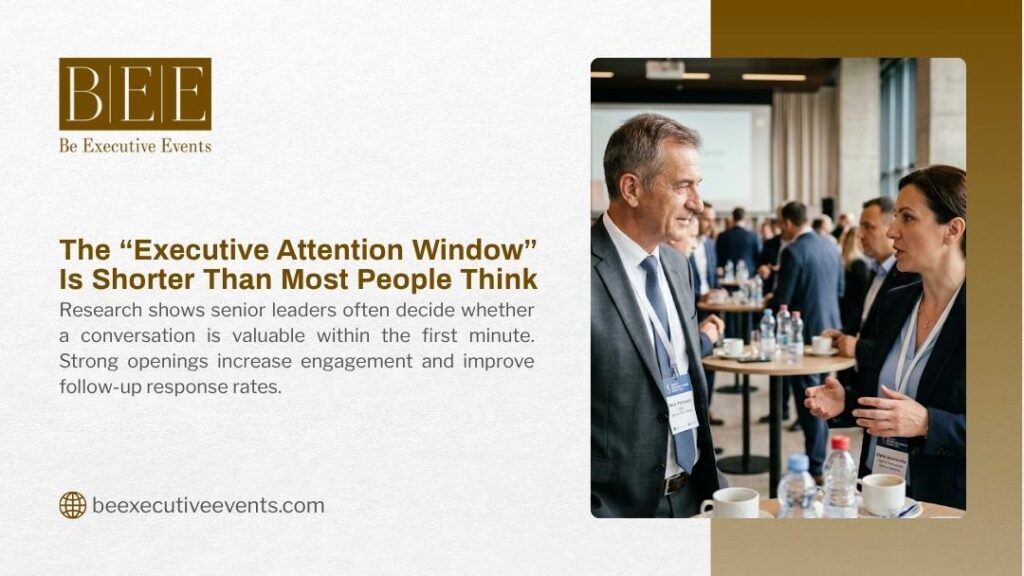
Senior leaders scan for relevance fast. Within the first 60 seconds of a conversation, they are already deciding whether to engage fully or move on mentally.
Their attention typically centers around four areas:
- Business outcomes and measurable results
- Risks or problems that need resolution
- A clear ask or specific recommendation
- Evidence that you prepared for this conversation
A frame that works consistently across industries: “Here is the business issue, here is the impact, and here is what I need from you.” Three parts. Clear and fast.
| Executive Priority | What They Want to Hear | What to Avoid |
| Outcomes | How this connects to a measurable result | Activity updates without business context |
| Risk | What could go wrong and why it matters now | Minimized or vague concerns |
| Clarity | A specific recommendation or question | Long explanations without direction |
| Relevance | That you understand their business context | Generic or scripted talking points |
This is supported by Deloitte’s 2025 Global Boardroom survey of 739 C-suite executives across 50+ countries, where 66% identified open, transparent communication as the single most critical leadership factor for organizations to thrive.
Conciseness Helps You Build Rapport With Executives Faster Than Trying to Impress
Respect for an executive’s time is a form of respect for the person. That connection matters more than most professionals expect.
Axios HQ’s 2025 research found that poor communication costs organizations $54,860 per year for every senior employee who earns over $200,000. Unclear, overlong communication is not just frustrating to senior leaders. It carries a real financial cost.
The most trusted voices in any executive room are the ones that say more with fewer words.
| Vague, Long Version | Concise, Executive-Ready Version |
| “I wanted to touch base and share some thoughts on the project when you have a moment” | “The project is two weeks behind. Here is my recommendation.” |
| “We were hoping to explore some potential areas of alignment” | “I see a direct overlap between your Q3 goal and what we can offer.” |
One rewritten sentence is the difference between holding attention and losing it.
The Fastest Ways to Build Rapport With Executives in the First Conversation
If you only have five minutes with a senior leader, how you use that time shapes the entire relationship that follows.
The priority is to move from social to purposeful as fast as professionally possible, with direction but without being abrupt.
| Time Block | Focus | Sample Behavior |
| First 60 seconds | Purpose and context | “I wanted to ask about X because Y is a current priority for us” |
| Next 2 minutes | One relevant question, active attention | Ask about their priorities, not their professional history |
| Final 2 minutes | A clear takeaway or next step | Propose a specific follow-up, not just a thank you |
The most common error is spending the first two minutes on warm-up and then rushing the actual point. Executives remember conversations that had direction. They forget the ones that were pleasant but empty.
How to Build Rapport With Executives in the First 60 Seconds
The best conversation openers are not clever. They are specific and relevant to the person in front of you.
Avoid openers that require the executive to explain context you could have researched in advance. Come prepared with something real to say.
| Setting | Sample Opener |
| Conference or event | “I read your comments on [specific topic]. I wanted to ask what you see as the biggest risk for next year.” |
| One-on-one meeting | “I know your time is limited. My main goal today is to get your input on [specific issue].” |
| Email follow-up | “After our conversation at [event], there was one point I wanted to come back to.” |
How to get meetings with executives is one skill. What to do once you are in that meeting is a completely separate one, and most professionals only focus on the first part.
How to Ask Questions Executives Actually Want to Answer
Generic questions get generic answers. Executives respond to questions that signal you already understand their environment.
| Question Type | Why It Works | When to Use It |
| Priority-based | “What is your main focus this quarter?” | At the start of the conversation |
| Challenge-based | “Where are you seeing the most friction right now?” | When they seem open to direct discussion |
| Outcome-based | “What does success look like for this in six months?” | When a specific project is on the table |
| Insight-based | “What are you seeing in the market that others are missing?” | To invite real perspective, not just information |
Each of these questions shows respect for the executive as a thinker. That distinction separates a productive conversation from a forgettable one.
How to Speak in a Way Executives Trust
Credibility in an executive conversation is not about vocabulary or confidence. It is about whether what you say connects to outcomes that matter to the business.
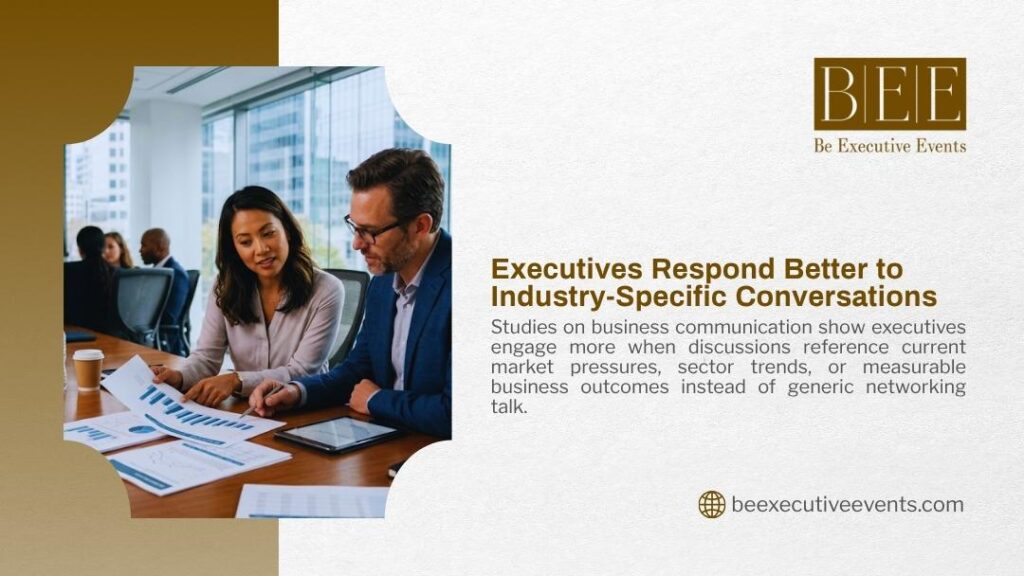
Executives do not think about tasks. They think in goals, timelines, risks, and measurable results. Part of how to build rapport with executives at the senior level is learning to speak that language naturally, not to perform it.
The Simpplr State of Internal Communications (2026) found that 89% of executives say communication should be measured in business terms like productivity or revenue.
That mindset extends to every conversation they have, not just formal presentations.
How to Translate Work Into Outcomes
The simplest way to connect your message to executive priorities is to use this three-part frame:
- What happened
- Why it matters to the business
- What comes next
| Raw Statement | Executive-Ready Version | Why It Works |
| “We finished the audit last week” | “The audit is complete. It found a gap that could affect Q4 revenue. Here is the fix.” | Connects a task to a business impact and a clear path forward |
| “The campaign is live” | “The campaign launched Monday. Early results are 20% above the expected rate.” | Leads with outcome, not activity |
In my experience, this three-part structure is the fastest way for any professional, at any level, to earn serious attention in a senior conversation.
How to Avoid Overexplaining
Overexplaining signals uncertainty. In an executive conversation, that costs trust fast.
A simple edit test: if you can remove a sentence without losing the main point, remove it.
Before: “I wanted to reach out because I have been thinking about the project and there are a few things that might be worth addressing when you have a moment.”
After: “I have three questions about the project. Are you free for 15 minutes this week?”
The second version is easier to act on. That is what earns a response from a senior leader.
How to Build Rapport With Executives Over Time
One good conversation is a starting point. It is not rapport.
The 2026 Edelman Trust Barometer found that trust within close professional circles, specifically coworkers and the CEO (+9 points), grew significantly while trust in broader institutions dropped.
Executives extend trust to people who are consistently present and reliable, not to those who made one strong impression and then went quiet.
The real work of how to build rapport with executives is done in the days, weeks, and months after the first conversation ends.
What Consistency Looks Like in Practice
Consistency is not contact for its own sake. It is being visible in ways that add genuine value to the other person.
| Frequency | Behavior |
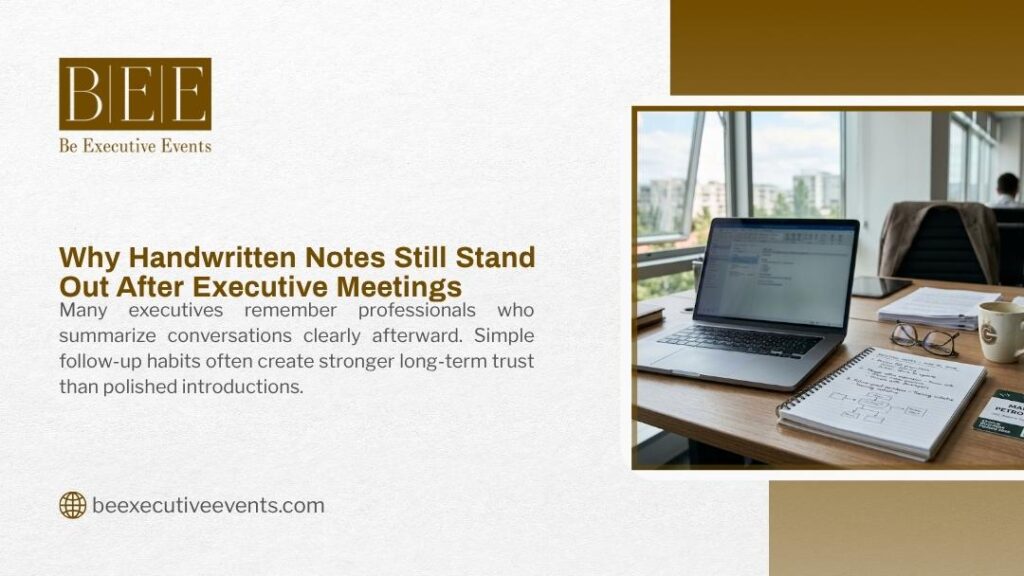
| After every meeting | Send a short, clear recap with next steps within 24 hours |
| Weekly or biweekly | Share a relevant data point or article with no reply required |
| After a result | Report back on what happened and what it produced |
| Before key events | Prepare one clear point you plan to raise in the conversation |
These are small habits. Over six months, they separate people who have a real relationship with a senior leader from those who had one good exchange and never built on it.
How to Build Trust Without Trying Too Hard
The discomfort some professionals feel about executive relationship-building often comes from a fear of appearing political or forced. That concern is understandable. But trust with senior leaders is not built through social performance.
It is built through reliability, usefulness, and honesty.
| Trust Builder | Trust Breaker |
| Delivering on every commitment you make | Silence after a strong first meeting |
| Asking sharp, specific questions | Asking questions only to appear engaged |
| Sharing relevant data or insight proactively | Sharing content that advances your own agenda |
| Admitting when you do not know something | Overclaiming or making vague promises |
In my experience at senior-level forums and executive roundtables, the professionals who earn lasting trust are the ones who do what they say they will do. It is that direct.
4 Common Mistakes That Kill Rapport With Executives
A conversation can feel friendly and still produce nothing of value. Every one of these mistakes gets in the way of the effort to build rapport with executives and can undo a strong first impression within seconds.
- Trying to Be Impressive Instead of Useful
The instinct to appear credible through credentials or polish is natural. But senior leaders are not moved by performance. They respond to relevance.
A Forbes Insights survey, cited by DigitalDefynd (2026), found that 85% of executives said peer advice directly influenced a business decision. What made those conversations valuable was not the other person’s title.
It was what they brought to the table.
| Weak Approach | Better Alternative |
| “I have 15 years of experience and have worked with companies like…” | “I noticed a specific pattern in your sector that may be relevant to what you are working on right now.” |
| “We offer a full range of solutions that could benefit your team” | “One thing that connects directly to your Q3 goal is…” |
Lead with insight. Let your track record come up later, if at all.
- Treating Every Executive Interaction Like a Networking Event
When every executive interaction feels like a pitch in disguise, it damages trust fast.
Bizzabo’s 2026 State of Events Benchmark Report found that only 15% of event organizers rate their networking as very effective, a sharp drop from the prior year. When interactions have no real intent behind them, the value leaves with the attendees.
| Internal Setting | Conference or Event Setting |
| Lead with a specific business question | Lead with a relevant observation or shared context |
| Reference their current priorities directly | Reference a session, talk, or event theme |
| Propose a concrete, named next step | Suggest a follow-up with a clear, specific purpose |
The best channels to reach C-suite executives are always the ones where the conversation has a genuine reason to exist, not where contact happens by accident or by default.
- Being Vague About What You Need
Executives make decisions. If every conversation ends without a clear ask or next step, nothing moves forward.
“Let’s stay in touch” is not a real next step, but more as a polite ending with no momentum behind it. A true close is specific and action-oriented, such as: “Can I send you a one-pager on Friday and schedule 20 minutes next week to walk through it?”
That level of clarity removes ambiguity, makes the next step easy to accept, and turns a casual conversation into a defined professional follow-up that actually moves the relationship forward.
- Generic Post-Conversation Follow-Up
After a high-value conversation, a generic message signals that the exchange meant nothing specific to you.
Weak: “Great to speak with you. Let me know if I can help with anything.”
Strong: “Good to speak with you about [specific topic]. Based on what you shared about [specific challenge], I thought this might be directly relevant to what you are working on.”
The reference to the real conversation is what earns a reply from a senior leader. Without it, your message looks like every other one in their inbox.
Frequently Asked Questions About How to Build Rapport With Executives
How do you start a conversation with an executive?
Open with context and a clear purpose. Avoid long warm-ups. Executives respond to people who know why they are there and get to the point without delay.
What do executives care about most in a conversation?
Business priorities, clarity, and preparation. They decide within the first 60 seconds whether the conversation is worth their full attention.
How do you build rapport with executives if you only have a few minutes?
Be direct, ask one relevant question, listen carefully, and close with a specific next step. Have a clear focus ready before the conversation begins.
Should you be formal or friendly with executives?
Professional first, warm second. Match their tone. Most senior leaders value directness combined with genuine respect far more than social ease.
What questions should you ask an executive?
Ask about current priorities, specific challenges, key goals, and what success looks like over a defined period. Stay away from generic background questions.
Turn Executive Conversations Into Real Business Relationships
Be Executive Events creates high-value formats where that kind of exchange happens by design.
With 250+ events delivered across Europe, North America, and Asia, and 10+ years of experience working with global enterprises, SaaS firms, and consultancies, BEE builds the environments where real executive relationships begin.
For teams that want to build rapport with executives without the friction of a cold approach, alternatives to cold outreach for executives often start with a well-structured executive event, where the right leaders are in the right room and the conversation has a genuine reason to happen.
Contact Be Executive Events today to explore how your next event can connect your team with the right people at the right level.