
Most sales advice focuses on personalization tricks and A/B testing. But executives filter messages based on strategic relevance, not clever opening lines. When your outreach lacks board-level signal, it gets deleted before anyone reads past the first sentence.
This article made from Be Executive Events’ 10+ years of expertise, breaks down why executives ignore sales outreach from a strategic positioning perspective.
You’ll learn how C-suite leaders actually filter information, what triggers their attention, and where most B2B outreach fails before it ever reaches a decision maker’s screen.
7 Common Reasons Why Executives Ignore Sales Outreach From You
The disconnect between your outreach and executive response rates isn’t random. Specific strategic gaps cause C-suite leaders to filter out vendor messages before ever engaging.
1. Your Message Lacks Strategic Signal
Executives operate at the business model level, not the feature level. When your outreach leads with product capabilities instead of business impact, it signals that you don’t understand their world.
A message about “improving workflow efficiency by 30%” means nothing to a CEO worried about market share erosion. They need solutions that address revenue growth, competitive positioning, or existential business risks.
Surface Benefits vs Strategic Impact
| Element | Tactical Message | Strategic Message |
| Opening focus | Product features | Business outcomes |
| Value frame | Team productivity | Market position |
| Time horizon | Quarterly gains | Multi-year trajectory |
| Risk discussion | Implementation ease | Enterprise risk reduction |
| Success metric | User adoption rate | Revenue impact or margin protection |
The language you use reveals your understanding level immediately. Terms like “streamline processes” or “boost team collaboration” signal mid-level concerns.
Executives respond to language around market expansion, regulatory compliance risk, competitive advantage, and shareholder value.
Research from Gartner shows that 80% of B2B purchase decisions are influenced by emotional factors, even in multi-million dollar deals.
But executive emotions center on career risk, board scrutiny, and business survival rather than department-level frustrations.
2. You’re Solving an Operational Problem, Not a Board-Level Risk
Department managers care about making their teams more productive. Executives care about whether the company will exist in five years.
The gap between operational pain and strategic risk explains why so much B2B outreach fails at the C-suite level. Your solution might genuinely help the marketing team work faster. If a deal stalls after the leadership conversation, our breakdown of procurement buyers versus C-suite buyers shows where the evaluation moves next.
But if it doesn’t connect to growth targets, margin pressure, or competitive threats, executives have no reason to engage.
Board-level priorities break down into specific categories, revenue expansion into new markets and cost structure optimization that affects overall margins.
Risk mitigation around compliance, security, or operational continuity. Strategic positioning against competitors who are moving faster.
Executives trust strategic insight over feature lists.
3. There’s No Trust or Social Proof Signal
Executives default to ignoring cold outreach from companies they’ve never heard of because the risk of wasting time outweighs the potential benefit.
Trust operates differently at the C-suite level.
Mid-level managers might take a demo call based on an interesting LinkedIn message, but executives need multiple credibility signals before they’ll invest 30 minutes in a discovery conversation.
Trust Signal Hierarchy:
| Trust Level | Signal Type | Executive Response |
| Very low | Cold email from unknown sender | Immediate delete |
| Low | Generic LinkedIn connection request | Ignore or decline |
| Medium | Referral from known contact | Possible response |
| High | Introduction from board member or peer CEO | Strong consideration |
| Very high | Invitation to curated executive roundtable | Active participation |
Peer validation carries exponentially more weight than any marketing claim. When another CEO vouches for your company, you inherit their credibility. When you show up as a sponsor at the same industry conference where they’re speaking, you gain legitimacy through association.
Only 32% of B2B buyers trust that salespeople fully understand their needs, according to Gartner’s research. This trust deficit means executives require proof before engaging.
You should also consider exploring alternatives to cold outreach, rather than relying solely on it. To help, here are the six best alternatives to cold outreach for executives we recommend.
4. You’re Asking for Time Without Context
Every meeting request competes against board preparation, investor calls, and crisis management.
Executives evaluate the opportunity cost of their time differently than other professionals do.
A 30-minute discovery call might seem reasonable to a sales rep but to a CEO, that same 30 minutes could be spent reviewing acquisition targets, preparing for earnings calls, or handling urgent customer escalations.
The bar for “worth my time” sits much higher.
Vague requests like “I’d love to show you what we’re working on” or “Can we grab 15 minutes to discuss your challenges?” fail because they don’t justify the time investment.
Executives need to know exactly what they’ll gain from the conversation and why it matters now rather than next quarter.
Context matters enormously. If you’re reaching out during their fiscal year-end, right before a major product launch, or when they’re dealing with a public relations crisis, your timing undermines your message regardless of how relevant your solution might be.
Research shows that decision-making time in B2B sales has increased by 60% compared to just a few years ago. Executives face more stakeholders, more approval layers, and more scrutiny on every significant decision.
5. Your Outreach Feels Mass-Produced (AI Saturation Effect)
Executives can spot automated outreach instantly.
Generic personalization like “I noticed your company just raised funding” or “Congrats on the recent hire” signals that you’re running a mass campaign rather than offering genuine strategic insight.
The rise of AI-powered sales tools has flooded executive inboxes with messages that look personalized but feel hollow.
When 50 different vendors all reference the same LinkedIn post or press release, the personalization becomes meaningless noise.
Surface Personalization vs Strategic Relevance:
| Approach | Surface Personalization | Strategic Relevance |
| Research depth | Scans recent LinkedIn activity | Understands business model and competitive position |
| Opening line | “Saw your post about AI” | References specific strategic initiative from earnings call |
| Value proposition | Generic capability statement | Addresses known board-level pressure or market threat |
| Call to action | Generic meeting request | Invitation to peer discussion on shared challenge |
| Follow-up pattern | 5+ identical template emails | Context-specific value in each touchpoint |
Pattern recognition works against generic outreach. When executives see the same opening structure, the same “quick question” subject lines, and the same three-email cadence from dozens of vendors, they develop filters that catch these patterns automatically.
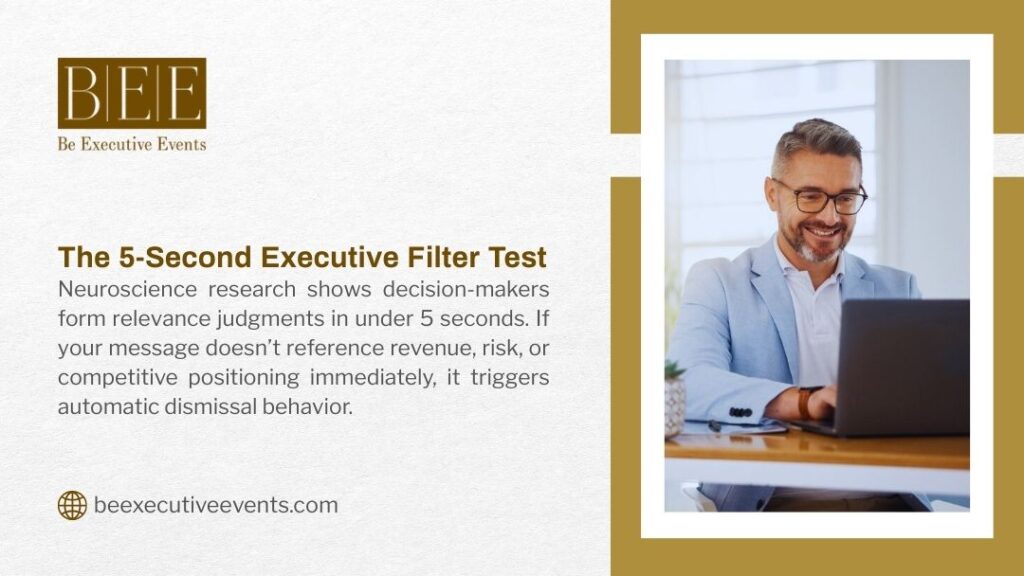
Average cold email response rates dropped to 1-5% in 2026, according to SalesCaptain. The decline reflects growing inbox fatigue and increasingly sophisticated filtering by recipients who receive more automated outreach than ever before.
Interestingly, C-level executives respond to cold emails 23% more often than non-C-suite employees but this higher response rate only applies to messages that clear their strategic relevance filter.
6. You’re Approaching the Wrong Channel
Cold email and LinkedIn messages rank among the least effective channels for reaching C-suite decision makers.
The best channels to reach c-level executives usually differ from what the majority of outreach strategies target.
Industry events create direct access without gatekeepers. Teams selling into IT leadership can find channel-by-channel tactics in our playbook for engaging technology executives.
When an executive attends a conference or roundtable, they expect substantive business conversations. The context pre-qualifies both parties and removes the cold outreach stigma entirely.
Peer introductions bypass trust barriers immediately.
A warm introduction from another CEO, a board member, or an industry advisor transfers credibility in ways that months of cold outreach cannot match.
According to recent research, 73% of B2B marketing executives rank peer recommendations as the most influential factor when considering vendors.
Thought leadership builds visibility before any direct outreach.
Executives consume industry analysis, competitive intelligence, and strategic frameworks through publications, podcasts, and speaking events. When they recognize your company as a credible voice in their space, subsequent outreach feels natural rather than intrusive.
Be Executive Events has spent years creating high-value environments where C-level decision makers connect with potential partners before formal buying processes begin.
Our curated programs bring together CEOs, CFOs, and CTOs for focused discussions on strategic challenges they actually care about.
7. You’re Targeting the Executive Too Early in the Buying Process
Most enterprise purchases don’t start with executive involvement. Department leaders identify problems, evaluate solutions, and build internal consensus before any C-suite leader weighs in.
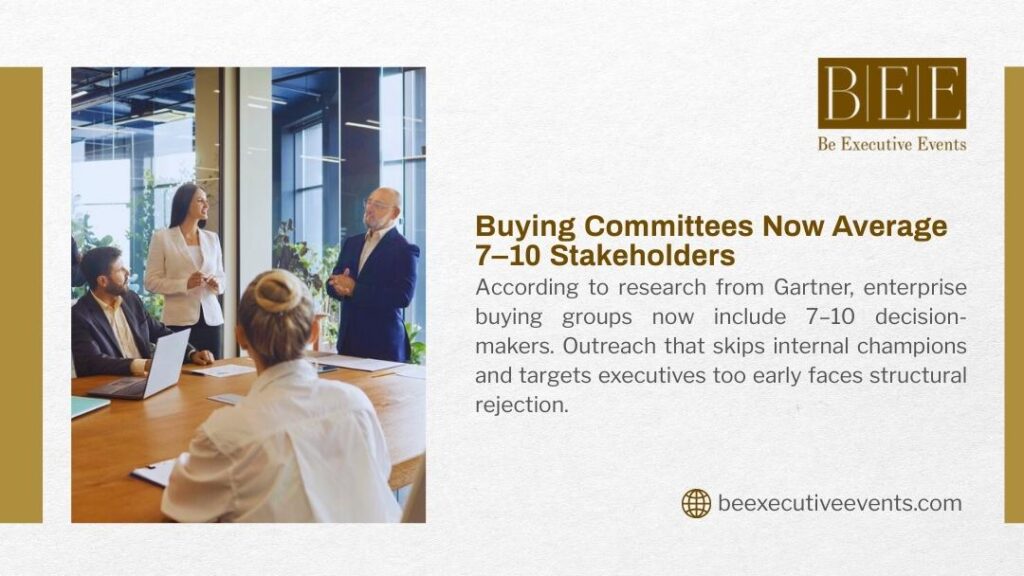
Buying committees typically include 6–10 stakeholders across different functions. With technical teams evaluating architecture and security, finance reviewing budget impact and ROI models, and operations assessing implementation risk.
Only after these groups build consensus does the executive sponsor get involved for final approval.
When you bypass this process and pitch directly to the CEO, you create friction rather than progress.
The executive will redirect you to their team anyway, but now you’ve burned credibility by demonstrating you don’t understand how their organization actually makes decisions.
Strategic timing matters more than persistence.
Reaching out to a B2B executive before their team has identified the problem and explored solutions, wastes everyone’s time. But engaging at the right moment when they need executive-level strategic guidance can accelerate deals significantly.
This self-directed buying process means executives often only engage during final stages when strategic alignment, partnership terms, or major implementation concerns need resolution.
Understanding where you fit in their buying timeline prevents wasted outreach to executives who aren’t ready for your message yet.
Manager vs Executive Messaging: A Side-by-Side Breakdown
The messaging that works for department managers fails completely with executives. The difference isn’t just seniority level. It’s about fundamentally different priorities, decision-making authority, and strategic perspectives.
A marketing manager cares about campaign performance metrics and team productivity. The CMO cares about market share, brand positioning, and revenue attribution. Your message needs to match the level you’re targeting.
Messaging Framework Comparison:
| Message Element | Manager-Level Version | Executive-Level Version |
| Opening statement | “Your marketing team probably struggles with…” | “Based on your Q3 earnings discussion about customer acquisition costs…” |
| Problem definition | Tactical pain point | Strategic business challenge |
| Solution framing | Feature capabilities | Business outcome impact |
| Success metrics | Activity or efficiency gains | Revenue, margin, or market position |
| Time horizon | This quarter | 12-24 month strategic impact |
| Risk discussion | Implementation ease | Enterprise risk mitigation |
| Social proof | Customer testimonials | Peer CEO references or board advisor endorsements |
| Call to action | Product demo | Strategic discussion or executive roundtable |
Consider two outreach messages for the same company. The first targets the Director of Sales Operations. The second targets the Chief Revenue Officer.
Manager version:
“I noticed your team posted about hiring new SDRs. We help sales operations leaders give their teams better lead qualification tools so they can focus on high-value prospects instead of unqualified leads. Could we show you how it works?”
Executive version:
“Your Q3 call mentioned pressure on customer acquisition costs while scaling into enterprise accounts. We’ve worked with three companies in your space facing similar unit economics challenges. The common pattern we’ve seen involves sales capacity allocation rather than volume. Would a conversation about how others approached this be useful?”
Diagnostic Checklist: Why Your Executive Outreach Is Being Ignored
Most sales teams guess at why their executive outreach fails. This diagnostic framework helps you identify specific gaps in your approach.
Strategic Positioning Assessment:
| Question | Yes | No |
| Does your message address board-level business risk rather than operational efficiency? | ☐ | ☐ |
| Can you articulate how your solution affects revenue, margin, or market position? | ☐ | ☐ |
| Have you researched their earnings calls, analyst coverage, or strategic initiatives? | ☐ | ☐ |
| Does your positioning connect to known competitive pressures in their industry? | ☐ | ☐ |
| Are you approaching through channels where executives actually engage? | ☐ | ☐ |
Credibility Signal Check:
| Question | Yes | No |
| Do you have peer CEO references or board advisor endorsements? | ☐ | ☐ |
| Can executives find evidence of your strategic expertise independently? | ☐ | ☐ |
| Have you built visibility through thought leadership or speaking? | ☐ | ☐ |
| Do you have recognizable customers in their industry or segment? | ☐ | ☐ |
| Is your ask proportional to your credibility level with this executive? | ☐ | ☐ |
Timing and Context Evaluation:
| Question | Yes | No |
| Have you verified this executive has buying authority for your solution category? | ☐ | ☐ |
| Is your outreach timed to their business cycle rather than your quota period? | ☐ | ☐ |
| Do you understand which stakeholders they rely on for initial vendor evaluation? | ☐ | ☐ |
| Have you identified the strategic trigger that would make your solution priority? | ☐ | ☐ |
| Are you offering strategic insight rather than just requesting their time? | ☐ | ☐ |
If you answered “no” to more than half these questions, your outreach lacks the strategic positioning and credibility signals executives require before engaging.
The solution isn’t better email templates. It’s a fundamental repositioning of how you approach executive relationships.
Focus first on building credibility through thought leadership, peer relationships, and strategic visibility. Then layer in targeted outreach to executives who face specific business challenges your solution addresses.
This sequencing matters more than message optimization.
Frequently Asked Questions On Why Executives Ignore Sales Outreach
Why don’t executives respond to cold emails?
Executives read cold emails based on strategic relevance and trust signals rather than message quality. Most outreach fails because it addresses operational concerns instead of board-level business priorities.
Do CEOs read their own email?
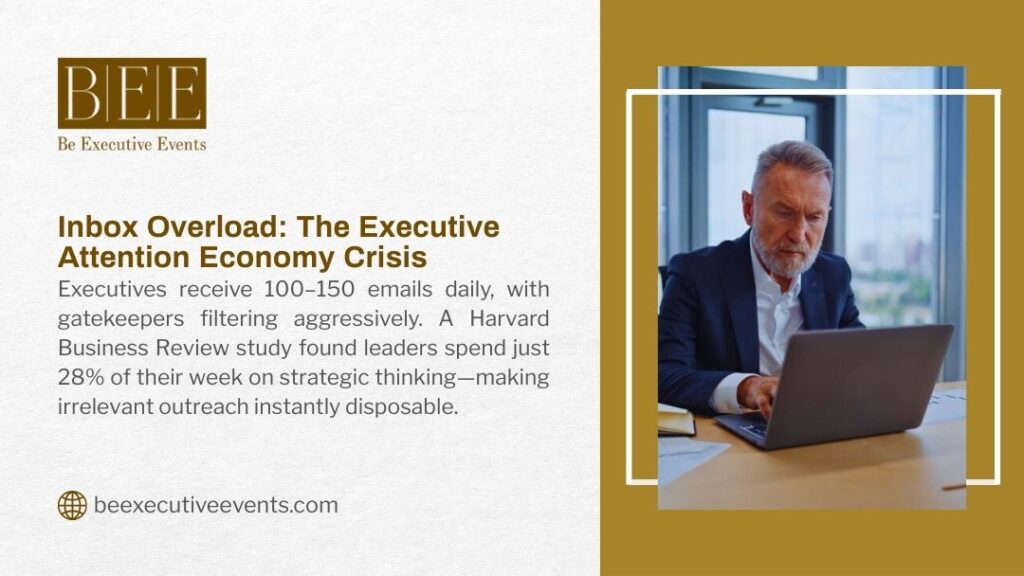
Most CEOs review their own email but use aggressive filtering systems and executive assistants to screen messages. Research shows executives receive an average of 120 emails daily, with 37% reporting they get over 10 cold sales emails weekly.
They scan messages in seconds and delete anything that lacks immediate strategic relevance to current business priorities.
Is cold outreach dead for enterprise sales?
Cold outreach to executives works when it demonstrates strategic positioning and arrives through appropriate channels.
However, traditional cold email and LinkedIn messages consistently underperform compared to peer introductions, executive events, and thought leadership visibility.
The channel and credibility context matter more than message optimization when targeting C-suite decision makers.
How do you get a C-level executive to reply?
Align your message with growth, risk, or competitive positioning priorities that executives discuss with their boards. Reference specific strategic challenges from their earnings calls or industry analyst reports. Offer strategic insight rather than product pitches.
Better yet, gain introductions through peer CEOs, board advisors, or participate in executive forums where they already engage on business challenges.
What channels work better than cold email for executives?
Industry conferences, private executive roundtables, and curated VIP events create higher response rates than digital outreach. Thought leadership through industry publications, speaking engagements, and strategic analysis builds recognition before any direct contact.