
A demand generation lead in enterprise SaaS lands the meeting: forty minutes with a CIO who agrees the current data platform is holding back three transformation programs. Clear next step. Six weeks later the opportunity sits with procurement, the business case has been compressed into a per-seat rate card, and the offer is scored against two vendors the CIO never mentioned.
Nothing went wrong in that first meeting. The deal moved to a second scoreboard. The C-suite is measured on revenue, growth and strategic risk. Procurement is measured on cost, contract terms and supplier risk. Both are genuine buyers, and a deal that satisfies only one of them stalls.
This is written for the people who plan and fund executive engagement in B2B technology: demand generation, field marketing and event leaders who need to reach a specific tier of buyer.
What follows is a practical guide to selling to procurement vs C-suite: how each side evaluates, what budget each controls, and how to sequence the two instead of choosing between them.
Procurement vs C-suite at a glance
| C-suite | Procurement | |
|---|---|---|
| Core mandate | Growth, margin, market position, strategic risk | Cost, supplier risk, contract integrity |
| Success metric | Business outcomes against the operating plan | Savings delivered, risk mitigated, process followed |
| Budget type | Discretionary and real locatable when conviction is high | Fixed envelopes with approval thresholds |
| Decision speed | Fast once the case is made | Paced by process stages and sign-off ladders |
| Evidence they want | Business narrative, quantified impact, peer proof | Structured data, like-for-like comparison, documentation |
| What kills the deal | “Not a priority this year” | Incomplete paperwork or no defensible differentiation |
Procurement is not a gatekeeper to be dodged. It is a buyer with a different scorecard, and usually the function holding the pen at signature.
What the C-suite actually buys
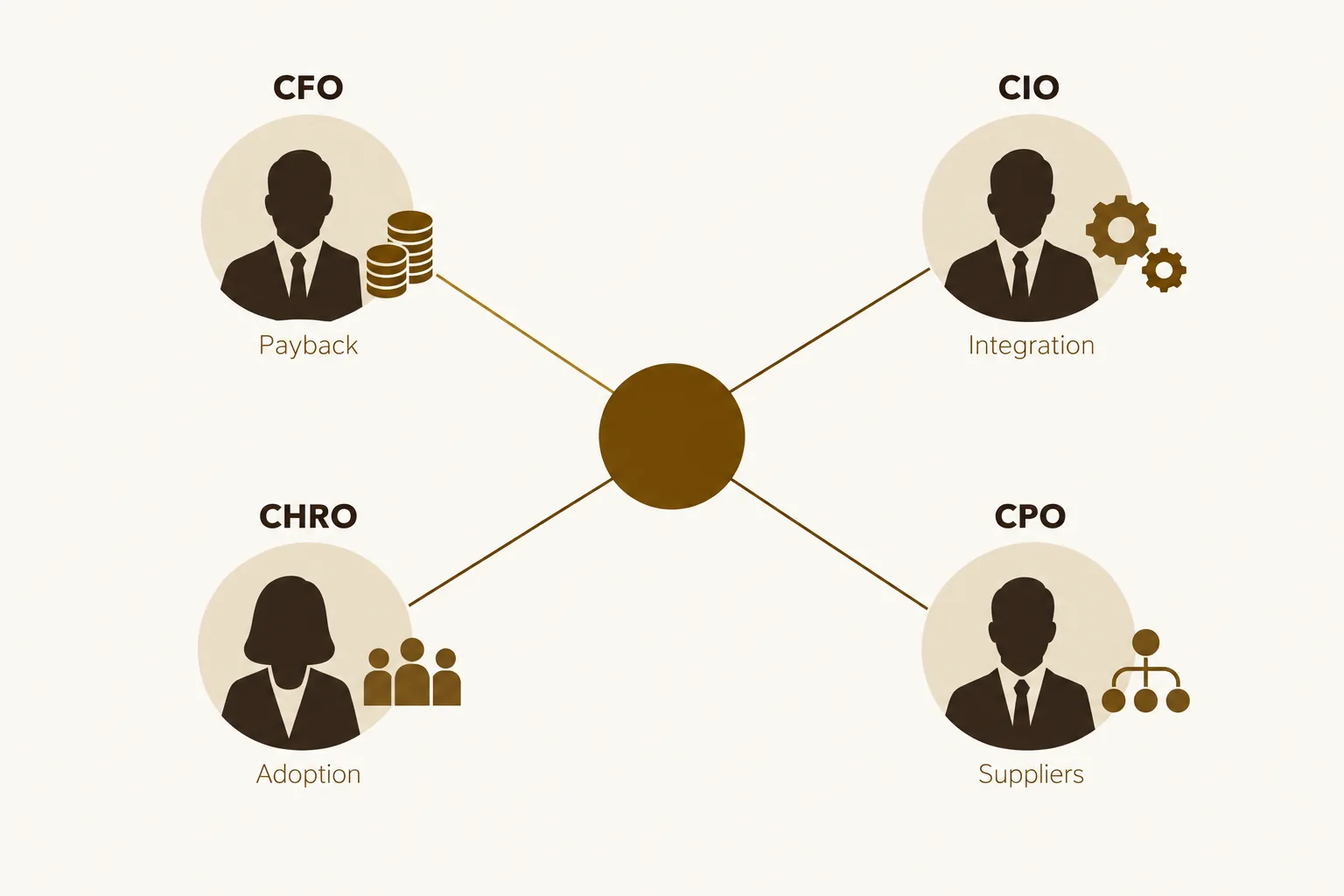
Identifying executive decision makers correctly is half the battle, since the wrong C-suite contact wastes the same effort as no contact at all.
Executive decision makers buy against their own operating plan: growth targets, margin pressure, transformation timelines, regulatory and cyber exposure. The product is incidental. The question they are answering is whether this changes a number they are accountable for.
The same offer lands differently across the C-suite, which is why how to market to c-level executives starts with knowing which one you’re actually talking to. A CFO weighs payback period and cash impact. A CIO or CTO weighs integration burden and the technical debt created or removed.
A CHRO weighs adoption and workforce disruption. A CPO weighs supplier consolidation and dependency.
Buying behavior follows from a short attention window. Executives have little patience for discovery questions answerable from an annual report or an earnings call, and they expect a point of view on arrival rather than a needs analysis. Budget behavior is the mirror image of procurement’s: strategic spend can be created or moved mid-year when the case is strong enough. The binding constraint is priority, not line item.
An executive pitch that works has five parts: the business problem in their language, the quantified consequence of doing nothing, what measurably changes within twelve months, proof from comparable organizations, and one clear ask.
What procurement actually buys
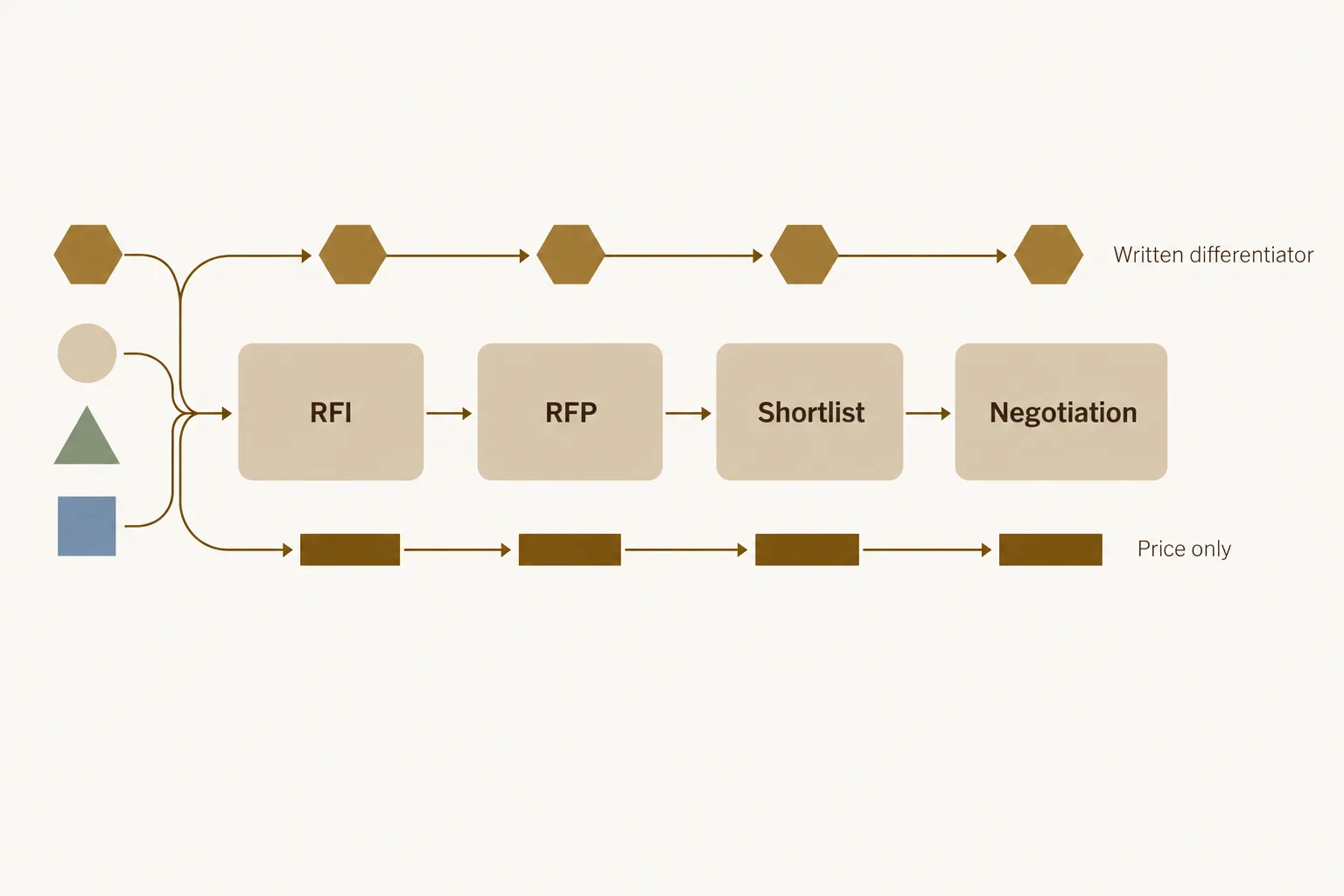
Procurement’s mandate is wider than price. It covers total cost of ownership, contract terms, supplier viability, security and data protection review, and increasingly ESG and supplier concentration risk. Cost remains the headline.
In Deloitte’s survey of more than 260 chief procurement officers, improving margins via cost reduction (72%) and driving operational efficiency (68%) ranked as the top two priorities for responding to macroeconomic pressure.
Related reading7 Insights on Why Executives Ignore Most Sales OutreachRead the guide →The process is structured by design: RFI, RFP, shortlist, negotiation, each stage scored and documented for audit. That structure creates the commoditization risk. Where no differentiated requirement has been written down, a scoring matrix normalizes every offer to price per unit, because price is the only thing left that varies.
Budget behavior means fixed envelopes, spend thresholds that trigger competitive tender automatically, and sign-off ladders that add weeks. A pitch built for procurement is complete and early: a TCO model rather than a list price, differentiation expressed as written requirements, named risks with named mitigations, and clean answers on security and data protection before they are requested.
Where sellers get it wrong in both directions
| Mistake | Why It Backfires |
|---|---|
| Leading with feature depth to the C-suite | A capability walkthrough reads as a vendor briefing, and executives delegate vendor briefings |
| Leading with vision to procurement | Strategic language without pricing detail reads as evasion, and evasion invites a harder comparison |
| Treating an executive relationship as immunity from process | A sponsor’s enthusiasm does not replace documentation; arriving at procurement with neither paperwork nor an internal champion resets the deal to zero |
| Letting the sponsor go quiet during procurement | Someone senior has to defend the business case internally when price pressure arrives, or the discount conversation becomes the whole conversation |
| Single-threading on either side | One executive contact and one buyer contact are two points of failure in a buying group that contains many more people than the two you have met |
Sequencing: why the executive conversation comes first
Value is defined at the executive level and defended at the procurement level. A deal that enters through procurement first gets scored on price, because nobody has established a strategic frame worth protecting.
The workable sequence: build executive conviction, convert that conviction into written requirements, then enter the process with those requirements already shaping the scorecard. The handoff matters more than either meeting. Give the sponsor something they can carry, namely a one-page business case in their vocabulary, a TCO summary, and a short risk register that pre-empts the review questions.
How executive events change the access problem
The structural difficulty sits upstream of all of this. Cold outbound rarely reaches CxOs, and inbound routes tend to surface mid-level evaluators who forward the enquiry straight to procurement.
We cover the channel question directly in reaching decision makers in B2B. By the time you are in the process, the frame is already set.
Executive roundtables, curated dinners and virtual executive sessions solve that access problem before an RFP exists. A roundtable that produces real discussion needs six to twenty-six pre-approved senior decision makers, one sharp topic rather than a broad theme, an independent moderator, and no pitch deck in the room. The conversation is peer-to-peer, which is why priorities get named candidly.
Virtual executive events extend the same access across UKI, DACH, BENELUX and NAMER without travel, which is useful when one theme needs to reach several regional executive groups in a short window. Audience quality is the entire mechanism: seat filling produces attendee counts, while pre-approved profiles produce the conversations that later become requirements.
Senior audience acquisition should run on GDPR-compliant channels (email, LinkedIn and trusted B2B data providers), which matters particularly for UK, DACH and BENELUX executive audiences.
Executive events work best as one piece of a broader system, not a standalone tactic. Our C-level lead generation strategies guide covers how to combine them with the rest of the pipeline. These formats create the conditions for pipeline and trust. They do not guarantee deals.
Regional and seasonal nuance
Procurement formality varies by market. DACH and BENELUX enterprise processes tend to be documentation-heavy and consensus-driven, with committee review as standard. NAMER deals more often move on executive sponsorship, with procurement validating afterwards. Weight the pitch accordingly.
Budget cycles govern both buyers. Executive engagement demand rises from late February through July as fresh budgets are allocated, then peaks from September to early December as teams push to close annual targets.
August in Europe and the late-December window are effectively closed for senior in-person attendance: plan into those periods, do not deliver into them. Work the executive conversation in the quarter before budget is committed, not after a tender has opened.
A working checklist for each buyer
Before the C-suite meeting
1. Read the last annual report and quarterly commentary; never ask what it already answers. 2. Frame the problem with a number attached to inaction. 3. Bring evidence from comparable organizations in their sector and region. 4. Make one ask, not four. 5. Agree who follows through internally and by when.
Before procurement engages
1. Have a TCO model ready, not a list price. 2. Get your differentiation written into the requirements while the sponsor still owns them. 3. Prepare the security and data protection pack in advance. 4. Structure references by comparable scale and sector. 5. Agree your negotiation floor internally before the first call, not during it.
Run both threads at once. Warm on one side and cold on the other is how good deals stall.
Frequently asked questions
Should you approach the C-suite first or procurement first?
How do you stop procurement turning your offer into a price comparison?
Is the CPO a procurement buyer or a C-suite buyer?
How do you reach C-suite executives who ignore outbound?
How many executives should be in a roundtable for real discussion?
Next step
If the bottleneck sits upstream of the RFP, in getting real executive conviction before procurement ever opens a scorecard, Be Executive Events builds the curated formats that create it. We design invitation-only executive roundtables, VIP dinners, and branded virtual sessions that put senior decision makers in a room built around one sharp topic, with no pitch deck and no vendor-briefing feel.
Here’s what a program with Be Executive Events gets you when you’re selling to procurement vs C-suite at the same time:
- A pre-approved guest list of six to twenty-six senior decision makers, screened against your target accounts so the room stays peer-level
- An independent moderator and a live industry problem as the agenda, not a product walkthrough
- Reach across UKI, DACH, BENELUX, and NAMER through a virtual session, then depth with priority accounts through an in-person dinner or roundtable
- Timing built around real budget cycles, not whichever week a venue happened to be free
- Post-event handoff material your sponsor can carry straight into the procurement conversation
Talk to Be Executive Events about the accounts and the tier of buyer you need in the room, and we’ll work back from there to the right format.