
Turning event attendees into customers is one of the highest-ROI activities in a B2B marketing strategy when it is done with a system.
According to Spiro, up to 96% of attendees report being more likely to make a purchase after an event. The potential is there, but the execution is where most companies fall short.
This guide is written from the Be Executive Events team, with more than 10 years of experience helping global companies produce measurable results from executive gatherings.
You will learn why event leads fail to convert and get a structured, repeatable system to turn event attendance into a real pipeline.
Why Turning Event Attendees into Customers Fails for Most Companies
If your events are labeled successful but no deals are following, something is structurally broken. The problem is almost never the event itself. It is the absence of a commercial system around it.
80% of trade show leads never receive any follow-up at all..
| What Companies Track | What Actually Matters |
| Total attendance | Seniority ratio of attendees |
| NPS and satisfaction scores | Post-event meeting rate |
| Session engagement rate | Pipeline created or influenced |
| Social media mentions | Deal velocity post-event |
| Email open rate | Revenue attributed to the event |
The gap between high engagement and flat revenue comes from a few consistent structural issues:
- No attendee qualification before the event
- No system to capture buying signals in the room
- Generic or delayed post-event follow-up
- Sales and marketing disconnected after the event ends
According to Bizzabo’s 2026 State of Events Benchmark Report, only 15% of organizers rate their networking as very effective, a sharp drop from the previous year. When networking has no structure, the commercial value of the event leaves with the attendees.
The Event-to-Customer Conversion Framework
Turning event attendees into customers does not happen by accident. It follows a clear sequence that can be built into a repeatable system.
| Stage | Goal | Key Actions | Outcome |
| Pre-Event Qualification | Attract the right attendees | ICP definition, targeted outreach, segmentation | A room of qualified decision-makers |
| In-Event Intent Capture | Identify buying signals | Behavioral tracking, structured conversations, technology | Qualified, scored contacts |
| Post-Event Conversion | Turn conversations into deals | Personalized follow-up, CRM discipline, multi-touch sequence | Pipeline and revenue |
Each stage builds directly on the previous one. A weak qualification stage creates a pipeline problem that no follow-up tactic can fix.
Stage 1: Pre-Event Qualification – Attract the Right Attendees
The process of turning event attendees into customers starts before the event begins. The quality of your attendee list is the single biggest factor in your post-event commercial results.
Define Your Ideal Attendee Profile
A room of 50 qualified executives will produce stronger outcomes than 500 general attendees. It is a pattern seen consistently across high-performance executive events globally.
Knowing how to get executives to attend events the right way starts with a precise definition of who belongs in the room.
| Criteria | What to Define |
| Job title and seniority | C-suite, VP, Director level |
| Company size and sector | Enterprise, SaaS, Consultancy |
| Budget ownership | Decision-maker, not just influencer |
| Commercial fit | Active problems your offer solves |
Pre-Event Engagement That Builds Intent
Once you know who to invite, the next step is pre-event engagement that creates genuine intent before the first session begins.
| Pre-Event Tactic | Expected Outcome |
| Personalized invite with a specific value case | Higher attendance from target accounts |
| Pre-event content (briefings, insight reports) | Warmer conversations on the day |
| Personal confirmation message 7 to 10 days out | Fewer day-of cancellations |
| Pre-scheduled 1:1 meetings | Structured commercial touchpoints at arrival |
Data from the Ortus Club, drawn from 2,839 completed B2B executive events across 40+ countries, confirms that a personal confirmation message in the 7 to 10 days before the event is the single highest-ROI action in their entire dataset.
Book Meetings Before the Event Starts
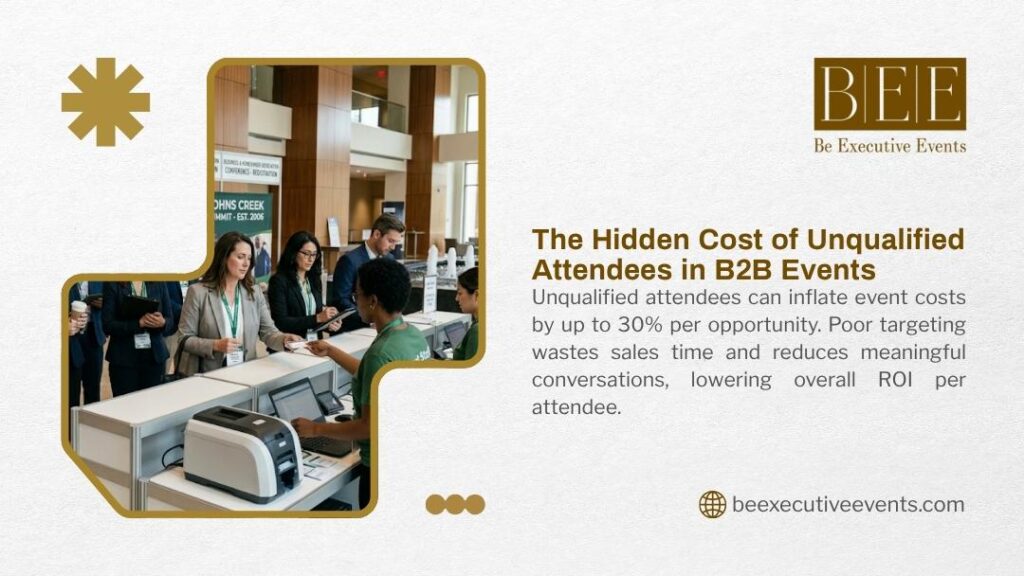
Passive attendees are a missed opportunity. Identify the top 10 to 15 accounts you want to speak with and book time before they arrive. Pre-scheduled 1:1 meetings convert passive attendees into active commercial prospects before the event even opens.
Stage 2: In-Event Strategy – Capture Buying Intent in Real Time
There is a real difference between an attendee who is engaged and one who is ready to buy. Most event teams do not have a system to tell the two apart.
This gap is exactly what makes turning event attendees into customers so difficult for most organizations.
Identify High-Intent Attendees
High-intent attendees send clear signals during an event, and those signals are trackable.
| High-Intent Signal | Low-Intent Signal |
| Asks about specific business outcomes | Asks general or educational questions |
| Books a follow-up meeting on the day | Collects materials with no next step |
| Introduces a second stakeholder from their team | Attends sessions solo, no direct engagement |
| References an active internal project or challenge | Shows general interest, no sense of urgency |
If your goal is learning how to reach decision makers in B2B, executive events give you a direct line to them, but only if you know what signals to look for when you are in the room.
Structure Conversations Around Business Outcomes
The goal at a high-value executive event is to move from introductions to real business context as fast as professionally possible.
For instance, a simple shift in how you open a conversation makes a measurable difference.
Instead of asking “What do you do?”, try “What is your main focus this quarter?” That single change moves a social exchange into a commercial one.
According to ON24 data, attendees who take part in Q&A, polls, or direct in-event interaction are 30% more likely to convert than those who remain passive.
Use Technology to Track Engagement
Event apps, CRM-connected platforms, and AI tools now make real-time behavioral data practical for most enterprise event teams.
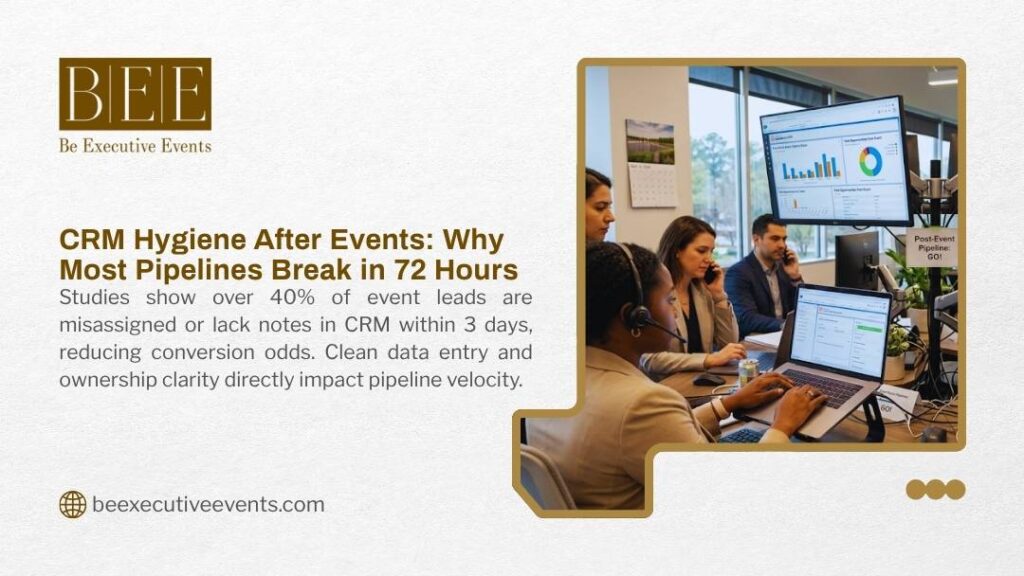
When your CRM captures session data, meeting notes, and engagement patterns on the day, your post-event outreach becomes precise. You are not guessing who showed interest. You have a record.
Stage 3: Post-Event Conversion – Turning Conversations into Deals
The event ends. The real work starts. Generic messages do not convert executive-level prospects. A mass email sent three days after a high-value event signals that the conversation meant nothing specific to you.
The 24 to 48 Hour Follow-Up Window
Speed is one of the most critical factors in post-event conversion. Companies that follow up within 24 hours of an event produce 3x higher pipeline value than those who wait a week or more.
| Follow-Up Timing | Effect on Conversion |
| Within 24 hours | 3x higher pipeline value |
| 2 to 3 days | Moderate, interest still warm |
| 4 to 7 days | Notable drop in response rate |
| After 1 week | Conversion probability drops sharply |
Personalization That Reflects Real Conversations
The follow-up message has to reference the actual conversation. Here is a direct comparison:
Weak: “Great to meet you at the event. Let us explore potential synergies.”
Strong: “Good to speak with you about [specific challenge]. Based on what you shared, [specific next step] seems like a logical starting point. Are you free on [specific date]?”
The second message shows that you listened. That is what earns a response from a senior executive.
Sales and Marketing Alignment
One of the most common reasons turning event attendees into customers fails at this stage is a broken handoff between marketing and sales.
The data behind why in-person meetings close more deals consistently points to one factor: trust built in a real setting. That trust disappears fast when the post-event follow-through does not match the quality of the event itself.
Every event-sourced lead needs:
- A named owner in CRM (SDR or AE)
- A specific next step with a clear deadline
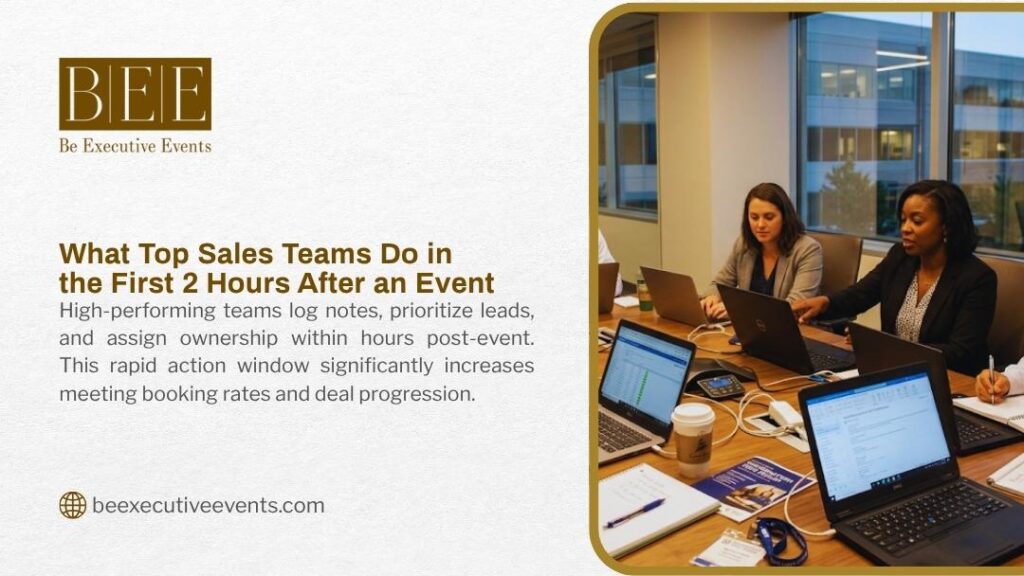
- A post-event debrief between sales and marketing within 72 hours
Build a Multi-Touch Conversion Sequence
One follow-up is rarely enough. A structured 7-day sequence is what separates teams that close event leads from those that do not.
| Day | Action |
| Day 1 | Personalized email referencing specific conversation |
| Day 2 | LinkedIn connection with a short personal note |
| Day 3 | Send relevant content (report or case study) |
| Day 5 | Second email with a direct meeting request |
| Day 7 | Phone call or voice message |
How to Measure Event Conversion and ROI
Most teams measure events too early and with the wrong metrics. Attendance and satisfaction scores tell you what happened at the event. They do not tell you what the event produced for the business.
Core Metrics That Actually Matter for Turning Event Attendees into Customers
| Metric | What It Reveals |
| Attendee to lead rate | Quality of attendee selection |
| Lead to opportunity rate | Effectiveness of the follow-up process |
| Opportunity to revenue rate | Full-funnel commercial impact |
| Cost per opportunity | Event efficiency vs. other channels |
| Deal velocity (event vs. non-event) | Speed advantage from event-sourced pipeline |
The teams that track results at 30, 60, and 90 days post-event are the ones that prove the value to leadership and secure budget for the next event.
Attribution Models for Events
Events rarely receive credit for the deals they helped close, because most attribution systems are not built to capture event influence accurately.
A solid approach to measuring executive event ROI relies on tagging every event-touched contact and opportunity in your CRM on the day of the event, then reviewing pipeline movement at 30, 60, and 90 days.
Two models worth applying:
- First-touch attribution credits the event for creating the initial relationship
- Multi-touch attribution distributes credit across all touchpoints, including the event
Advanced Strategies to Increase Conversion Rates
The organizations that consistently convert best do not rely on standard tactics alone. They build systems and refine those systems with data and technology.
- Use AI to Prioritize Leads
AI-driven intent scoring is now accessible for most enterprise event teams.
Bizzabo’s 2026 Benchmark Report confirms that 95% of respondents expect their use of AI in events to increase this year.
AI can analyze attendee profiles, behavioral data from the event, and CRM history to produce a ranked list of accounts most likely to convert. If you’re evaluating which platforms can do this, our roundup of the 15 best AI tools for event management covers the solutions that are actually delivering these capabilities for event teams right now. That list tells your sales team exactly where to focus in the 48 hours after the event closes.
- Focus on Smaller, High-Value Executive Events
Exclusive formats convert better. Data-driven executive events achieve 25 to 35% lead conversion rates, compared to 10 to 15% for traditional large-format events (2stream.live, 2026).
From our experience, one of the most frequent questions from senior marketing leaders is about how to get meetings with executives at scale. The answer rarely comes from volume. It comes from the quality of the environment and the precision of the invitation list.
- Create Post-Event Content That Keeps Deals Alive
Not every prospect is ready to buy in the first week after an event. A content-led sequence keeps the commercial relationship active without a hard sell:
- A summary of key insights from the event
- A relevant report tied to a challenge discussed on the day
- An invite to a follow-up roundtable or exclusive session
Common Mistakes That Kill Event Conversion
Even well-run events fail because of avoidable mistakes.
| Mistake | Impact | Fix |
| No pre-event qualification | Wrong people in the room | Define your ICP before outreach starts |
| Delayed follow-up | Warm leads go cold | Act within 24 hours |
| Generic post-event messages | Low response rates from senior buyers | Reference specific conversations |
| No sales involvement | Event leads are not actioned | Align sales before the event |
| No CRM tagging on the day | Attribution becomes guesswork | Tag all touchpoints in real time |
| Over-reliance on attendance data | Misleads leadership on event value | Report on pipeline and revenue |
Turning event attendees into customers is not a one-day job. It is an end-to-end system that runs from the first invitation through to the closed deal.
Frequently Asked Questions
How do you turn event attendees into actual customers?
Turning event attendees into customers requires three connected elements: the right people in the room, a system to identify who is ready to buy during the event, and a fast, personalized follow-up after it. Speed, specificity, and CRM discipline are the key factors.
Why do most event leads never convert?
The most common reasons are delayed or generic follow-up, no system to capture high-intent signals during the event, and a weak handoff between marketing and sales after it ends.
What is the best follow-up strategy after an event?
A multi-touch sequence that starts within 24 hours. This includes a personalized email that references the specific conversation, a LinkedIn connection, a relevant content piece, a second follow-up email, and a phone call within 7 days.
How soon should you follow up with event attendees?
Within 24 hours. Companies that act in this window produce 3x higher pipeline value than those who wait a week or more (Exhibit Surveys, 2025).
How do you identify high-intent attendees during an executive event?
Watch for these behavioral signals: specific questions about business outcomes, requests for a follow-up meeting on the day, introductions to other stakeholders from their team, and references to active internal challenges.
Ready to Build a Conversion System Around Your Events?
Be Executive Events has spent more than 10 years helping global enterprises, SaaS firms, and consultancies run events that produce real, measurable business results.
Across 250+ events delivered in Europe, North America, and Asia, the pattern is consistent: the teams that convert best are the ones with a clear system in place before the event starts.
From attendee qualification and pre-event strategy to on-site execution and post-event ROI reporting, the Be Executive Events team works with you at every stage to make sure your results are real and provable.
Contact Be Executive Events today, and plan your next high-impact executive event.