
Most cost questions about executive dinners get answered with a range so wide it helps nobody. A useful answer depends on three variables: how many executives you seat, which city you seat them in, and whether you are paying only for food or also for the harder job of getting senior decision-makers to accept and turn up.
The short answer: what an executive dinner costs
There are two numbers, and buyers confuse them constantly. The first is per-cover spend, which is what the venue quotes you. The second is all-in event cost, which is what finance actually approves, and it includes outreach, service charges, production, and everything the restaurant does not invoice.
As a scale anchor, published private dining benchmarks put larger corporate dinners of 60 guests or more at $5,000 to $15,000 or more in total. At 60 covers, the bottom of that band works out to roughly $85 a head, with no ceiling once venue tier and wine enter the picture.
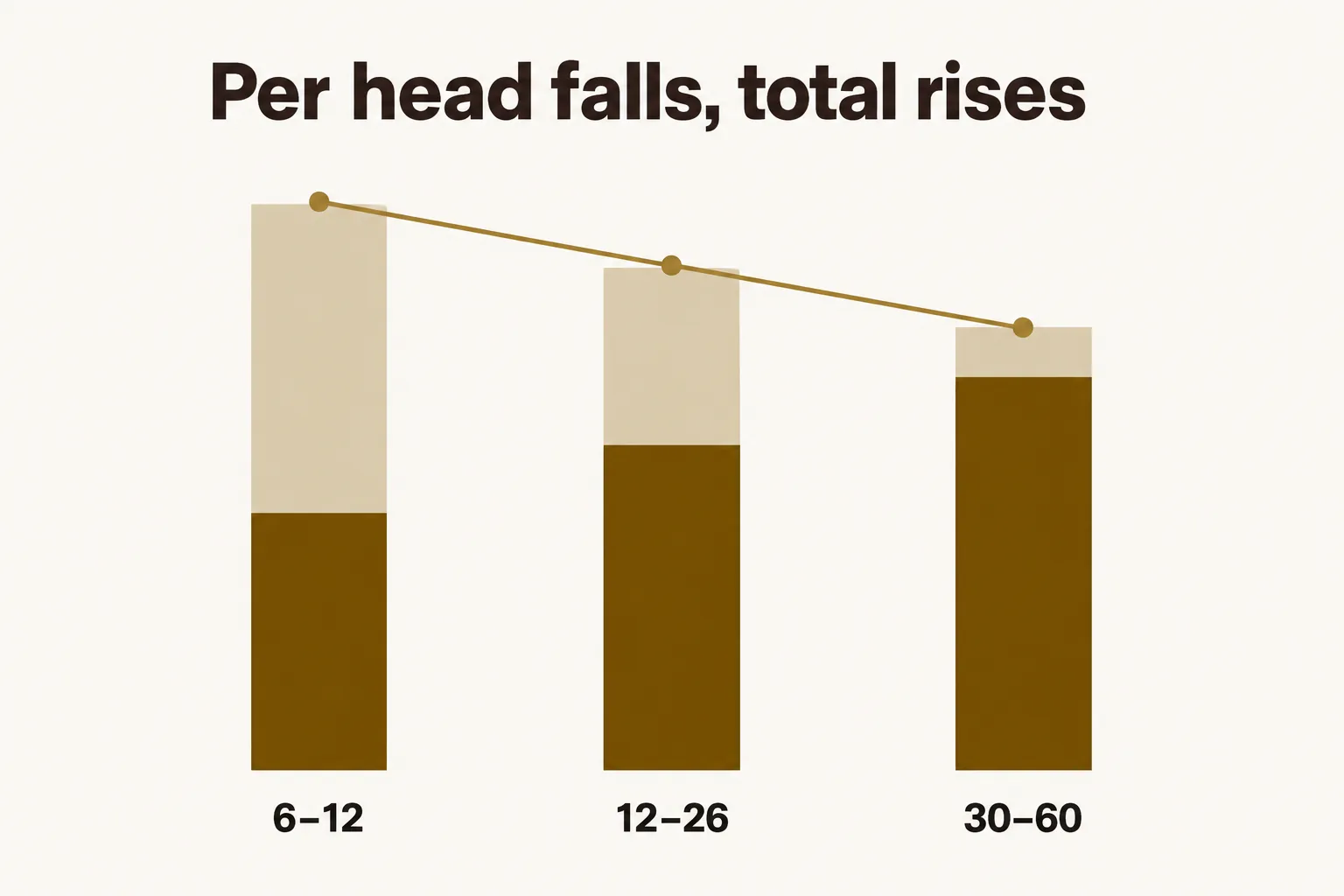
Per-guest spend moves in the opposite direction to group size: a table of ten CxOs in a premium private room with a wine pairing carries the highest cost per head and the lowest total bill.
Two expectations worth setting now. The quoted menu price is almost never the final invoice, because service charge, minimum spend shortfalls, AV, and staffing land on top. And the biggest driver of whether the evening was worth the money is not the food. It is whether the fourteen people in the room were the fourteen people you needed.
Cost per guest vs. total budget by group size
| Dinner size | Typical characteristics | Main cost pressure | Budget risk |
|---|---|---|---|
| 6–12 executives | Highly curated, private room, set menu, often premium wine | High venue and food cost per person | One or two no-shows can materially affect the conversation |
| 12–26 executives | Private dining room or partial/full buyout, more event support | Minimum spend, AV, staffing and moderation | Higher total commitment if the room is not fully qualified |
| 30–60 executives | Larger private space, more arrivals management and production | Staffing, AV, venue hold and operational requirements | Audience quality can decline as the guest list expands |
Budget both ways. Per-cover spend tells you which venues are in range. All-in cost tells you what the evening is worth defending in a quarterly review. Note the inversion of risk as headcount rises: cost per head falls, but exposure grows, because two no-shows at a table of ten gut the conversation while two absences from a room of forty barely register.
Small curated dinners (6-12 executives)
Highest per-head spend, lowest total. You are paying for a genuinely private room, a set menu, and usually a considered wine list. This size is the default for real peer conversation: everyone can speak, no side-tables form, and the moderator can keep one thread running across the table.
It is the format that most executives-only dinner planning work is built around. What pushes this band to its ceiling is city tier, venue prestige, and the wine.
Mid-size executive dinners (12-26 executives)
Venue requirements change here. You need a dedicated private dining room or a full buyout, and minimum spend thresholds become the governing number rather than the per-person menu price.
Moderation and light production turn into real line items: microphone, screen, printed agendas, name cards, and a deliberate seating plan. If a co-host or sponsor shares the bill, your net cost drops sharply without reducing the quality of the room.
Larger corporate dinners (30-60+ guests)
Costs stop scaling in a straight line. Staffing ratios, additional AV, cloakroom and arrivals management, and longer venue holds all step up at once. A dinner for 30 sits well below the 60-guest total band but rarely below it per head, because fixed production costs spread across fewer covers.
The caveat worth stating plainly: as headcount rises, audience quality falls unless vetting is enforced on every single acceptance.
Where the money goes: the line items
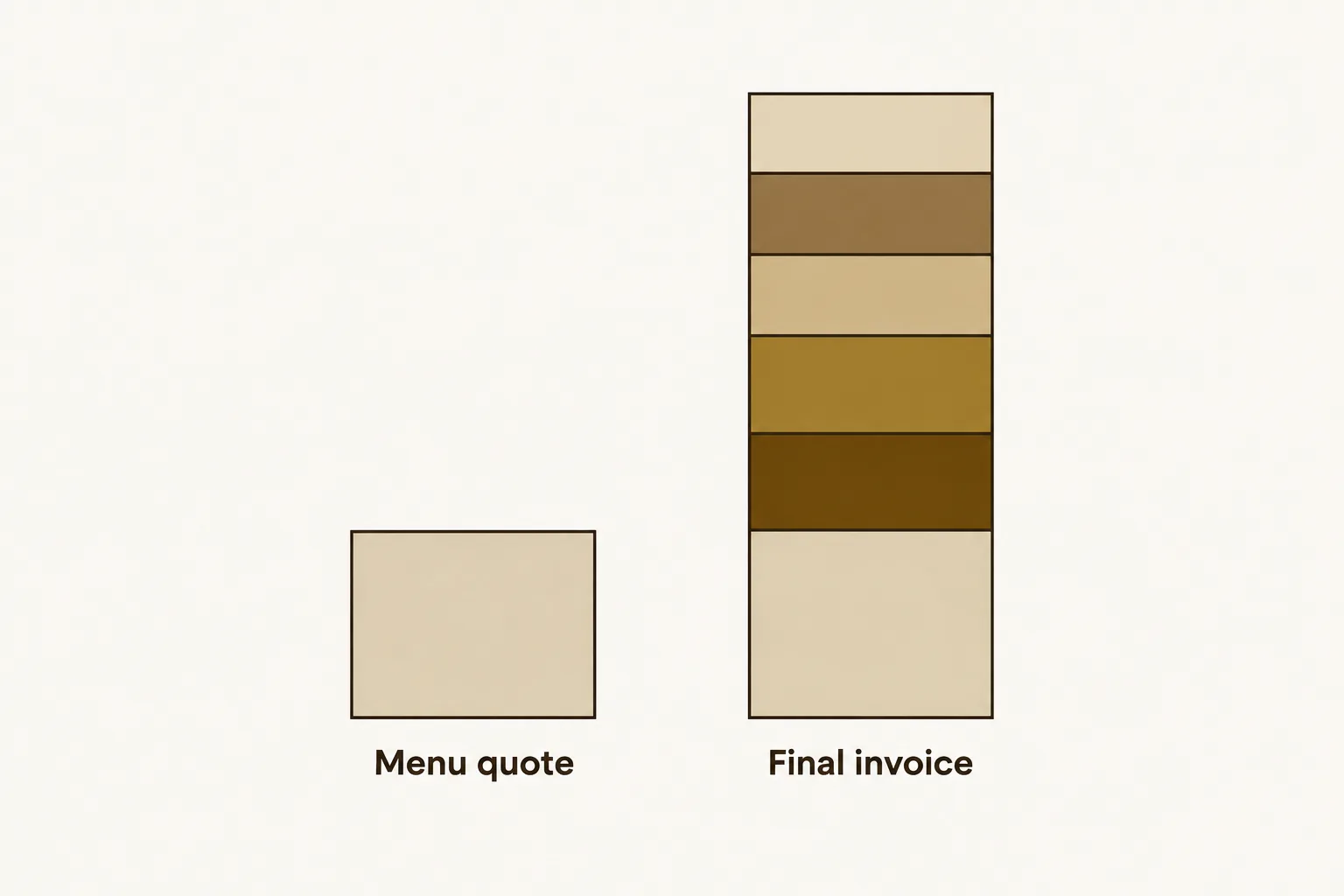
- Venue. High-end restaurants usually charge through a food-and-beverage minimum rather than a flat room hire fee. Ask which model applies before you compare two quotes, because they are not comparable.
- Food. A set menu is the predictable option. Tasting menus and private chefs at a residence or private venue price differently and often bill ingredients separately.
- Beverage. The most volatile line on the sheet, and usually the difference between a mid-band and a top-band per-guest figure. Control it with a pre-selected list, a consumption cap, or a corkage arrangement.
- Service charge, gratuity, and tax. A stated percentage on top of the F&B total. Get the exact figure written into the contract and into the first budget draft, not the third.
- Staffing and event production management. An on-site manager, a host desk, place cards, printed materials.
- AV and content. Microphone, screen, presentation support, and someone capturing the discussion for post-event reporting.
- Design details. Branding, menu cards, gifting, photography.
- Contingency. A buffer for late menu changes and over-consumption on the beverage line.
The cost nobody budgets: filling the room with the right executives
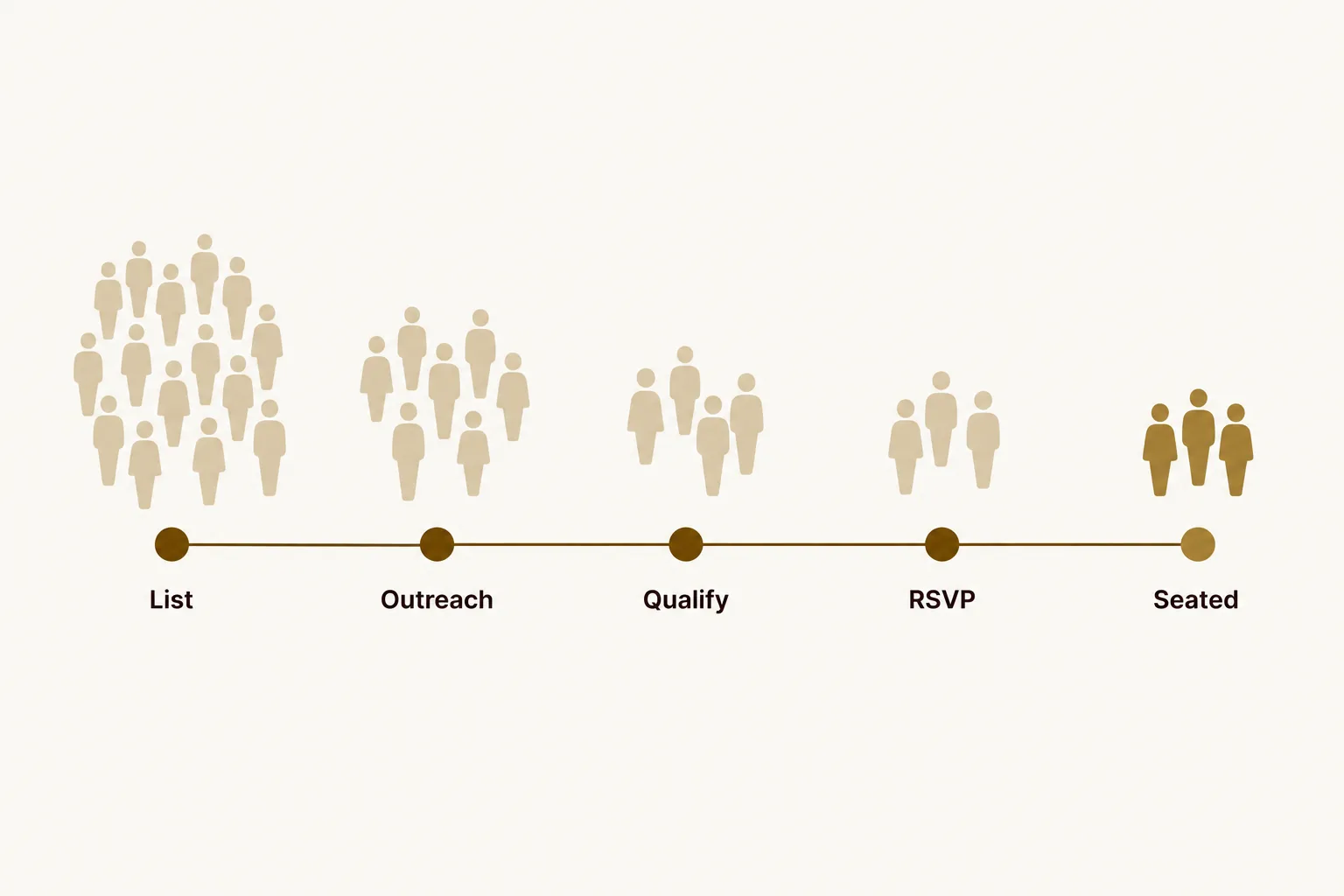
Most cost guides stop at the invoice. The invoice is the visible cost. The one that decides whether the dinner returned anything is audience acquisition.
Reaching a CIO, CFO, or CHRO for a Tuesday evening is multi-touch, multi-week work: building a list aligned to your target accounts, running GDPR-compliant outreach by email, LinkedIn, and trusted B2B data providers, qualifying every response against the approved profile, managing RSVPs, and reconfirming in the final week.
That discipline sits at the center of c-suite event planning, and it is where the hours go.
The economics are unforgiving. Venues bill against confirmed covers, so attrition is a direct loss with nothing to show for it. Over-inviting is the standard countermeasure, and pre-approval of every attendee by the host company is the control that protects the spend.
Related readingIn-Person vs Digital for Executive EngagementRead the guide →The metric to manage is not cost per head. It is cost per qualified executive decision-maker in the room.
Six variables that move the price
| Cost variable | What can increase the cost | Practical way to control it |
|---|---|---|
| City | Premium markets, higher venue minimums and stronger demand | Consider a strong secondary city with the same target-account density |
| Season | Peak spring and autumn demand for venues and executive calendars | Book earlier or consider lower-demand periods when attendance remains viable |
| Venue tier | Luxury hotels, starred restaurants and premium private rooms | Compare several venues using the same minimum-spend or room-hire model |
| Format | Moderation, agenda design, AV and additional content preparation | Keep production focused on what the discussion actually needs |
| Lead time | Limited venue availability and lower executive acceptance rates | Plan eight to twelve weeks ahead for peak periods |
| Scope | Audience acquisition, event management and post-event reporting | Separate essential services from optional production or branding |
DIY vs. managed delivery
DIY looks cheaper because you only see venue, food, and service on the invoice. The costs that stay hidden are internal marketing hours spent on outreach and RSVP chasing, no-show risk against committed covers, empty seats you have already paid for, and no structured data after the event.
Managed delivery adds a fee and transfers the audience risk, along with venue research and booking, agenda design, on-site execution, and reporting.
DIY is fine when you are hosting warm existing relationships at a small local table. It is the wrong call for net-new target accounts, an unfamiliar market, or genuinely senior profiles.
Building the budget: a working sequence
Rather than start from a per-head number you found online, build the figure in this order.
1. Fix the objective and the target account list. Headcount follows from that, not the other way round. 2. Get venue quotes in a single model, either minimum spend or room hire plus menu. That quote is your anchor. 3. Add service charge, gratuity, and tax as the exact contracted percentages. 4. Price beverage as its own line above the base menu, with a stated cap. 5. Cost the outreach: the weeks of list building, invitation, qualification, and reconfirmation needed to seat the profile you promised. 6. Add production: AV, materials, on-site management, and post-event reporting. 7. Hold contingency for late menu changes and beverage overrun.
If you are trying to determine how much does it cost to host an executive dinner for your own audience, use your actual venue quote and target headcount rather than relying on a generic industry average. The final figure should include the costs that are easy to overlook, particularly service charges, beverages, outreach, production, and contingency.
Dinner, roundtable, or virtual: cost per head vs. depth
An executive dinner carries the highest cost per head and the deepest relationship return, best suited to a defined local cluster of target accounts. Executive roundtables over lunch or a half day sit mid-cost, carry more structured content value, and are easier to land in a senior calendar.
A branded virtual event or webinar has the lowest cost per head, with no venue or travel spend, and works best for multi-region reach and for warming accounts ahead of an in-person invitation.
Sequencing beats choosing once: use virtual sessions to identify and warm the audience, then convert those relationships over a C-suite dinner.
Frequently asked questions
What is the 30/30/30 rule for restaurants?
How much does it cost to host an executive dinner?
How much does a celebrity chef charge for a private dinner?
How much does a dinner for 30 people cost?
How do you host a private executive dinner?
Is a dinner worth it against a conference booth?
How far in advance should we book?
Next step
For most teams, the sensible first commitment is a curated dinner or executive roundtable for 6-26 pre-approved executives, or a virtual executive session if you want a lower-commitment entry into the format. If the dinner is already booked and the real gap is the guest list, audience acquisition and registration support can run as a standalone piece of work.
Well-run executive events create the conditions for trust, pipeline, and follow-up conversations rather than guaranteeing them. Start with a budget conversation for a specific city and audience profile, and the numbers above stop being ranges.