
When a single conference sponsorship can cost tens or even hundreds of thousands of dollars, are large B2B conferences still the best way to build pipeline and real relationships?
Alternatives to large B2B conferences are smaller, more targeted event formats built around fewer, higher value guests.
Executive roundtables, VIP dinners, workshops, and virtual forums fall into this group. Instead of chasing large crowds, these formats give organizers more control over who is in the room and how success gets measured.
More B2B teams are testing this approach in 2026, as budgets tighten and leaders ask for clearer proof of return.
This guide covers:
- Why more B2B teams are moving away from large conferences
- The best alternatives to large B2B conferences for different goals
- Which format fits which business objective
- How to pick the right approach based on ROI, audience, and engagement
Alternatives to Large B2B Conferences: Why More Companies Are Rethinking Event Strategy
More attendees do not always mean more impact. Large conferences still pull a crowd, but the room is broad, the conversations are short, and the cost per real connection keeps climbing.
More than 70% of B2B executives say peer recommendations and word of mouth carry the most weight in a purchase decision, more than any speaker stage or booth ever will.
| Large Conferences | Smaller Event Formats |
| Brand reach | Relationship depth |
| High attendance | High relevance |
| Broad audiences | Curated attendees |
| Lead volume | Lead quality |
| Complex logistics | Greater flexibility |
None of this means conferences have lost their place. For the right goal, they still do a job no dinner table can match.
When Large B2B Conferences Still Make Sense
Sometimes the goal is to be seen by thousands. Other times, it is to have meaningful conversations with ten people.
Product launches, market expansion, and industry-wide visibility still call for scale. 78% of organizers say in-person conferences remain their most impactful marketing channel, a number worth remembering before cutting them completely.
The comparison between boutique events vs trade shows often comes down to this exact stage: whether a company needs to be found, or needs to go deeper with people who already found it.
The 7 Best Alternatives to Large B2B Conferences for Modern B2B Teams
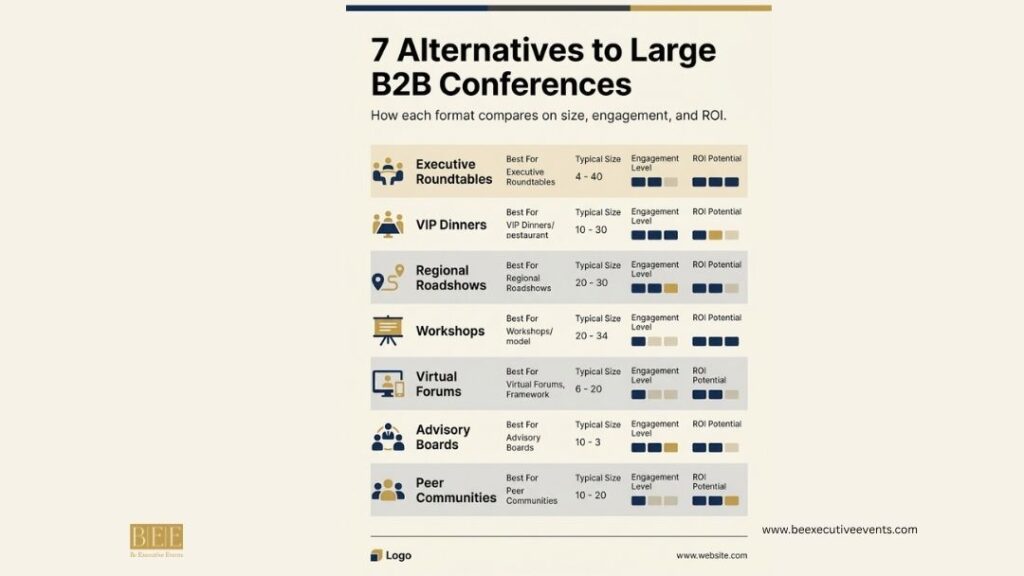
The best alternative depends on the business outcome a team is chasing. Awareness, pipeline, retention, and account based marketing each call for a different room size and a different kind of conversation. If a paid sponsor slot is on your shortlist, see how a roundtable sponsorship package stacks up on cost per qualified conversation. The table below shows where each format fits best.
| Event Format | Best For | Typical Size | Engagement | ROI Potential |
| Executive roundtables | Peer trust, ABM | 8 to 15 | Very high | High |
| VIP dinners | Executive access | 10 to 20 | High | High |
| Regional roadshows | Local pipeline | 20 to 60 | Medium to high | High |
| Workshops | Product education | 15 to 40 | High | Medium |
| Virtual forums | Global reach | 30 to 200 | Medium | Medium |
| Advisory boards | Retention | 8 to 12 | High | High |
| Peer communities | Ongoing trust | Open | Medium | Medium |
Executive Roundtables
An executive roundtable works best with 8 to 15 senior leaders around one clear business challenge. There is no stage and no pitch, just peer to peer discussion under a strict no sales rule.
This format works well for account based marketing, where the goal is a handful of the right people, not a crowd. Channel teams pitching this kind of program to a vendor will find practical steps in our guide to getting partner marketing funds approved.
VIP Dinners and Invite-Only Networking
A dinner for ten CIOs from target accounts builds trust faster than a booth ever could. VIP dinners work because they remove the pitch and replace it with a shared meal and real conversation.
In our experience running these events, a dinner with 20 senior guests often creates a more usable pipeline than a hall with thousands of casual visitors. The format fits customer expansion just as well as new business.
Regional Roadshows and Micro-Events
Three regional events may outperform one flagship conference. Roadshows put the team closer to the buyer, cut travel cost, and create several touchpoints across the year instead of one.
As Ashleigh Cook, Chief Marketing Officer at RainFocus, explains:
“AI is driving the growing trend of micro-events and roadshow series. One large annual conference might not be sufficient for organizations in today’s quickly evolving tech landscape.
We’re seeing a rise in small, repeatable events, enabling companies to get in front of customers more often and with a more personalized approach.”
For example, for regional B2B programs with deal sizes above $50,000, roadshow return on investment can reach 5 to 10 times the cost within 90 days. Programs with 4 to 8 stops a year tend to work best. Fewer than that, and the planning effort rarely pays off.
Hands-On Workshops and Masterclasses
Workshops trade passive listening for real practice. Instead of watching a keynote, attendees work through a problem with the product or the process in front of them.
| Workshops | Conferences |
| Participation | Observation |
| Practical skills | Industry insights |
| Smaller groups | Larger audiences |
A $10,000 workshop that produces 20 qualified conversations and a strong win rate can return well over 100% on the spend, proof that a small room can still move a big number.
Virtual Executive Forums and Curated Webinars
Virtual forums trade depth for reach. Senior leaders who will not fly across the country for a dinner may still give up 45 minutes on a screen.
Webinar attendance is set to grow again in 2026, with more organizers reporting higher turnout year over year. The trade-off is real though, since only a small share of marketers feel confident running a virtual event that keeps a senior room engaged.
Customer Advisory Boards
An advisory board turns a customer into a strategic partner instead of a support ticket. Formal advisory programs are becoming standard once a company passes a certain size, and the jump in adoption between mid-market and enterprise B2B software firms is sharp.
Structured programs, run with a named owner and a clear agenda, produce far stronger participation than an ad-hoc customer call ever will.
Industry Communities and Peer Groups
The most valuable conversations often happen outside traditional event calendars. A private community, whether a peer group or a members-only forum, keeps the relationship alive between events.
It takes longer to build than a single dinner, often a year or more, but engaged members show meaningfully higher retention than customers who never take part.
How to Choose the Right Alternative to Large B2B Conferences
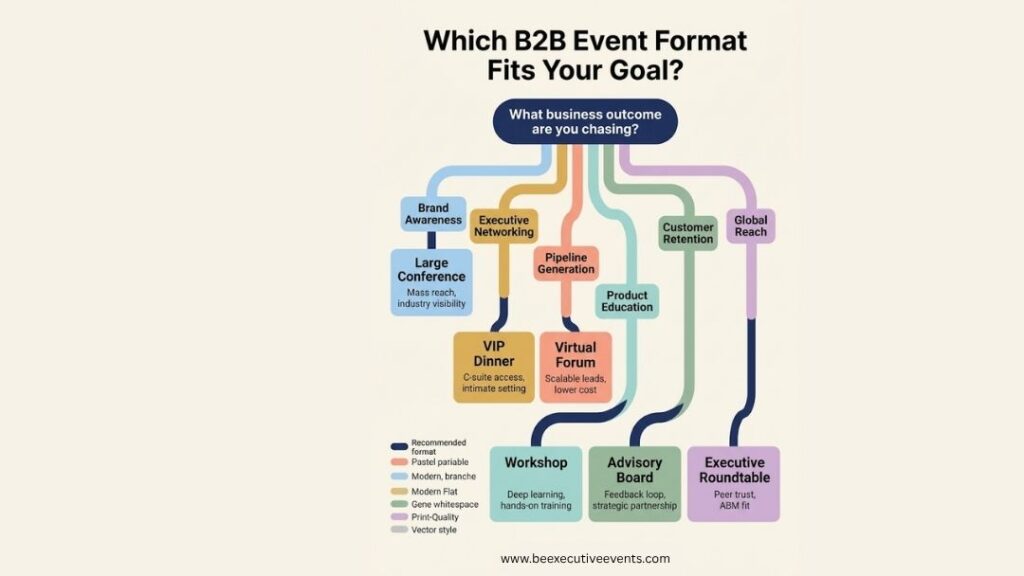
The right event format depends on what success looks like for the organization running it. A goal-first approach beats a format-first one every time. The matrix below maps common goals to the format built to deliver them.
| Goal | Recommended Format |
| Brand awareness | Conferences |
| Executive networking | VIP dinners |
| Pipeline generation | Roundtables |
| Product education | Workshops |
| Customer retention | Advisory boards |
| Global reach | Virtual forums |
Match Your Event Format to Your Business Goals
Awareness campaigns still favor scale. Demand generation and account based marketing favor precision. Customer expansion favors trust built over time, not a single touchpoint.
Thought leadership can go either way, depending on whether the goal is reach or depth. How to get executives to attend events becomes a much easier question once the format already fits the goal.
Measure Success Beyond Attendance Numbers
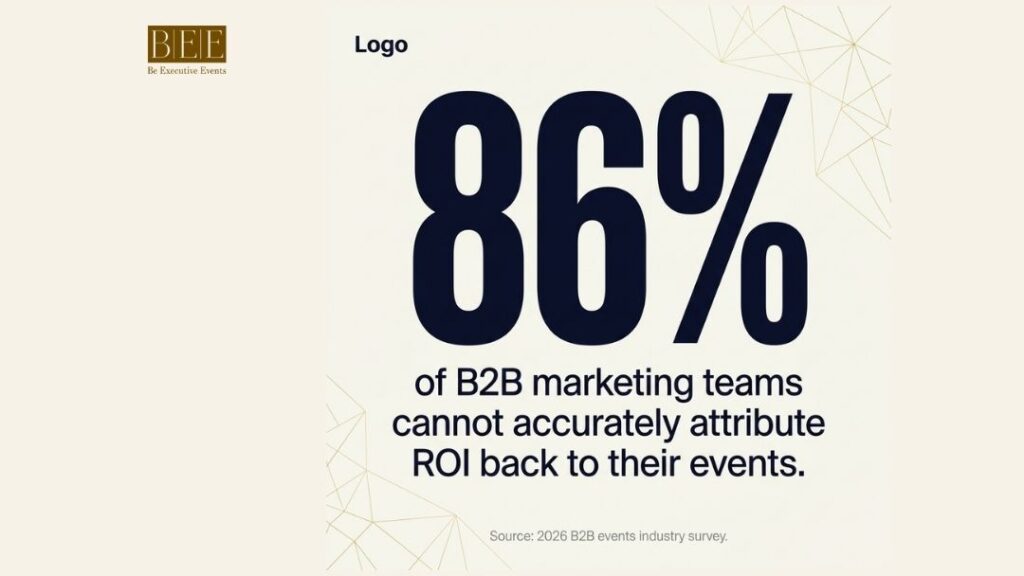
Registration counts and booth traffic look good in a slide deck, but they rarely predict revenue. 86% of B2B marketing teams say they cannot accurately attribute ROI back to their events, which makes the wrong metric an expensive habit to keep.
Executive event ROI should be tracked through pipeline created and meetings booked, not attendance alone.
| Vanity Metrics | Business Metrics |
| Registrations | Pipeline created |
| Attendee volume | Executive engagement |
| Booth traffic | Meetings booked |
| Social mentions | Revenue influence |
Are Smaller B2B Events Better Than Large Conferences?
The answer is not bigger versus smaller. It is reach versus relevance. A conference vs small event for B2B comparison usually comes down to what a team needs right now, not which format is objectively better.
| Large Conferences | Smaller Events |
| Maximum exposure | Maximum engagement |
| Broad awareness | Deep relationships |
| Higher investment | Flexible budgeting |
| Industry visibility | Executive access |
Why Many Organizations Are Building Event Portfolios Instead of Relying on One Flagship Conference?
One conference every year is being replaced by several intentional moments throughout the buyer journey. Planning for large flagship events dropped 12% year over year, while more marketers report running smaller, hosted events instead.
The lift varies by company size too. Smaller companies tend to see the biggest jump in closed deals from live, intimate formats, while larger enterprises get more value from virtual reach. A portfolio built from a few formats, timed across the year, tends to outperform a single big bet.
Frequently Asked Questions About Alternatives to Large B2B Conferences
What are the best alternatives to large B2B conferences?
Executive roundtables, VIP dinners, regional roadshows, workshops, virtual forums, advisory boards, and peer communities are the most common alternatives to large B2B conferences. Each one fits a different goal, so the right pick depends on what the event needs to prove.
Do smaller B2B events generate better ROI?
Often, yes, for pipeline and retention goals. Smaller events cost less to run and reach a more relevant audience, though conferences still win on pure reach and brand visibility.
Are executive roundtables more effective than trade shows?
For account based marketing and executive access, roundtables usually perform better. Trade shows still win when the goal is broad exposure to a large, mixed audience in a short window.
How many attendees should an executive event include?
Most executive roundtables work best with 8 to 15 senior guests. VIP dinners run well with 10 to 20. Beyond that range, the room starts to lose the intimacy that makes these formats work.
What event format works best for account-based marketing?
Executive roundtables and VIP dinners tend to work best for account based marketing, since both formats let a team focus on a small, named list of target accounts.
A final note. There is no single best format among the alternatives to large B2B conferences. The goal decides the room size, not the other way around. A flagship conference, a private dinner, and a regional roadshow can all sit in the same plan, each doing a different job.
Work With a Team That Builds the Right Format for Your Goals
Be Executive Events has built more than 250 events across Europe, North America, and Asia over the past 10 years, working with enterprises, SaaS companies, and consultancies on every format in this guide.
Private roundtables, VIP dinners, regional programs, and virtual forums are all part of the offering, each one built around a clear business goal rather than attendance numbers.
If your team is weighing the alternatives to large B2B conferences and wants a partner who has run all seven formats at scale, get in touch with Be Executive Events today.