
A roundtable sponsorship proposal usually arrives with a venue, a date, and a headcount. It rarely arrives with what a demand-generation lead actually needs in order to approve it: a defensible reason this line item will outperform the next best use of the same budget.
That is the real question behind “is it worth it?”. Not whether executive roundtables are a good idea in the abstract, but whether this specific room, built by this specific organizer, will put your named accounts in front of you in a way that a booth, a paid media flight, or three months of outbound effort would not.
For demand-generation and field marketing teams, executive roundtable sponsorship is ultimately a question of whether the access, account coverage and executive engagement justify the spend.
What “worth it” means when you are the one paying for the table
If you run demand generation or field marketing for a B2B SaaS business, you are working against a target-account list and a quarterly pipeline number. Your constraint is not awareness. It is access to the small group inside each account who decide whether a platform gets evaluated at all.
Sponsors who come away disappointed almost always hit one of two failure modes.
The first is a room of the wrong seniority. The invitation said CxO; the room delivered managers and analysts sent in their place. Everyone was pleasant, nobody could authorize anything, and the follow-up went nowhere.
The second is subtler and more expensive: the right people, with no reason to speak. Twelve genuinely senior executives sit through a topic framed around a product category rather than a business problem, contribute politely, and leave. You paid for access and received attendance.
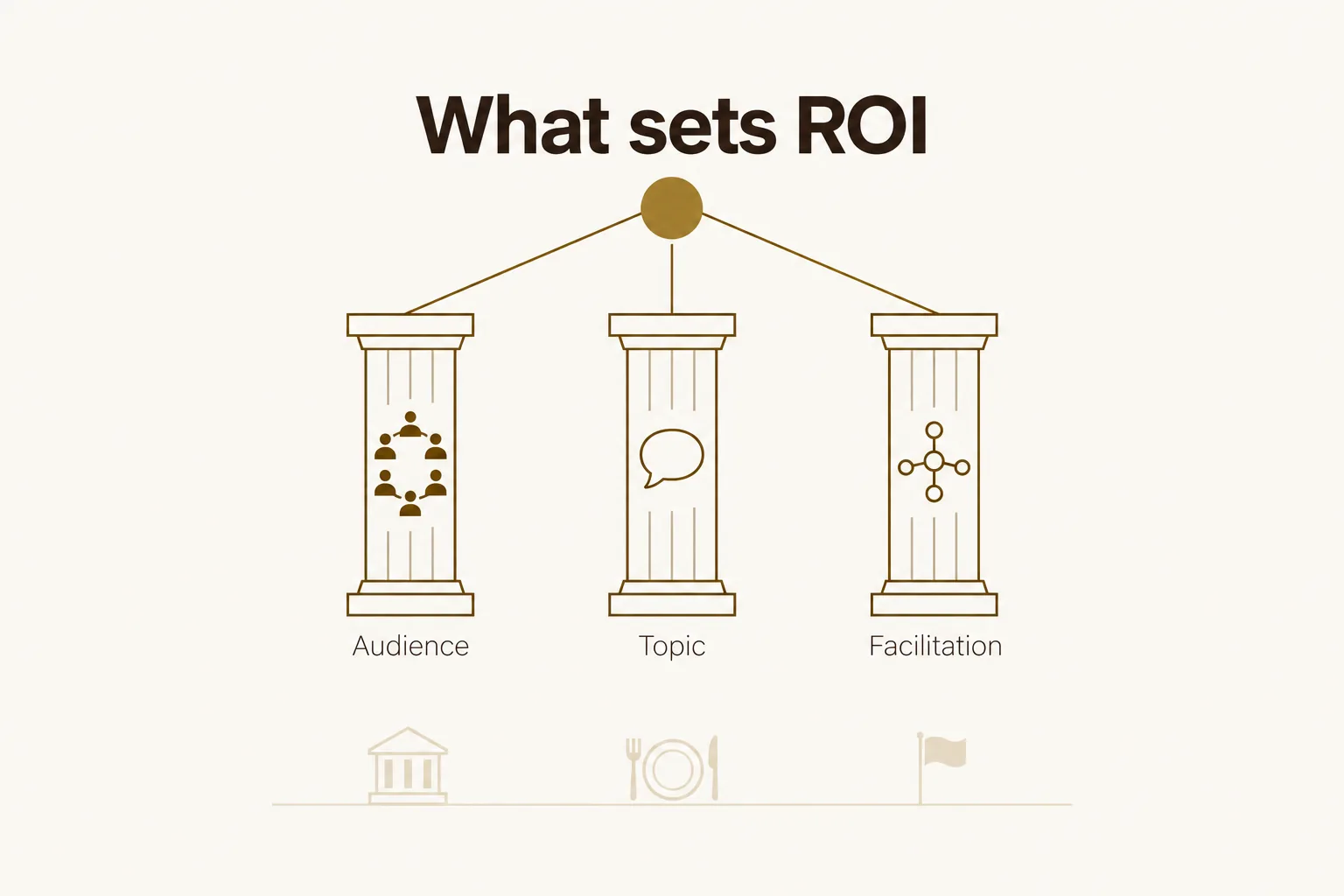
Both failures are decided long before anyone sits down. Sponsorship value is set by three things: how the audience is defined and verified, how the topic is framed, and how the conversation is facilitated. The venue, the menu, and the branding are the visible part of the spend and the least predictive part of the return.
What follows is a diligence framework you can apply to any roundtable offer currently on your desk.
What an executive roundtable actually is
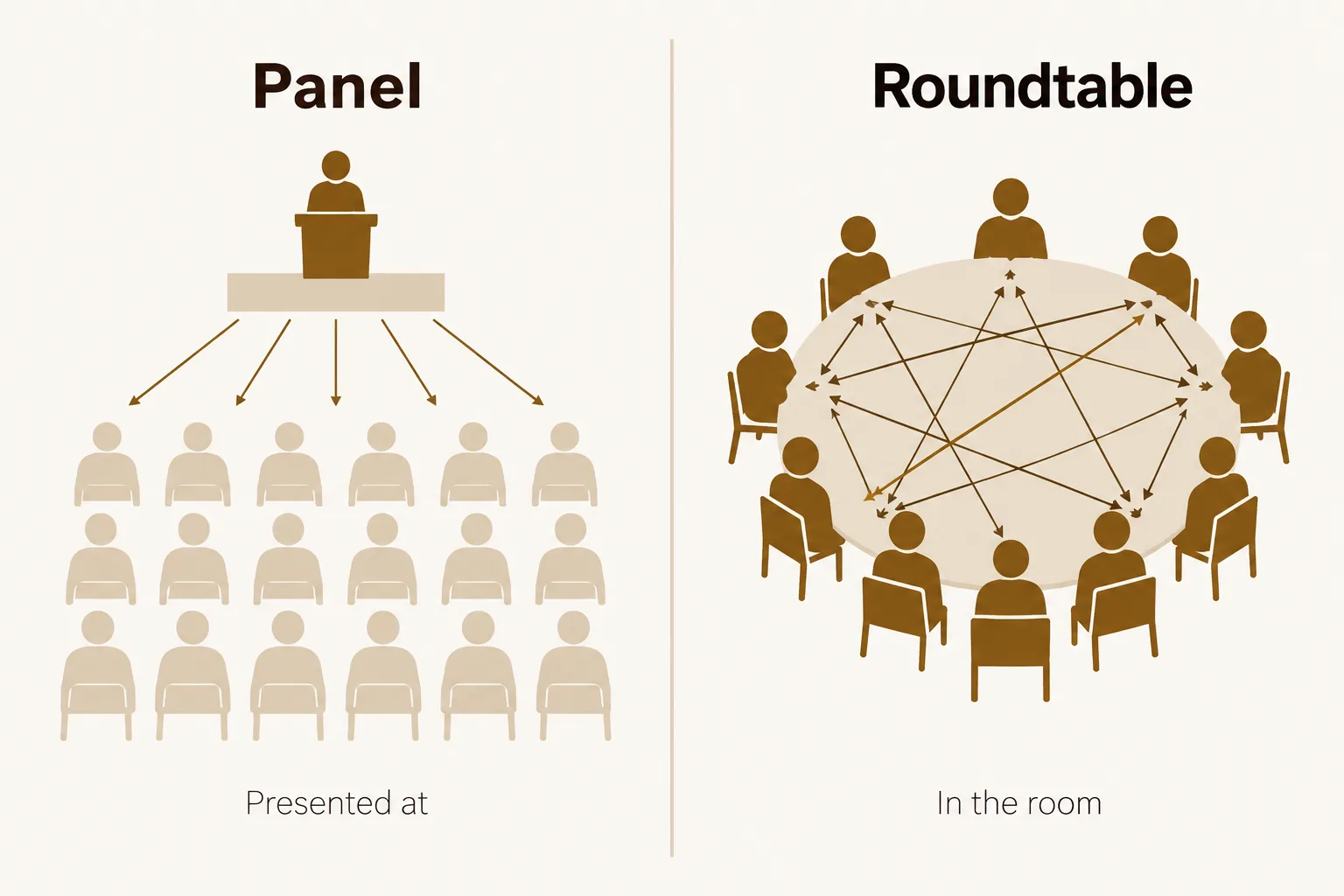
An executive roundtable is a closed-door, invitation-only discussion among senior decision-makers, built around one business challenge. There is no stage, no deck, and no pitch. The executives in the room are the content, not the audience for someone else’s content.
That single distinction separates it from the formats it is often confused with. A panel puts three people on a platform and the rest in rows. A webinar broadcasts to an audience that can mute you.
A conference breakout is a presentation with a Q&A appended. In each, the sponsor talks and the executives listen. In a roundtable, the sponsor convenes and participates, and earns airtime through the quality of the question it puts on the table.
In practice the format shows up in three shapes:
- The executive dinner roundtable, typically two to three hours around one table, with the discussion structured but conversational.
- The half-day working session, used when the challenge needs depth (a transformation program, an AI governance question, a cyber risk posture) and warrants breakout threads.
- The branded virtual roundtable, run across regions when the target executives sit in different markets or the topic does not justify travel.
The reason this suits high-value decision-makers (chief executives, founders, owners, and the wider CxO tier) is straightforward. It offers peer candour, protected time, and no vendor theatre. Senior leaders will give up an evening to compare notes with peers facing the same problem. They will not give up an evening to be presented at.
How many executives belong at the table
Size is not a logistics detail. It is the single mechanical factor that decides whether a discussion happens.
The working range for a curated executive roundtable is roughly 8 to 15 seated participants, with the wider band across dinner and larger formats running from about 6 to 26. The logic is simple: small enough that every person speaks at least twice, large enough that two late cancellations do not collapse the conversation.
This is one of the practical reasons smaller curated formats behave so differently from large B2B conferences, where the same budget buys presence rather than participation.
Virtual roundtables run tighter than in-person ones. Attention decays faster on a call, cross-talk is harder to manage, and a facilitator cannot read the room through body language. Eight to twelve is usually the ceiling for a genuine discussion online.
Over-inviting is the most common destroyer of sponsorship value. At 30-plus, you no longer have a roundtable. You have a presentation with catering, and the executives who came for peer conversation quietly disengage.
Ratio discipline matters just as much. If four people from the sponsoring vendor sit at a table of twelve, the executives will read the room correctly and behave accordingly. Two is usually right: one to frame, one to listen and take notes.
The format and flow of a well-run executive roundtable
The sequence below separates a structured session from a dinner with name cards.
Before the event. Short framing calls with confirmed attendees, so the agenda reflects problems those specific executives are working on this quarter rather than a vendor’s roadmap. This step also protects attendance: an executive who helped shape the agenda is markedly more likely to show up.
Opening. Chatham House-style ground rules stated out loud, then a round-the-table positioning where each executive names their current challenge in ninety seconds. That gives the moderator a live map of where the energy is.
Core discussion. Two or three threads, facilitated by an independent moderator whose job includes redirecting any participant, sponsor included, who starts pitching. Independence is not a nicety. It is what allows executives to speak freely in front of a vendor.
Sponsor moments. A short framing input near the start and a synthesis at the close, both earned contributions to the discussion rather than scripted sales content. The synthesis is the most valuable slot in the evening and the most commonly wasted.
Close. Agreed takeaways, peer follow-ups, and a clean, low-pressure path to a next conversation for anyone who wants one.
After the event. An attendee-level report, the substance of what was discussed, and recommended next steps per account. Without this, the sponsorship cannot be attributed and the knowledge in the room evaporates within a week.
Executive roundtable vs the Business Roundtable: not the same thing
Sponsors researching the format frequently land on results about the Business Roundtable, which is something else entirely: a nonprofit association whose members are chief executive officers of major U.S. companies, a membership and advocacy body rather than an event format.
An executive roundtable, by contrast, is a private convening that any organization can host. The distinction matters when you are benchmarking. Your comparable are other privately convened executive sessions, not the published output of a chief executive association.
What a sponsorship fee actually buys
Executive roundtable sponsorship is not simply a fee for a venue, dinner and a list of attendees. It is a package of audience acquisition, event delivery, moderation and post-event support, and each component should be assessed separately.
| Sponsorship component | What it should include | Why it affects ROI |
|---|---|---|
| Audience acquisition | Target-account outreach, qualification, RSVP management and reconfirmation | Determines whether the room contains the senior decision-makers you actually need |
| Agenda and content design | Business-question development and pre-event framing calls | Makes the discussion relevant enough to generate meaningful executive participation |
| Venue or platform | Private meeting space, dinner setup or virtual event platform | Enables the session, but is less predictive of return than audience quality |
| Moderation | Independent facilitator with experience running executive discussions | Keeps the conversation peer-led and prevents the session from becoming a sales presentation |
| Event execution | On-site coordination, technology support and attendee management | Reduces operational friction that can damage the attendee experience |
| Post-event reporting | Attendee-level engagement notes, account insights and recommended next steps | Turns the conversation into usable account intelligence and follow-up opportunities |
The cost distribution is counterintuitive. Audience acquisition is the expensive part and the part that decides your return. Venue and catering are the visible part and, in pure ROI terms, close to irrelevant. A perfect private dining room filled with the wrong titles is a write-off. A functional meeting room filled with twelve in-profile CxOs is not.
This is where “venue plus invite list” services diverge from turnkey delivery. In the first model, the organizer sends invitations to a list they already own and hopes enough people accept.
In the second, attendance is committed against an agreed profile and every attendee is pre-approved by the sponsor before the seat is confirmed.
The pre-approval right is the clearest test of whether an organizer is confident in their sourcing.
The same question applies to the list itself. Recycled databases produce recycled rooms. Events built from scratch against your named accounts and go-to-market priorities cost more to fill, and they are the only version that moves an account-based program.
Virtual executive events change the cost structure without changing the audience standard. No venue, no travel, no catering, which alters the per-conversation economics considerably. It should never alter the seniority bar.
The ROI model: how to price a roundtable before you sign
Build one number before the contract goes out, then defend it afterwards.
Cost per qualified executive conversation. Take the total fee, add your internal time and travel, and divide by the number of in-profile executives who actually engaged. Not registrations. Not attendees. Executives who were in profile and who contributed. A twelve-seat dinner where nine in-profile leaders engaged is a very different asset from one where four did.
Compare that figure honestly against the same budget spent on a conference presence, paid media against the same titles, or the fully loaded cost of an SDR team working the same account list for a quarter. Roundtables tend to look expensive per head and competitive per qualified senior conversation.
Target-account coverage. Of the named accounts on your ABM list, how many now have a senior relationship that did not exist before? This metric survives contact with your CRO, because it maps to the account plan rather than to an event.
Time-to-meeting. How quickly after the session does a follow-up conversation get booked? It is a leading indicator, available in weeks, and far more useful for deciding whether to run the next session than closed-won data arriving three quarters later.
Related readingExecutive Event ROI: How to Measure & Maximize ValueRead the guide →| ROI metric | How to calculate it | What it tells you |
|---|---|---|
| Cost per qualified executive conversation | Total sponsorship cost ÷ in-profile executives who actively engaged | Whether the spend is producing valuable senior-level conversations |
| Target-account coverage | Target accounts with a new senior relationship ÷ total target accounts invited or targeted | How effectively the event is expanding access within priority accounts |
| Time-to-meeting | Time between the event and the next qualified meeting | How quickly event engagement turns into an actionable sales conversation |
| Opportunity influence | Existing opportunities with measurable event engagement | Whether the roundtable is accelerating deals already in the pipeline |
| Cost per qualified attendee | Total sponsorship cost ÷ in-profile executives who attended | Shows the efficiency of the audience acquisition and event delivery |
Be precise about what a roundtable does and does not buy. It creates conditions: access, trust, and context. It does not guarantee deals, and any organizer who implies otherwise is telling you something about their diligence rather than their capability. Enterprise buying is a group activity, so influencing one CxO usually improves your position inside the cycle and shortens it. It rarely replaces the cycle.
Signals a roundtable is worth sponsoring
Run the proposal against these seven checks.
1. Named-account alignment. The organizer works from your target list and tells you honestly which accounts they can and cannot reach. A confident partner will decline a name rather than promise it. 2. Pre-approval rights. You see and approve every attendee before confirmation, with seniority and function verified rather than self-declared. 3. Topic ownership. You help set a business question the executives care about, not a product category question dressed as one. “How are peers sequencing AI investment against existing data debt?” fills a table. “The future of our platform category” does not. 4. Independent facilitation. A moderator who has run these rooms before, with agreed limits on pitching that apply to you as well. 5. Compliant, transparent outreach. The organizer can describe how executives are contacted (email, LinkedIn, trusted B2B data providers), on what lawful basis, and with what route to opt out. UK regulatory guidance confirms that the PECR rule on direct marketing by electronic mail does not apply to corporate subscribers, so B2B email to a corporate body does not require PECR consent. 6. A written substitution and no-show policy. Executive diaries move. What happens when three of them move is a contractual question, not a goodwill question. 7. Defined post-event deliverables. Attendee detail, engagement notes, and next-step recommendations, specified before you sign.
Red flags that predict a wasted sponsorship
- Guaranteed headcount with vague titles. “Senior stakeholders” with no defined CxO, VP, or Director standard means the shortfall will be filled with whoever is available.
- The organizer will not explain how attendees are sourced, or declines to give you pre-approval rights.
- An agenda built around your slides, including a keynote-style speaking slot in a room of twelve.
- The same faces recurring across unrelated sponsors’ events, which usually indicates an incentivized attendance pool rather than a curated audience.
- No moderator, or a moderator supplied by your own sales team. Executives read that instantly.
- No post-event reporting, which leaves you unable to attribute anything and unable to argue for a second session.
- Crowded multi-sponsor rooms where competing vendors dilute the discussion and the executives disengage from all of them.
Virtual, in-person, or both: choosing the format that justifies the spend
In-person dinners and roundtables deliver the highest trust density. Peer candor is stronger, side conversations happen, and the fifteen minutes after the formal close are often where the real opening appears. They fit best when a concentrated set of high-value accounts sits within reach of one metro.
Branded virtual executive sessions and webinars buy reach. They remove venue and travel cost, which lowers cost per executive and makes a recurring series realistic across UKI, DACH, BENELUX, and NAMER without a travel budget. They also let you convene a role that is thin on the ground in any single city, such as a specific data or AI leadership profile.
The sequencing that works well: run a virtual session to surface which accounts and which executives engage across regions, then convene an in-person roundtable for the ones that did. The virtual session qualifies the room the dinner will fill.
Where virtual falls short is relationship depth and informal conversation. Nobody lingers on a call. Plan for that rather than pretending otherwise.
Discussion themes can be repurposed afterwards into on-demand sessions or follow-up campaigns, which extends value well beyond the room, provided attendee confidentiality is respected and nothing attributable leaves the session without permission.
Roundtable sponsorship against large-conference sponsorship
Conference sponsorship buys visibility to many. Roundtable sponsorship buys attention from few. Both are legitimate, and the choice depends on what your quarter actually needs.
The attention economics favor the roundtable for senior access. Supplier face time is scarce across the whole buying journey: research on B2B buying behavior finds that buyers spend only 17% of their total purchase journey meeting with potential suppliers.
At a large conference, you compete for a slice of that slice against every other exhibitor in the hall. A roundtable seat is a committed block in an executive’s calendar with no competing stimulus.
Conferences still win when you need category-level brand awareness, a product launch moment, or high-volume lead capture across a broad audience. Roundtables win when you have a defined target-account list, a complex considered purchase, and a need for trust at the senior level before an evaluation will ever start.
A common pattern among demand-generation leads under budget pressure: reallocate part of a single large conference sponsorship into a series of curated executive sessions across priority regions, then compare the two on cost per qualified executive conversation rather than on lead volume.
Measuring what happened after the room empties
Same week. A moderator debrief, per-attendee notes, and a named owner assigned to each account within 48 hours. Roundtable value decays fast, and the most common attribution failure is a good event followed by nothing for a fortnight.
Reporting that matters. Who attended against the agreed profile, what each executive said they were prioritizing, and which accounts warrant a follow-up meeting. Attendance count is a vanity signal. Contribution to the discussion, questions asked, and follow-ups requested are engagement signals, and they predict pipeline far better.
30, 60, 90 days. Meetings booked, opportunities created, and measurable influence on existing opportunities inside the target accounts. Track influence explicitly, because a roundtable often accelerates a deal already in flight rather than creating a new one.
Where the group discussion surfaced a specific need, facilitated 1:1 follow-up meetings are a useful optional layer. They convert a shared conversation into an account conversation without the awkwardness of a cold follow-up.
Finally, feed what you learned into the next session’s topic. A series that evolves its question compounds. A series that repeats its question loses the executives who came the first time.
Timing and regional realities that affect attendance
Senior attendance is seasonal, and ignoring the pattern is an avoidable way to waste a sponsorship.
The strongest windows are late February to July, when fresh budgets are allocated and diaries are open before summer, and September to early December, when executives push to close the year. The second window is the busiest in the calendar, particularly in Europe after the summer return.
The weak windows are August in Europe, when executive availability drops sharply and in-person sessions are difficult to fill, and the late-December to early-January period, when year-end closures dominate. Those months are for planning, not delivery.
Regional nuance is real. Europe shows a sharp summer slowdown and a strong September rebound, while North American demand often holds through the Q4 budget close. Virtual sessions continue through the quieter periods, at a reduced pace.
Lead time deserves the same discipline. Senior diaries typically need several weeks of notice. A roundtable assembled at short notice selects for availability rather than seniority, which is precisely the wrong filter. If you are planning next year’s program, lock the topic and audience profile ahead of the season rather than during it.
Frequently asked questions
What is an executive roundtable?
How many people should be at a roundtable?
What is the format of an executive roundtable?
Who are the attendees of the Business Roundtable?
Is a virtual executive roundtable worth sponsoring?
How is roundtable sponsorship ROI measured?
Where to start if you are testing the format
If you are evaluating executive roundtable sponsorship for the first time, the sensible move is to test one session against a clearly defined account list rather than committing to a full program.
The sensible first move is one session, run properly, against a defined account list. A single branded virtual executive session, one curated executive dinner or roundtable, or audience acquisition support for an event you already run will each tell you what you need to know without committing a year of budget.
Measure that first session on cost per qualified executive conversation and account coverage, not on attendance. If the numbers hold, a series across your priority regions becomes a straightforward business case rather than an act of faith.
If you are weighing a proposal now, the useful conversation covers three things: the audience profile you need in the room, the business question that will bring those executives to it, and the regions where your accounts actually sit. We are happy to talk that through before anyone discusses a date.