
Twenty-two confirmed CIOs on the list, fourteen in the room. Anyone who has run an executive roundtable recognizes that arithmetic, and it is not an administrative annoyance. At a table built around a named target list, eight absences remove eight of the accounts the event existed to reach, at exactly the cost printed on the invoice.
Most published advice on reducing no-shows was written for a different problem: clinical appointments, service bookings and open-registration webinars with four-figure sign-up counts. Those tactics assume a high-volume, low-value appointment where the attendee is the one seeking the service. An invitation-only executive gathering inverts that relationship.
The executive is the guest, the host is asking for two hours of the scarcest calendar in the building, and the strongest lever is not a better reminder email. It is who you invited, and why they should care.
Why Executive No-Shows Are a Different Problem From Ordinary Event Drop-Off
In a curated roundtable of 6 to 26 executives, a missing attendee is not one empty seat. It is a missing perspective in a discussion designed around peer exchange.
Two absences from a table of twelve change the dynamic: the conversation loses a sector viewpoint, the sponsor loses two of the accounts the event was built to reach, and the executives who did travel feel the room is thinner than promised. Peer quality is the product. Erode it and you erode the reason the next invitation gets accepted.
The second difference is measurement. A webinar that registers a thousand people and seats four hundred still produces four hundred records. An executive dinner built around ten target accounts and attended by six produces a specific, named shortfall against a list someone approved in writing.
The working thesis for the rest of this playbook: no-shows at executive events are mostly an audience-selection and relevance failure that surfaces on event day. Reminder cadence, calendar mechanics and waitlists are real levers worth running properly, but they recover a few points. Inviting the right executive decision-makers, for the right reason, recovers far more.
Quality of audience beats volume of registrations at every stage, from target-list construction through to the post-event report.
Measure First: How to Calculate an Executive No-Show Rate That Means Something
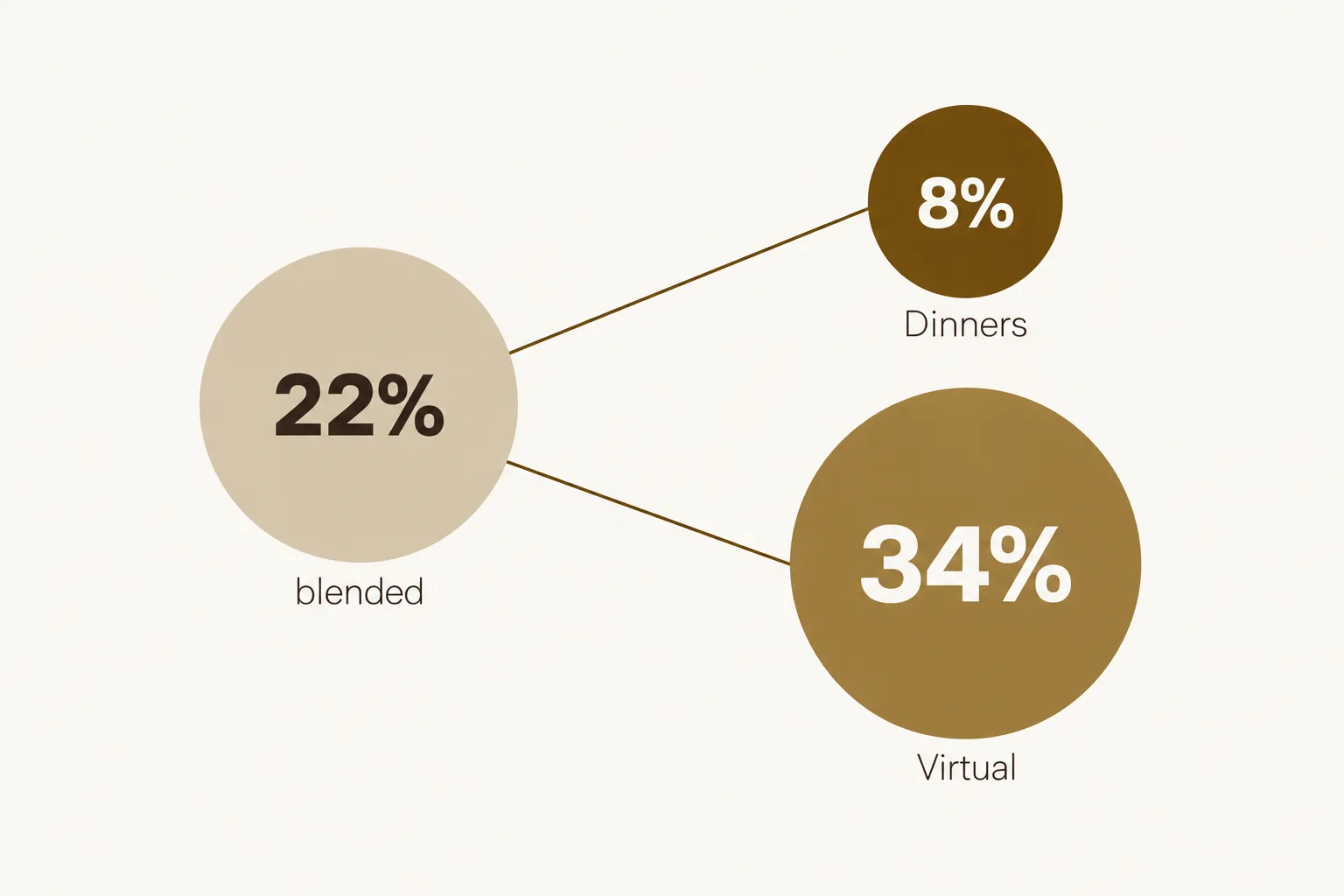
The formula is simple: no-shows divided by confirmed registrations, expressed as a percentage. The value comes from how you segment it.
Track the rate separately by format (virtual session, executive dinner, roundtable, summit), by seniority tier, by region and by acquisition channel. A 22% no-show rate that is actually 8% on in-person dinners and 34% on open virtual sessions is two different problems wearing one number.
Run a second metric alongside it: qualified attendance rate, meaning how many of the executives who did attend matched the approved target profile. A full room of the wrong titles is a worse outcome than a light room of the right ones, and only the second metric catches it.
Separate four outcomes that often get merged:
| Attendance metric | What it measures | Why it matters |
|---|---|---|
| No-show rate | Confirmed executives who did not attend | Shows how many confirmed seats were lost |
| Qualified attendance rate | Attendees who matched the approved target profile | Shows whether the room contained the right decision-makers |
| Late cancellation rate | Confirmed attendees who cancelled inside the release window | Shows how much demand could potentially be recovered |
| Substitution rate | Executives who sent a direct report instead | Identifies profile failures that a basic attendance rate can hide |
Set a baseline before you optimize anything, and re-measure the same way each time. Improvements you cannot attribute are improvements you cannot repeat.
What Actually Causes Senior Executives to Drop Off
Six causes account for most of the loss.
Calendar collision. Board meetings, quarter-end, a customer escalation or unplanned travel routinely displace a commitment made six weeks earlier. The executive is not being casual. Their diary is being rewritten by people more senior than your event.
Weak personal relevance. The invitation sold a topic rather than a decision the executive is currently accountable for. “The future of AI in financial services” is a topic. “How three CIOs handled data residency after their first agentic deployment” is a decision.
Low perceived cost of skipping. A generic, unbranded registration form carries no social or professional commitment at all.
Long lead time with silence in between. The gap between RSVP and event date is where commitment decays, and most programs leave it empty.
Delegation culture. The invitation gets forwarded to a direct report, which quietly becomes a no-show against the approved profile.
Logistics friction. An unclear venue, an unstated dress code, a joining link buried in a footer, no parking guidance, or a virtual platform that demands a download five minutes before the session starts.
Evidence from outside the events industry supports the lead-time point. Across 67 treatment organizations in 10 states, structured process changes, including reminder calls and shorter waits between scheduling and the appointment, cut no-show rates from 37% to 20%.
The setting is clinical and the numbers do not transfer to a CxO dinner in Frankfurt, but the mechanism does: less time for a commitment to decay, and more contact inside the window that remains.
Attendance Is Won at the Invitation Stage

Best practices for inviting senior executives to events and peer groups reduce to one principle: invite fewer, better-matched people and work harder on each one. A pre-approved target list built around the client’s go-to-market priorities attends at a materially different rate than a bought list of plausible titles, because relevance was established before the invitation went out rather than assumed afterwards.
Practical rules that hold across UKI, DACH, BENELUX and NAMER:
- Lead with the peer group and the question, not the sponsor’s product. Executives accept invitations to sit in a room with their counterparts. The brand pays for the room; it should not headline it.
- State format, size and duration explicitly. “Twelve CIOs, two hours, Chatham House rule, no slides” lets an executive price the time commitment accurately. Vagueness invites a soft yes, and soft yeses are where no-shows come from.
- Use GDPR-compliant outreach channels: email, LinkedIn and trusted B2B data providers, with an opt-out honored immediately. Executive outreach that cuts corners on data protection damages the host brand long before it fills a seat.
- Send from a named human, not a no-reply alias. A reply-able sender is the first step in a relationship, and the person the executive contacts when their diary moves.
- Qualify in a short call or exchange before confirming a seat. This is the highest-yield step in the process. It verifies profile fit, surfaces what the executive actually wants to discuss, and works as a commitment device: people keep appointments they have personally discussed with a human being.
Registration Design That Manufactures Commitment
Once an executive says yes, registration should ask something of them rather than merely record them.
Require an active choice instead of a pre-ticked box: select a discussion theme, choose between two breakout tables, state a dietary preference. Ask one substantive question, such as what they would most want to compare notes on with peers, then visibly use the answer in the agenda. An executive who sees their own question on the running order has a stake in the room.
Capture a mobile number with explicit opt-in for day-of contact, plus the executive assistant’s details where one exists. Send a personal confirmation from a named organizer within 24 hours rather than an automated receipt. Add a light re-confirmation step 5 to 7 days out that requires a reply, and treat silence as a red flag to work, not a yes to bank.
Commitment Devices That Work on Senior Executives
Standard advice says to charge a registration fee or take a refundable deposit, on the logic that free events suffer the highest drop-off. That holds for open, ticketed events. It transfers poorly to invitation-only executive roundtables, where the host is asking for the executive’s time, and charging for the privilege reframes a peer gathering as a sales event.
Non-financial substitutes do the same job:
- Give each attendee a role. An opening perspective, a case share, a table host position, or one question they have agreed to put to the group. A person with a role is expected by name, and they know it.
- Make scarcity real and specific. A fixed seat count, a peer list shared in advance, and a waitlist that is genuinely used. Manufactured urgency reads as marketing; a real constraint reads as curation.
- Use reciprocity. Pre-event benchmarking data, a peer-only research summary, or a moderator briefing call the executive has already invested twenty minutes in. Invested time is hard to abandon.
Where a paid or deposit model does fit (typically larger-format summits or third-party ticketed events), use it with clear eyes: it lowers casual drop-off and also lowers the number of senior people who register at all. None of these devices guarantee a full room. They raise the probability of one, which is the honest claim.
The Reminder Sequence: A Concrete Timeline for Executive Calendars
A workable cadence for an executive event confirmed four to six weeks out:
| Timing | Recommended touchpoint | Main purpose |
|---|---|---|
| Same day as confirmation | Personal note and calendar invitation | Confirm the commitment and secure the time |
| 14 days out | Agenda and confirmed peer list | Reinforce the value of attending |
| 7 days out | Personal check-in requiring a reply | Identify uncertainty before it becomes a no-show |
| 48 hours out | Logistics-only message | Remove travel, venue or joining friction |
| 24 hours out | Short SMS or messaging-app note | Surface last-minute changes quickly |
| Morning of the event | Brief time and location confirmation | Keep the event visible on the executive’s calendar |
The cadence is doing two jobs at once, and both are the mechanisms behind reminder calls and a shorter gap between scheduling and attendance: repeated contact, and less unattended time for the commitment to decay.
Vary the payload, not just the timing. Each touch should carry new information: a confirmed moderator, a discussion question, a venue detail. Six identical reminders train the recipient to ignore the sender.
Match channel to region and relationship. Messaging apps are ordinary business channels in parts of NAMER and increasingly in UKI, while a German or Dutch executive may treat an unsolicited WhatsApp message as an intrusion.
Where an executive assistant controls the diary, route at least one reminder through them. Give every message a one-tap way to confirm, reschedule or release the seat, which converts silent no-shows into recoverable waitlist slots.
Calendar Integration and the Assistant Problem
Provide a one-click add-to-calendar option (Google, Outlook, Apple) inside the registration flow and repeat it in every reminder. Better still, send a real calendar invitation from a person, so the event lands as a blocked, defended slot rather than an email to action later.
Put the working detail inside the calendar entry body, not only in email: travel buffer, venue address, joining link, dial-in and the organizer’s mobile number. That is where the executive looks at 17:55 while leaving another meeting. When details change, update the existing invitation rather than issuing a new one, or you create duplicate and orphaned entries that assistants resolve by deleting both.
Where an assistant manages the diary, copy them in with a plain-language summary of why the time is worth protecting: who else is attending, what will be discussed, and what their principal will leave with. Assistants defend slots they understand.
Keep the Commitment Warm Between RSVP and Event Day
The silent stretch between yes and event day is where confirmations quietly expire. Fill it:
- Share the peer list (anonymized to company and title level, or named with permission). For executive roundtables and business executive networking groups, peer quality is the strongest attendance driver you control.
- Publish the agenda and discussion questions early, and let attendees influence them.
- Send a short pre-read: a benchmark, a research extract, a summary from a prior roundtable. Not a promotional deck.
- Announce the moderator or a peer speaker as a dated milestone the reader can anticipate.
- Open light contact between attendees where appropriate, so the executive arrives already connected to someone in the room. Executive networking that starts before the event tends to survive a difficult calendar week.
Timing, Seasonality and Regional Scheduling
Executive engagement has two reliable demand windows: late February to July, when fresh budgets are allocated, and September to early December, when teams push to reach decision-makers before year-end. Attendance confirmations hold up best inside those windows.
The low-yield periods are equally predictable. August empties diaries across Europe, particularly in UKI, DACH and BENELUX, with a sharp rebound in September. Late December to early January is a planning window rather than a delivery window. NAMER holds up later into Q4 on budget-cycle pressure, but the holiday slowdown still arrives.
On day and time: mid-week evenings work for dinners, with Monday and Friday consistently weaker. Late morning or early afternoon suits virtual sessions spanning overlapping time zones. Where you can, shorten the gap between confirmation and event date. Long lead times invite calendar displacement.
Virtual Sessions Versus In-Person Dinners and Roundtables
Virtual executive events fail differently. The cost of skipping is near zero, so commitment has to be built through relevance, role and small group size rather than the sunk effort of travel.
What works: cap attendance, keep the session under an hour, use a named moderator, open with a round of introductions so every attendee is visible to peers, and choose a platform that runs in a browser without a download. A well-produced branded virtual event still lives or dies on who is in the room, not on the production overlay.
In-person formats lean on different levers: a venue worth the journey, a confirmed peer list, a personal reconfirmation call 48 hours out, and a realistic travel window built around the executive’s working day.
One warning on hybrid. Offering a virtual option for an in-person event converts confirmed physical attendance into optional viewing, and the people most likely to switch are the senior attendees you least want to lose. Keep recording and on-demand follow-up as a recovery path for genuine last-minute conflicts rather than advertising it up front as an alternative way to attend.
Over-Invitation Maths, Waitlists and Live Replacement
Work backwards from the seat count. Decide the target room size first, then set outreach and confirmation ratios per format and region from your own historical data rather than a published average drawn from an unrelated event type.
Maintain a warm, pre-approved waitlist of executives who match the same profile, so a 72-hour cancellation is filled rather than absorbed. Set a clear internal cut-off for releasing a seat, and communicate it as a courtesy (“if your diary moves, let us know by Tuesday and we will offer the seat to a peer on the list”) rather than as a threat.
Keep a named organizer reachable on the day for late arrivals, redirections and venue problems. This is ordinary event production management, and it is where a handful of near-misses become attendances.
One caution: do not over-invite so aggressively that the room loses its curated profile. Filling twelve seats with twenty-two invitations of declining relevance defeats the purpose of the format.
Handling No-Shows and Late Cancellations Professionally
Language. In reports and follow-ups, use neutral, factual wording: “unable to attend”, “did not join”, “released their seat”. Nothing that implies fault. The executive who missed this roundtable is a candidate for the next one, and clients read these reports too.
Records. Log every confirmed seat with an outcome: attended, substituted, late cancellation or no-show, with a reason where one is known. That log is what makes the next event better; without it you re-guess every quarter.
Policy. For invitation-only executive formats, a stated seat-release deadline plus a courteous reminder outperforms a penalty. Late-cancellation fees and forfeited deposits belong to ticketed or deposit-based models, where the attendee bought a place. Penalizing a guest you invited is a poor trade for a seat you can refill from a waitlist.
Follow-up. Within 48 hours, share the session summary or recording, offer a seat at the next session or a 1:1 conversation, and keep the relationship intact.
Then treat the no-show as intelligence. The reason almost always tells you whether the profile, the topic or the timing was wrong, and each has a different fix.
What to Report After the Event
Report attendance against the approved target profile rather than raw headcount: titles, companies, seniority tier, industry alignment and account match. Fourteen attendees, of whom eleven sit on the target account list, is a stronger result than twenty-two of whom seven do.
Include engagement signals from the room: who contributed, which themes drew the most debate, which priorities and timelines executives stated out loud. Track conversion from attendance to a next conversation, framed as an achievable outcome rather than a promised one. Feed no-show reasons back into targeting, cadence and scheduling for the next event in the series.
That is what closes the loop between audience acquisition, delivery and follow-up, and it is why a well-run second event outperforms the first.
Frequently Asked Questions
Related readingDinner Marketing for Enterprise Sales: The PlaybookRead the guide →Frequently asked questions
How can I reduce the number of no-shows at an executive event?
What is a reasonable no-show rate for an invitation-only executive event?
What should a late-cancellation policy look like for executive events?
Should I charge a fee to stop executives registering and not attending?
How should I word a follow-up to an executive who did not attend?
Start With a Format That Proves the Model
The fastest way to test any of this is on a small, contained format where the variables stay visible: a virtual executive session, or a curated roundtable or dinner of 6 to 26 CxOs built around a defined target list.
One event with a properly qualified audience, a real reminder cadence and a working waitlist will tell you more about your attendance problem than a quarter of incremental email tweaks across a larger program.
If your team already runs its own executive events and the issue is the quality of who turns up rather than the mechanics of the day, audience acquisition and registration support can run as a standalone piece of work against your approved profile.
If it would help to talk through target profile, region and timing for a specific event, start a conversation with BE Executive Events and we will map it out with you.