
If you run demand generation or field marketing for a B2B technology or SaaS business, you already know what a customer on the agenda does to RSVPs. A CIO will sit through a vendor deck out of politeness. That same CIO will clear an evening to hear how a peer in their own market handled a migration, a security program or an AI rollout that went sideways before it went right.
The hard part is the mechanics. How to get customers to speak at events comes down to who you ask, how you ask, how to get their communications team to sign off, and how to do it without straining the account relationship.
This is a guide to recruiting your own customers as speakers, not to pitching yourself as a speaker at someone else’s event. Treat it as an outreach program with a pipeline, not a single ask made six weeks out.
Why customer speakers change the economics of an executive event
A customer speaker lifts the quality of your RSVPs, not just the volume. Executive decision makers accept invitations for two reasons: who else is in the room, and who is speaking. An agenda built on internal presenters signals a product pitch. An agenda built on a named peer signals a conversation worth an evening.
That matters most in invitation-only formats. In an executive roundtable of 6 to 26 people there is nowhere to hide. If the speaker is a vendor, the room stays polite and shallow. If the speaker is a peer describing a decision they actually made, the other executives start contributing their own experience. That exchange is the entire point of executive roundtables and peer groups.
Build a speaker bench before you need one
Score candidates on three axes instead of picking whoever the account team likes most.
Related readingTurning Event Attendees into Customers: A Full GuideRead the guide →| Speaker criterion | What to look for | Why it matters |
|---|---|---|
| Story strength | A specific outcome, such as a consolidation, a timeline they beat, or a problem they solved differently | Gives the audience a real experience to learn from rather than a generic customer testimonial |
| Seniority fit | A CxO, SVP, VP or Director leading Transformation, Cloud, Cybersecurity, Data or AI | Matches the speaker’s perspective to the seniority of the room |
| Approval likelihood | A clear path through communications, legal or compliance | Prevents a strong candidate from getting stuck in approvals for weeks |
Check relationship health with the account owner before any name reaches a list. A speaker request lands very differently during a renewal negotiation or an open escalation.
The operational fix is a standing bench: 10 to 15 named customers per region, refreshed quarterly. Regional nuance is real. A UKI audience expects a UKI speaker. DACH rooms expect someone who understands local regulatory and works council context, and often expect German. BENELUX and NAMER behave differently again. One global bench does not serve four markets.
How to get customers to speak at events
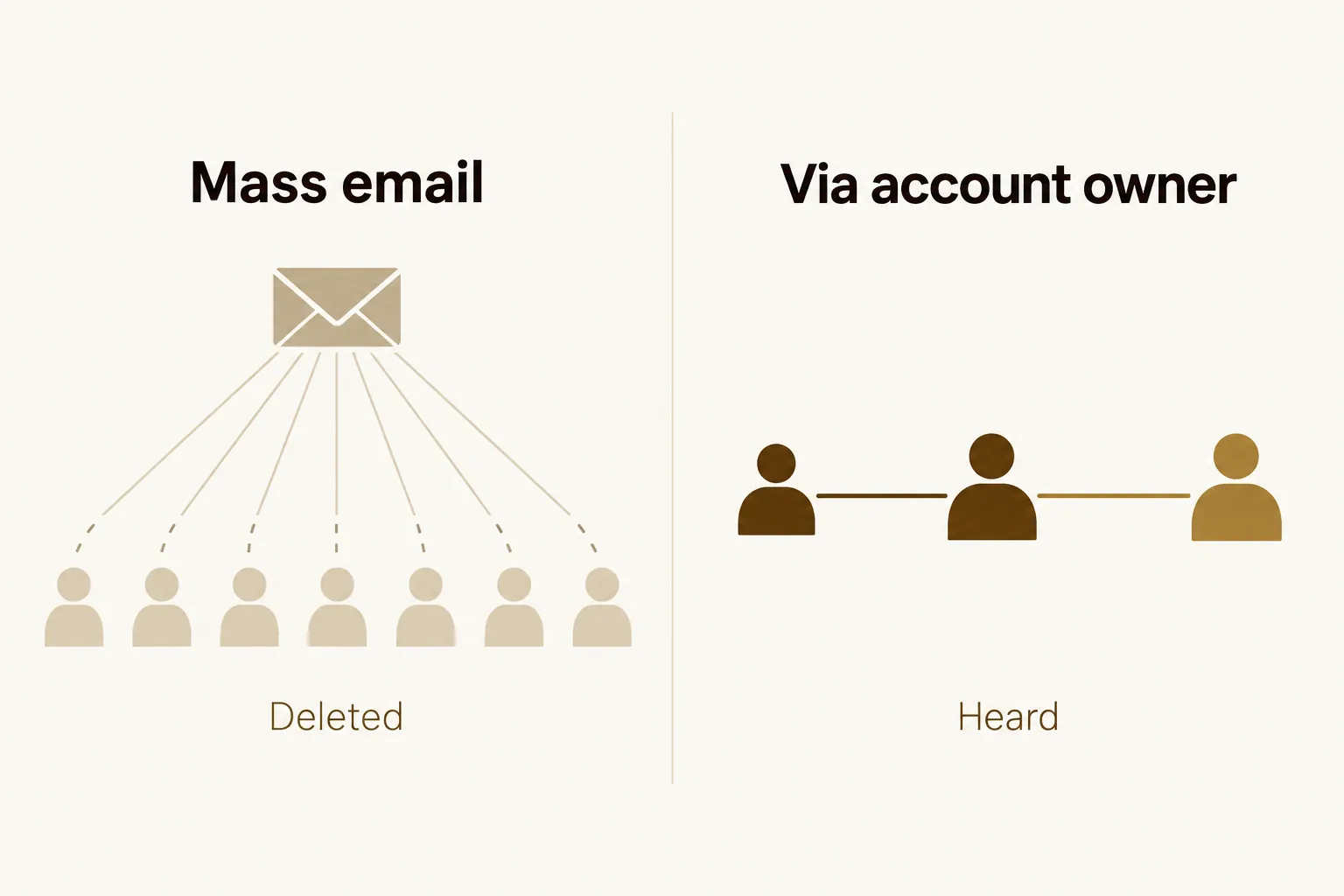
Route every ask through the relationship owner: customer success manager, account executive or partner lead. Never a mass email. A senior executive who receives a generic speaker invitation from an unfamiliar sender deletes it, and you have spent a relationship for nothing.
Keep the ask to four lines:
1. The outcome you want them to describe, named precisely.
2. Who else will be in the room, by title, industry and seniority.
3. The exact time commitment, prep included.
4. The date and the location or platform.
Lead with what they get, and be honest that it is not “exposure”. What a CIO values is a seat in a curated group of peers facing the same decisions, plus influence over what gets discussed. Say that.
A short personalized email or LinkedIn message followed by a 15-minute call converts better than a long written pitch. Where contact detail sits outside the existing relationship, source it through GDPR-compliant channels and trusted B2B data providers, with a clear route to object. Give a decision deadline and an easy way to decline; a fast no protects your agenda.
A usable skeleton:
> Subject: 20 minutes on your \[specific program\], 12 CIOs, \[city\], \[date\] > > We are hosting a closed roundtable for 12 CIOs in \[sector\] on \[date\]. The group wants to hear how you approached \[specific decision\]. No slides and no presentation: a moderated conversation where you answer three questions we agree in advance. Twenty minutes on the night, plus a 30-minute prep call. Dinner and travel are covered. If it is not right for you, a quick no by \[date\] is genuinely helpful.
Lower the cost of saying yes
Offer formats by effort, lowest first.
| Format | Speaker effort | Best use |
|---|---|---|
| Moderated roundtable seat | Low | Executives who want to share experience without preparing slides |
| Fireside chat | Low to moderate | A focused conversation with a moderator and questions shared in advance |
| Lightning talk | Moderate | A speaker who has one specific lesson or outcome to share |
| Panel | Moderate | Speakers who prefer sharing the discussion with other executives |
| Keynote | High | Experienced speakers who actively want a larger platform |
Default to the roundtable seat. For executives who cannot give up an evening, a branded virtual event or webinar removes travel and widens the geography you can draw a speaker from.
Write the questions and send them in advance. A speaker who knows exactly what they will be asked rarely declines. Then absorb the logistics: calendar holds, travel, dietary and access requirements, and a named contact reachable on the day.
Clear internal approvals before you announce
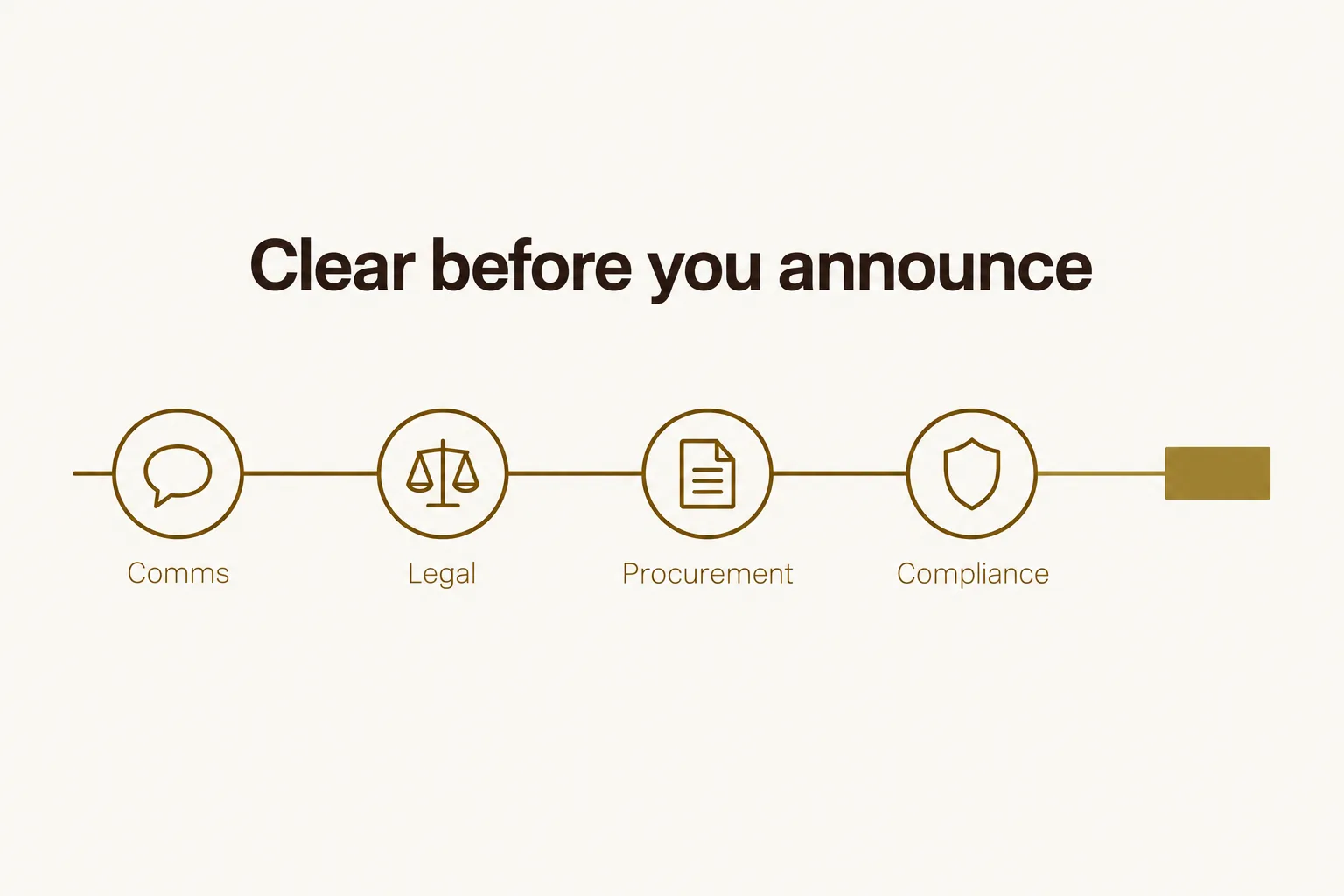
This is the step most speaker advice skips, and it is where programs fail. Most customer speakers need sign-off from communications, legal, procurement or compliance. In BFSI, healthcare and life sciences, and energy, policy may prohibit naming vendors, quoting performance or financial figures, or discussing live projects at all.
Ask three questions on the first call:
- Who approves this internally, and how long does it take?
- What can you not say publicly?
- Do we need an NDA, or non-attribution framing for the session?
Non-attribution framing (commonly described as the Chatham House Rule, where participants may use what they hear but not identify who said it) is the practical unlock when attribution is the only blocker. It suits closed-door roundtables and is often the difference between a no and a yes.
Get written confirmation of name, title and logo usage before any promotion goes live.
Prepare the speaker
One 30-minute prep call is usually enough. Confirm the arc (situation, decision, outcome, what they would do differently) and agree exactly which figures they are cleared to share.
Send a written brief: audience composition by title and industry, room size, timings, format, the moderator’s name and the questions. Run a dry run for anything longer than a lightning talk, and skip it for roundtable seats, where over-engineering the ask is the bigger risk.
Brief the moderator separately. Their job is to protect the speaker and keep the vendor pitch out of the conversation. Never script a customer into a testimonial. An executive audience detects a sales narrative quickly, and the peer value collapses when they do.
Incentives that work, and the ones that backfire
Senior speakers respond to access and influence: a named seat at an invitation-only gathering, a say in the discussion topics, introductions to specific peers. Build on that.
- Offer registration places for their own team.
- Facilitate a 1:1 with another executive in the room.
- Give them assets they own afterwards: the recording, a transcript, a written summary, or the session repurposed as on-demand content.
- Promote their brand alongside yours in the speaker announcement and on the event page.
Avoid cash fees and material gifts as a default. In regulated industries they trigger procurement and anti-bribery policies, and a paid speaker reads as a paid endorsement rather than a peer.
Promote the speaker to fill the room
The customer speaker is the strongest asset in your invitation. Their name and title in the subject line do more for acceptance among peer executives than the venue or the agenda description.
Give them an asset pack that makes promotion a two-minute job: a graphic, a suggested post and the event link. Their network is full of the executive decision makers you are trying to reach, so co-promotion pulls in the right profile.
Keep targeting tight anyway. Pre-approved, profile-matched invitations outperform an open registration page in executive networking formats.
Timing: when to ask, and when not to
Start speaker recruitment 8 to 12 weeks out for in-person dinners and roundtables, 4 to 6 weeks out for virtual sessions. Approvals, not availability, are usually the long pole.
Ask at the moment of proven value: shortly after a go-live, a milestone or a renewal, while the outcome is fresh and the internal sponsor still wants to talk about it.
Executive availability in Europe concentrates from late February to July and from September to early December. August is effectively dead for in-person formats across UKI, DACH and BENELUX, and the late-December window is for planning rather than delivery. NAMER follows a similar shape, with a stronger Q4 push as budgets close.
Handle the no, then build the pipeline
Every no contains a smaller yes.
- No time. Offer a roundtable seat instead of a talk.
- Not approved. Offer unattributed participation under non-attribution framing.
- Not comfortable presenting. Offer a moderated Q&A where they only answer questions.
- Wrong date. Book them into a virtual session later in the year.
Track the program as a funnel: identified, asked, accepted, approved, delivered, re-engaged. Debrief every speaker within a week and ask for one name. Customer speakers refer peer speakers, and that referral is the cheapest acquisition channel in the motion.
Measure what indicates quality: seniority mix in the room, session engagement, follow-up meetings booked, and whether the speaker would do it again.
Frequently asked questions
How do you attract customers at an event?
What are the 5 C’s of an event?
What are the 5 P’s of event planning?
How do you encourage people to participate in events?
Is it worth paying customers to speak?
Turning a speaker program into a repeatable motion
The operating rhythm is easy to describe and demanding to sustain: keep a standing bench by region, stage the ask through the relationship owner, clear approvals early, run one prep call, promote the speaker hard, debrief for the next name.
What usually breaks is capacity. Speaker procurement sits alongside audience acquisition, venue research, agenda design, execution and post-event reporting, while the same team runs a campaign calendar.
That is where end-to-end event production management earns its place: pre-approving attendee profiles against your target accounts, sourcing and briefing speakers, designing the discussion, and reporting on who was in the room and what happened next.
Planning your next executive program? A sensible first step is one curated format: a virtual executive event or webinar, or a single executive dinner or roundtable with 6 to 26 CxOs. If the event already exists and you need the right people in it, audience acquisition support on its own does the job. Start a conversation about which of the three fits the quarter you are planning.