
A CIO who accepts your invitation gives up ninety minutes of a heavily defended calendar. What they take away is decided almost entirely by the questions on the table. Get them right and the room produces the candid, peer-level exchange senior people cannot get from an analyst briefing. Get them wrong and you have spent your best budget line boring the exact accounts you wanted to open.
Below is a working question bank of executive roundtable discussion questions, grouped by business theme and phrased for delivery as written, followed by the selection, sequencing and facilitation logic that makes the questions land.
What an Executive Roundtable Is, and Why the Questions Carry It
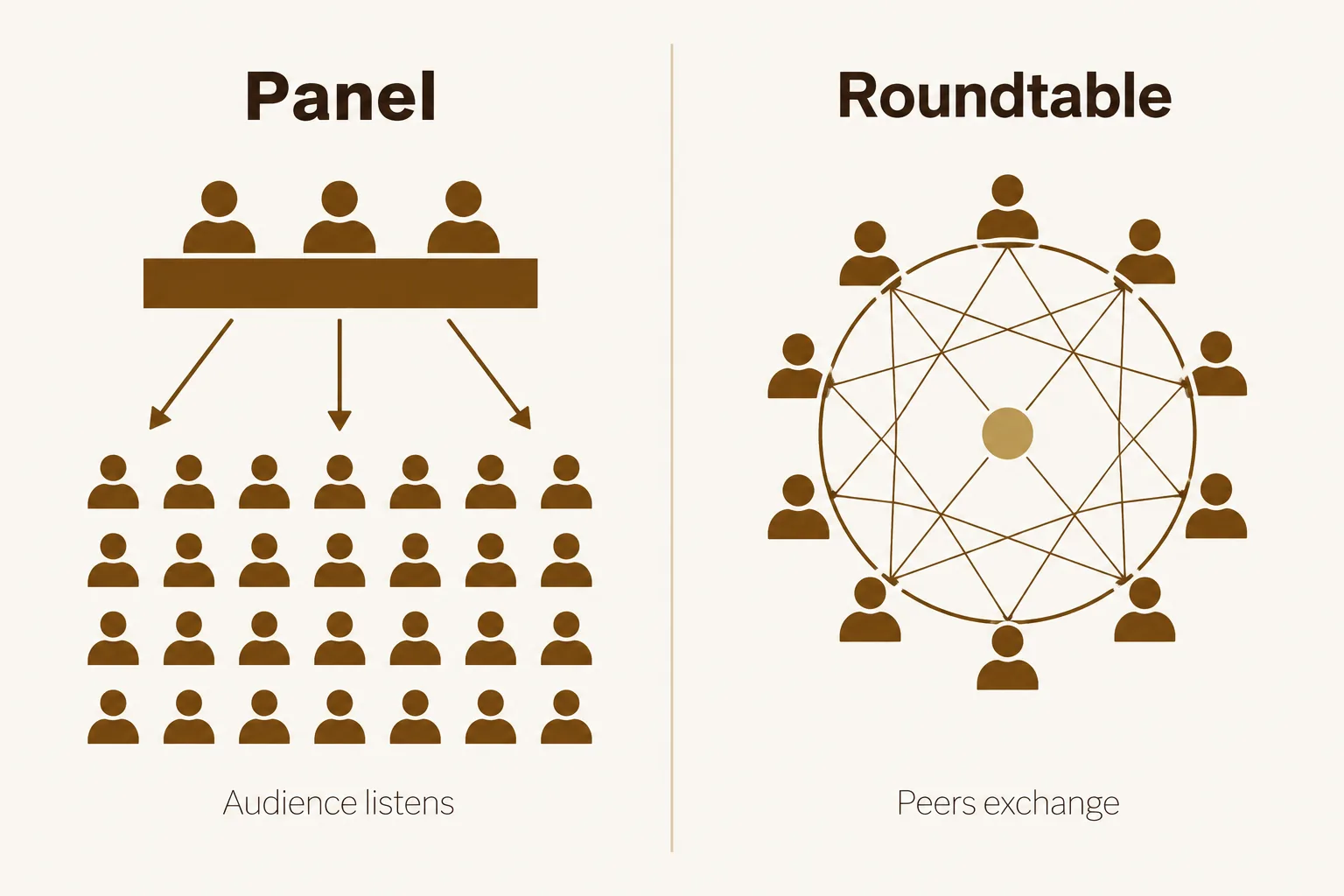
An executive roundtable is an invitation-only discussion among a small group of pre-approved senior decision-makers, typically 6 to 26 people, seated as peers rather than as an audience. No stage, no deck driving the agenda, no keynote. The question set is the agenda.
That separates it from the formats it gets confused with. A panel puts a few people in front of the rest. A webinar keeps the audience passive until the final ten minutes. A sales briefing has a predetermined destination. A roundtable has a direction but no predetermined conclusion, which is precisely why executives accept.
For the demand-generation or field-marketing leader funding the session, the stakes are practical. You are measured on the relationships and pipeline that follow, not on headcount. Weak questions cost credibility with a named account list you may only get one shot at.
What Separates a Good Executive Question From Filler
Senior people answer questions that let them reveal judgment. They avoid questions that test knowledge, because being wrong in front of peers has a cost and being right has no reward.
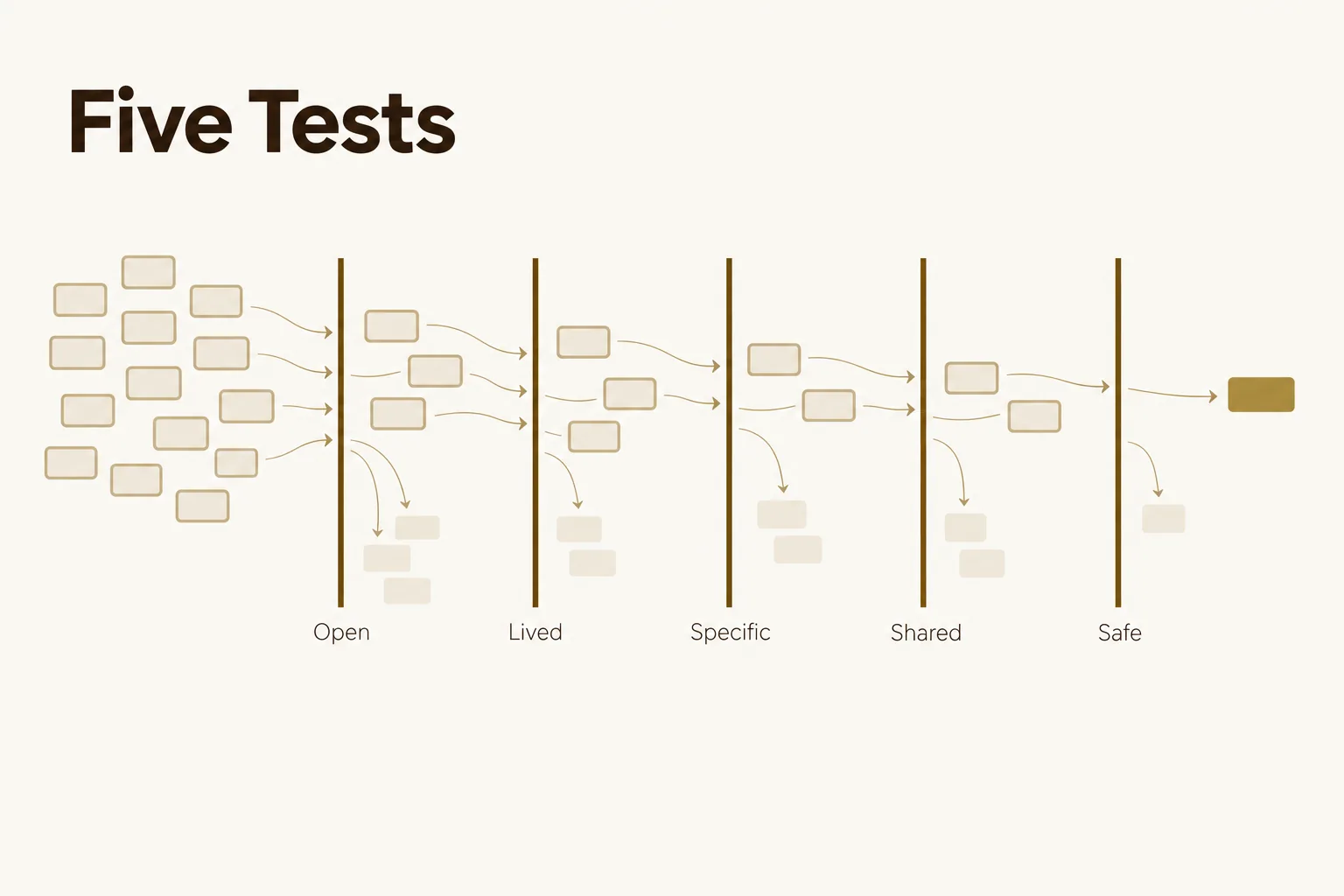
Five Tests Every Question Should Pass
1. No obvious answer. If the table would agree within ten seconds, you have written a statement with a question mark on it. 2. Answerable only from experience. It should require the executive’s own decisions, trade-offs or failures, not a definition anyone could look up. 3. Specific enough to be concrete, open enough to allow disagreement. Narrow the domain, not the conclusion. 4. Peer-relevant. Everyone seated can plausibly answer it. A question only two attendees can engage with strands the rest. 5. Safe to answer honestly under the ground rules you have set. If honesty would be commercially reckless, the answer will be a press release.
Question Types to Cut Before the Event
- Vendor-serving questions that route back to the sponsor’s product category. Candor ends the moment the table detects the funnel.
- Definition questions (“what is digital transformation?”) that put a CFO in a classroom.
- Yes/no openers. They close conversation rather than start it.
- Questions requiring disclosure of unannounced financials, live deals or personnel decisions.
- Compound questions stacking three ideas, so nobody knows which part they are answering.
Executive Roundtable Discussion Questions by Theme
Use one theme as the spine of the session and borrow two questions from an adjacent theme as pressure-release valves when the main line stalls or overheats.
| Business theme | What the questions should uncover | Example question |
|---|---|---|
| Strategy, Growth and Disruption | Growth constraints, market shifts and strategic decisions | Which shift in your market are you planning for that competitors still treat as noise? |
| Leadership, Talent and Culture | Leadership challenges, incentives and talent decisions | How do you keep functions with conflicting incentives pointed at the same outcome? |
| Technology, AI and Innovation | AI adoption, governance and technology investment | Which AI use case did you kill, and what did it teach you about the business case? |
| Operations, Efficiency and Resilience | Efficiency, operating weaknesses and resilience | Which two functions have the worst handoff, and what does that cost you? |
| Customers, Market Dynamics and Revenue | Buyer behaviour, customer retention and differentiation | What has changed in how your buyers evaluate and approve purchases in the last 18 months? |
| Risk, Security and Regulation | Risk exposure, regulation and security decisions | Which regulatory change is forcing an architecture decision you would not otherwise make? |
| Finance, Budget and Board Pressure | Investment decisions, funding and financial pressure | What proof does your board demand before releasing transformation funding? |
Tuning Questions to the Room: Role-Specific Prompts
A single-function table permits sharper questions than a mixed one. All CIOs, and you can open with architecture debt, platform consolidation and the shadow-AI problem. A CFO table engages on capital allocation under uncertainty and how transformation returns are actually measured.
A CHRO table responds to workforce redesign around AI and the retention of scarce technical leadership. A CISO table wants board reporting, overlapping regulation and third-party exposure.
Mixed CxO tables need a shared business problem as the frame, never a technology topic, because each function arrives with different priorities and different definitions of the same risk.
The ceiling is set long before the session. Question quality is capped by how precisely the attendee profile was defined and pre-approved. If the list was assembled by seniority label alone, no amount of question-writing will manufacture peer-level exchange.
Match the Questions to the Format
The format decides how many questions you need, how they are phrased and how much structure the moderator imposes.
Discussion-Based: 4 to 6 Open Questions, Heavy on Follow-Ups
Fewest questions, deepest exploration. The moderator probes rather than advances an agenda. Best when the group is genuinely peer-equal and the topic is contested.
Problem-Solving: One Real Problem, Questions as Scaffolding
A participant or the host frames a live problem, and the questions move the table from diagnosis to options to commitment. Requires a pre-event conversation with whoever owns the problem, or the framing collapses in the first ten minutes.
Expert-Facilitated: Short Input, Then Challenge Questions
Cap expert input at 10 to 12 minutes, then use questions that invite the table to disagree with it. Without the cap, the format quietly becomes a presentation and the peer dynamic never forms.
Sequencing a 90-Minute Executive Roundtable
| Session stage | Time | Question approach | Goal |
|---|---|---|---|
| Opening round | 10–15 min | One low-risk question that every attendee can answer | Establish voice and equal footing |
| Core discussion | 45–55 min | Two or three substantial questions with follow-ups | Explore the main business issue in depth |
| Sharpening | 15 min | The most contested or challenging question | Push the conversation beyond safe consensus |
| Close | 10 min | One forward-looking commitment question | End with a useful takeaway or next step |
Hold two spare questions in reserve rather than over-scripting.
A roundtable read from a list is a survey with catering.
Facilitation: How to Ask So Executives Actually Answer
Set ground rules before the first question. Non-attribution is the mechanism that makes candor possible: under the Chatham House Rule, participants are free to use the information received, but neither the identity nor the affiliation of any speaker or other participant may be revealed. Say it out loud at the start and the second half of the session changes.
Share the air deliberately. Track who has spoken and bring quiet participants in by name. This is not only etiquette: research on collective intelligence in human groups found that groups where a few people dominated the conversation scored lower than groups in which many members took turns talking.
The usable material almost always comes from the second question, not the first. “What made that hard?” and “What would you do differently?” convert a polished answer into a real one. Let silence run a full five seconds before rescuing the room. The moderator should speak least of anyone present, and should walk in briefed on every attendee’s role and current priorities.
Adapting Questions for Virtual Executive Roundtables
Virtual sessions strip out peripheral cues, so questions must be shorter and directed to a named person rather than released into the room. Post each one in chat as well as saying it. Cap virtual tables tighter than in-person ones and use a named speaking order for the opening round.
Breakouts need one question per room and a reporter agreed in advance, not volunteered on the spot. The trade-off worth naming: a virtual format can seat leaders from UKI, DACH, BENELUX and NAMER in one session, which is exactly why the questions should stay market-neutral rather than assuming a single regulatory or competitive context.
Regional and Scheduling Nuance
UKI tables tend toward fast, informal challenge. DACH tables reward precise, technically grounded questions and react badly to vagueness. BENELUX tables are direct and consensus-seeking. NAMER tables move quickly to outcomes and next steps, so build the commitment question in early. Where English is not the first language around the table, favor plain phrasing over idiom.
Timing matters as much as wording. August in Europe and late December across regions are poor windows for executive attendance; late February to July and September to early December are the workable periods.
Recruiting the table has its own constraints. In the UK and EU, B2B marketing email to a named individual at a corporate address still needs a lawful basis, and where legitimate interests is relied on, the ICO’s three-part test for legitimate interests applies: identify the legitimate interest, show the processing is necessary to achieve it, and balance it against the individual’s interests, rights and freedoms.
Compliant outreach by email, LinkedIn and trusted B2B data providers is a design requirement of the invitation process, not an afterthought.
Why Executive Roundtables Fall Flat
- Wrong room. Mismatched seniority makes peer-level exchange impossible regardless of question quality.
- Sponsor drift. The host converts discussion into a pitch and the table disengages, politely and permanently.
- Over-scripting. Too many questions turn discussion into an interview.
- No stakes. Topics chosen for safety produce agreement, and agreement produces nothing worth following up on.
- No follow-through. Insight surfaces, nobody captures it, and the next session starts from zero.
These failures share a cause: audience acquisition, agenda design, moderation and post-event reporting bought as separate pieces and optimized alone. Run as one chain, the attendee profile informs the questions, the questions inform the moderation brief, and the discussion informs both the follow-up and the topic for the next table.
The Questions Around the Session: Before and After
Ask every confirmed attendee two things in advance: what would make these ninety minutes worth your time, and what are you working on that this topic touches? Use the answers to select and reorder the question set, not to personalize a name badge.
Afterwards, three questions do the work: which part was most useful, what would you want to go deeper on, and who else should be in that conversation? Captured properly, the session becomes a record of attendee priorities that informs account follow-up, and the strongest themes become on-demand sessions, written summaries or the agenda for a second table.
Frequently Asked Questions
Related readingChief Executive Roundtable Organizer in Europe | BEERead the guide →Frequently asked questions
What are some good topics for a roundtable discussion?
What are some good discussion topics for a leadership roundtable?
What is the format of an executive roundtable?
What are some impressive questions to ask a CEO?
How many questions should a 90-minute roundtable have?
Should executive roundtable questions be shared in advance?
Putting the Question Set to Work
The order is sequential: the right room first, then the right questions, then disciplined facilitation. Reverse it and even an excellent question bank produces a pleasant evening with nothing behind it.
If you are planning your next session, the most useful conversation is about audience profile and topic, before anything gets booked. A curated executive dinner or roundtable of 6 to 26 pre-approved CxOs, a virtual executive session reaching leaders across UKI, DACH, BENELUX and NAMER in one sitting, or audience acquisition support for an event you are already running are all reasonable starting points.
Well-run roundtables create the conditions for trust, insight and pipeline. They never guarantee a deal, and anyone promising one is selling seats rather than conversations.