
A demand-generation lead with 300 named target accounts and a quarterly meeting number is not choosing between two tactics. They are deciding where a fixed amount of executive attention goes, and executive attention is the scarcest input in the whole go-to-market model. Spend it on a cold ask for thirty minutes, or spend it on an invitation to a room where the executive’s peers will be sitting.
That is the honest framing of C-level appointment setting versus executive events. Both channels solve one problem: access to CIOs, CISOs, CFOs, CHROs, and the VPs and Directors running transformation, cloud, data, and AI programs. They solve it with opposite mechanics. One pushes a request into a saturated inbox. The other creates a reason for the executive to opt in.
The Real Question Behind the Comparison
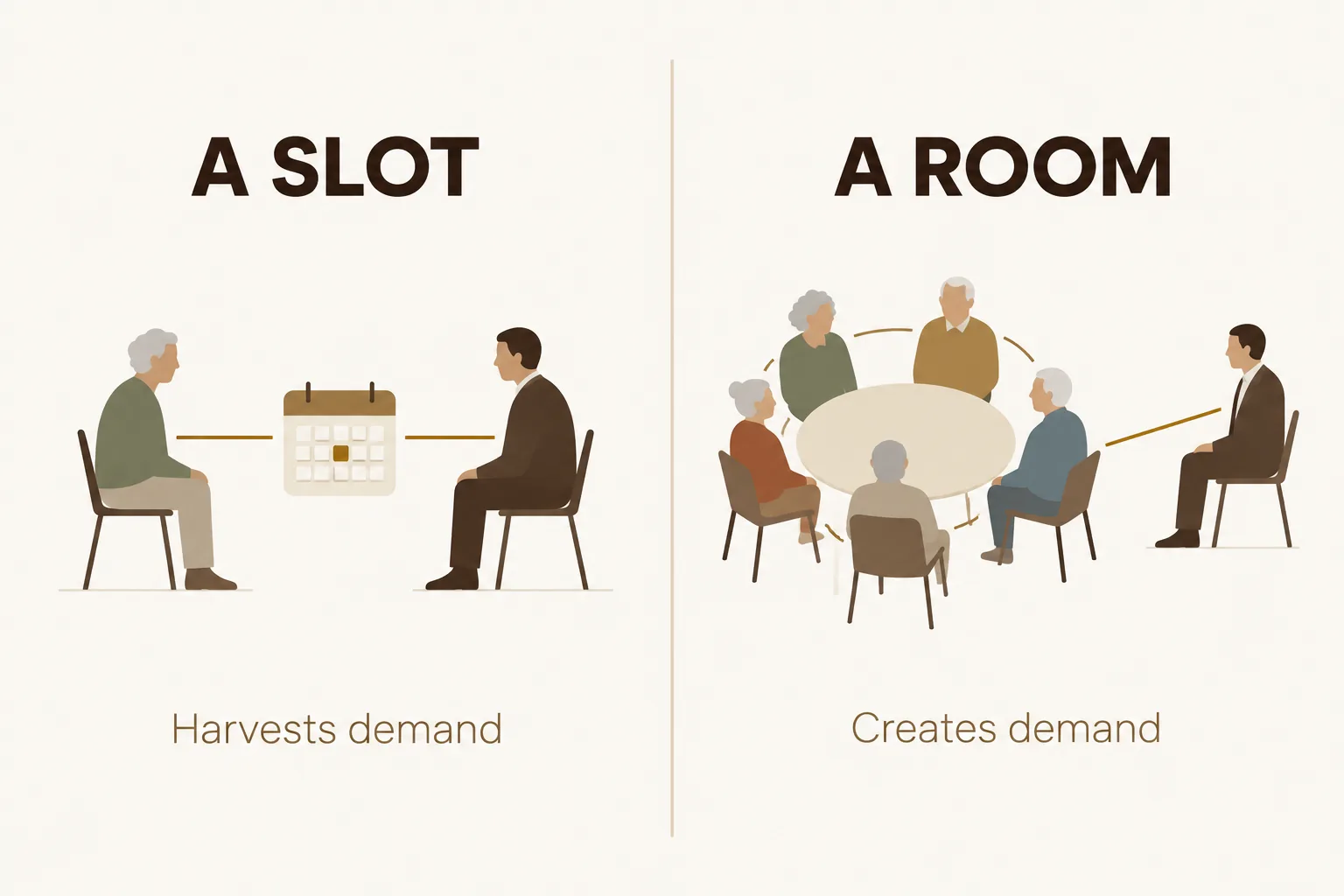
Appointment setting buys a slot: one executive, one seller, one calendar entry, and a conversation that starts from zero trust. Executive events buy a room: a curated group of executive decision-makers, an agenda they care about, and a peer dynamic that does most of the credibility work before the sponsor says anything.
The comparison gets useful when you stop treating it as a quality contest between vendors and start treating it as a question of buying stage, deal shape, and market. A booked meeting is a harvesting mechanism. It works when demand already exists and the executive has a reason to take the call. An executive event is a demand-creation mechanism.
It works when the category, the risk, or the priority is not yet on the executive’s agenda and needs to get there through peers rather than through a pitch.
Related readingC-Level Lead Generation Strategies That Work in 2026Read the guide →Most teams under-invest in the second because the first produces a number they can report on Friday.
What C-Level Appointment Setting Means
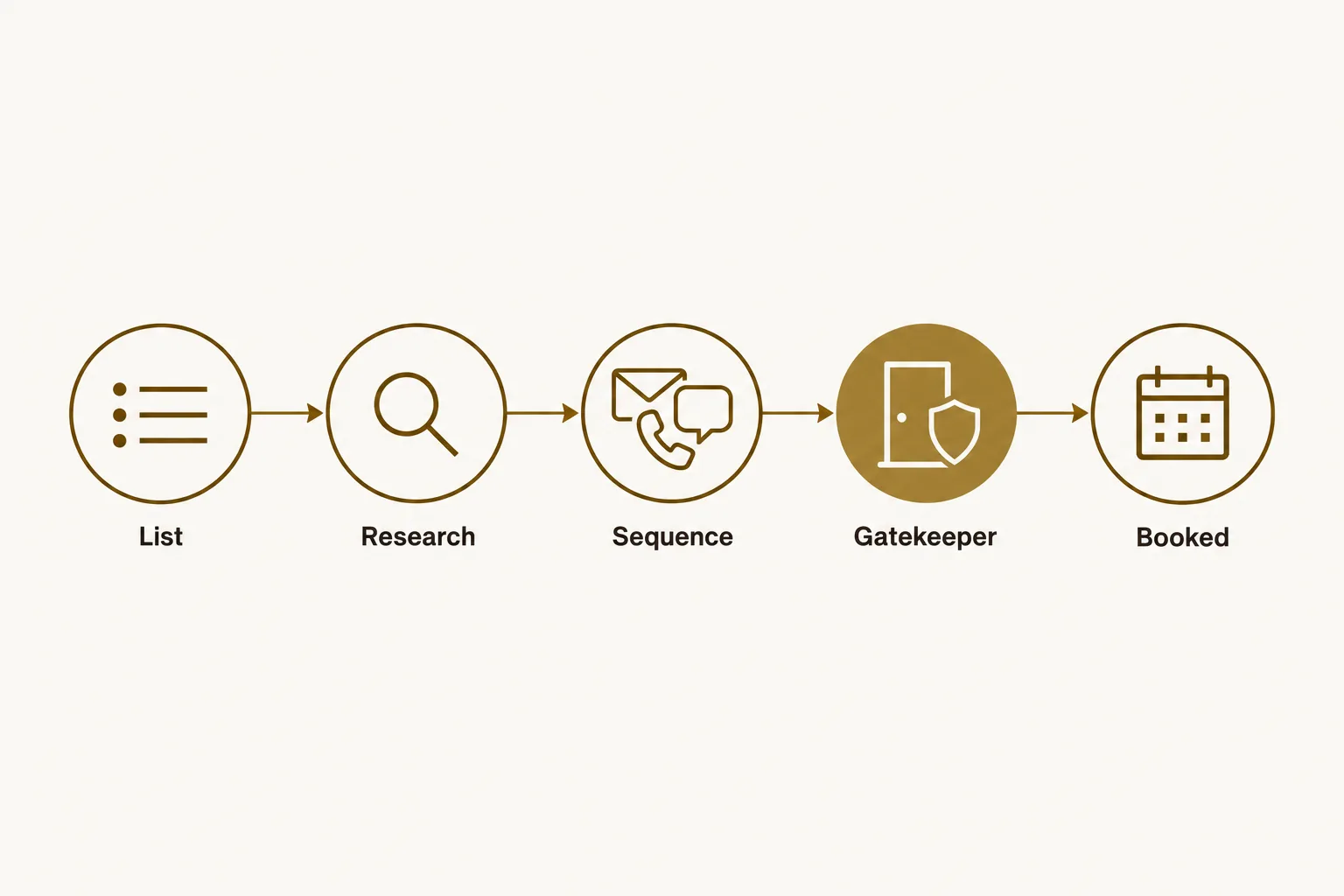
Appointment setting is the practice of booking a qualified meeting between a seller and a decision-maker. At C-level, it means securing a calendar slot with an executive who holds budget authority, usually so an account executive can run discovery.
The operating model is consistent whether it sits in-house or with an outsourced agency:
- List construction. Target accounts mapped to named executives with verified contact data, sourced through trusted B2B data providers rather than scraped.
- Research pass. Earnings commentary, recent appointments, announced transformation programs, regulatory pressure. Anything that gives the opening line a reason to exist.
- Multi-touch sequence. Email, LinkedIn, phone, spaced over two to four weeks, with the ask usually a short introductory call.
- Executive assistant navigation. The person guarding the calendar is often the real audience for the first three touches.
- Calendar hold and confirmation. Booking, briefing the account executive, reconfirming before the meeting.
Commercially it is priced per meeting or on a retainer, and performance turns on two variables: list accuracy and sequence volume. Both sit inside a team’s control, which is much of the appeal. It is a channel you can turn up on a Monday.
Why Appointment Setting Is Hard at the C-Level
Appointment setting is a hard job, and the difficulty is structural rather than a question of effort. A skilled setter working a clean list still faces conditions that persistence does not remove.
Executives delegate evaluation downward. A CIO who receives an unsolicited pitch for a data platform routes it to a director. That is not avoidance; it is how large organizations function. Outreach aimed at the top frequently lands back at the level the seller was trying to skip.
The gatekeeper is a role, not an obstacle to trick. Executive assistants are paid to protect the calendar against exactly the request being made. Tactics built on evading them age badly and damage the brand when they fail, which is most of the time.
Regulatory conditions vary sharply by market. Cold B2B outreach in Europe is not a single legal regime. Germany’s Unfair Competition Act requires prior consent for B2B commercial email in most cases, France’s CNIL permits legitimate interest with strict opt-out mechanisms, and the UK operates under PECR post-Brexit, according to a country-by-country breakdown of B2B cold email consent rules. A sequence designed for NAMER volume economics does not transfer cleanly into DACH.
There is no social proof in the room. The executive is asked to give thirty minutes to a vendor with no peer endorsement, no third-party context, and no reason beyond the seller’s own claim of relevance.
A booked meeting is not a valued meeting. Show rates, polite acceptances, and meetings that end without a next step all inflate the reported number while producing nothing downstream. Any comparison that counts meetings booked without counting what happened afterwards is measuring activity, not access.
What Executive Events Mean as a Demand-Gen Channel
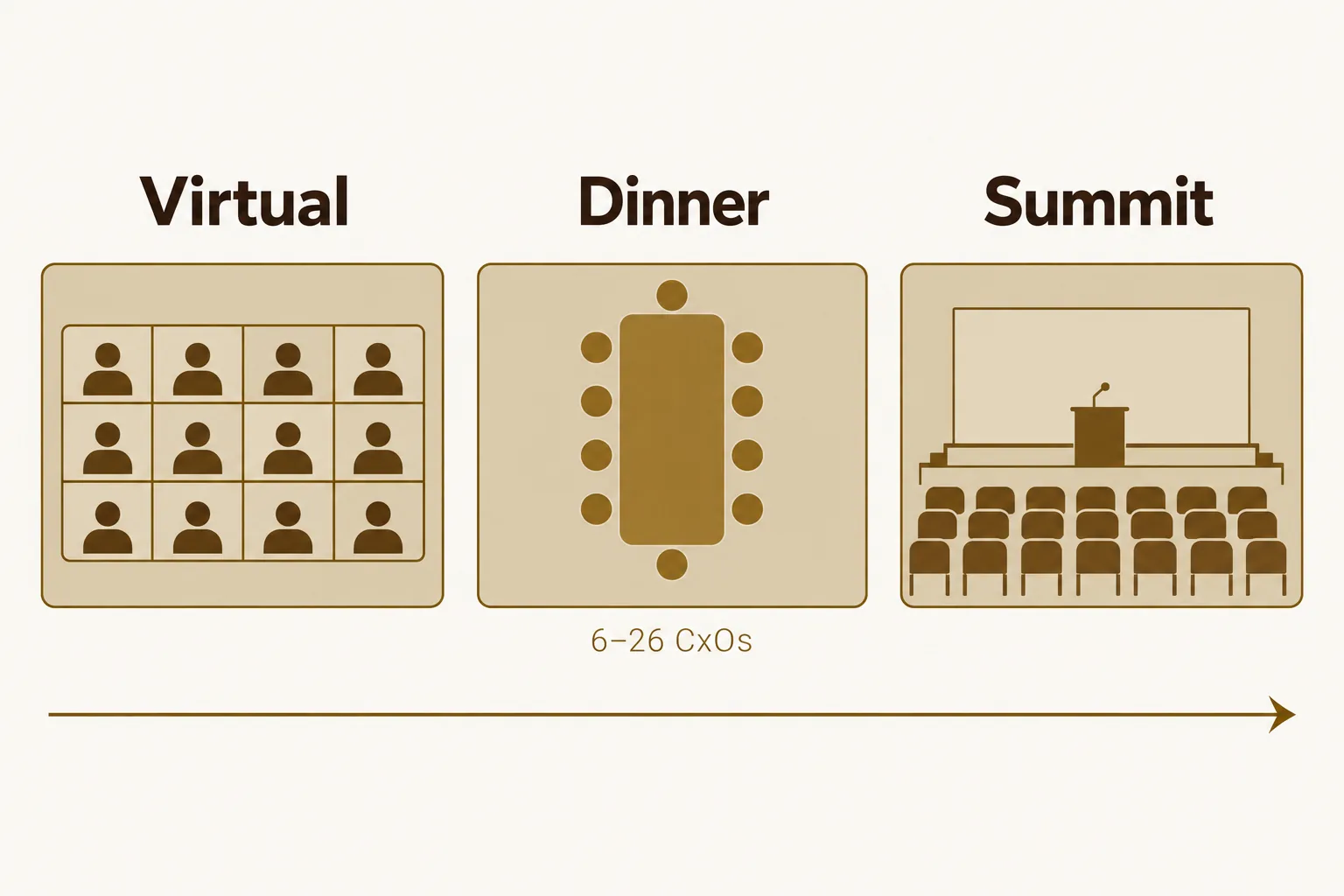
An executive event, in the sense that matters here, is an invitation-only gathering where senior decision-makers convene around a topic rather than a product. The sponsor is present, visible, and credited, but the agenda belongs to the discussion.
The formats that do the work:
- Virtual executive roundtables and webinars. The most scalable format, with no travel cost and the ability to assemble executives across UKI, DACH, BENELUX, and NAMER in one session. A branded virtual event also leaves the sponsor an owned content asset once it ends.
- Executive dinners and roundtables. Typically six to twenty-six CxOs around one table, with a moderator and a structured discussion. Small enough that every attendee speaks, large enough to justify the logistics.
- Executive summits. Larger multi-sponsor or multi-region gatherings, higher investment, usually a later-stage commitment rather than a starting point.
Executives accept these invitations for reasons that have little to do with the sponsor. They come for the agenda, for the chance to compare notes with people holding the same mandate, and above all for who else will be in the room. A CISO will clear an evening to hear how four peers handled a regulatory audit. The same CISO will not clear thirty minutes for a capability overview.
Composition is therefore the whole game. Executive-only rooms hold their value because peer dynamics only function among peers. Introduce mixed seniority and the conversation flattens into presentation mode, senior attendees disengage, and the format loses the one property that made it worth attending.
Strict seniority limits on who gets a seat are not exclusivity theatre. They are what makes peer-to-peer relevance possible.
Head-to-Head: Nine Dimensions That Actually Differ
1\. Speed to first conversation. Appointment setting wins outright. A sequence launched this week can produce a meeting next week. Executive events need lead time for audience acquisition, agenda design, and confirmation cycles: realistically a couple of months for an in-person format, less for virtual.
2\. Cost per qualified conversation. Appointment setting prices cleanly per meeting, which makes forecasting simple. Events blend one investment across an entire room, so cost per conversation depends on attendance quality rather than volume. Twelve pre-approved CxOs at one table can compare well against the same spend in per-meeting fees, particularly when several of those executives sit inside named target accounts.
3\. Trust transfer. A vendor asserting its own credibility is the weakest form of proof available. A facilitated room where peers validate a problem in front of each other is among the strongest. This is the largest structural difference between the two channels.
4\. Message control. Appointment setting gives the seller a script and full control of the narrative. An executive event gives up that control deliberately: the moderator runs the agenda, and the executives talk more than the sponsor does. Teams that cannot tolerate the trade should not run events, because a roundtable converted into a pitch is a roundtable nobody returns to.
5\. Scale and geography. Sequences scale by adding contacts and headcount. Events scale differently. Virtual formats reach executives across four regions in a single session; in-person formats require local market knowledge, venue work, and cultural fit in each city.
6\. Qualification rigor. Appointment setting infers fit from job titles in a list. A curated event holds every attendee against the client’s target profile before a seat is confirmed. That is the difference between hoping the right person accepts and approving the right person in advance.
7\. Downstream conversion quality. A cold first meeting opens with the seller establishing why they deserve the time. A follow-up after a shared discussion opens with a reference point both people were present for. The second conversation is materially easier, and it is why events keep producing meetings for months afterwards.
8\. Multi-stakeholder reach. Complex enterprise purchases are settled by committees, not individuals. Risk, compliance, operations, procurement, and finance each hold an effective veto. One booked meeting touches one of those people. A room, plus the internal conversation it starts, reaches more of them.
9\. Brand effect. Volume outreach spends brand equity with every send, converting or not. A well-run executive event builds it, with the sponsor associated with a discussion the attendees valued rather than an interruption they deleted.
Where Appointment Setting Genuinely Wins
- Very small named lists. With fifteen accounts where a single logo justifies months of effort, direct, researched, persistent outreach is the right instrument.
- An existing warm path. A referral, a shared investor, a former colleague. Where a credible introduction exists, use it immediately, because that advantage decays.
- Mid-quarter pipeline gaps. Events cannot be conjured in ten days. Outreach can.
- Confidential or highly technical deals. Security incidents, restructuring, and sensitive regulatory exposure will never be discussed in a group setting.
Where Executive Events Genuinely Win
- Category creation and new-market entry. Where no intent exists to intercept, there is nothing for outreach to catch. Demand has to be created, and peer discussion creates it faster than sequences do.
- Committee-heavy sectors. In BFSI, healthcare, and manufacturing, one meeting rarely moves a decision that requires risk, compliance, operations, and finance to align.
- Markets with strict outreach norms. Where consent requirements are tight and cold response is weak, an invitation to a peer discussion is both more lawful in spirit and more welcome in practice than a pitch.
- Relationship depth over slot count. When the objective is positioning inside an account across three quarters rather than a meeting this month, structured CxO engagement does work no sequence replicates.
The False Choice: How the Two Channels Compound
The comparison is usually framed as selection. It is more useful as sequencing.
Run the event first. The invitation becomes the outreach reason, and “join eight BFSI peers discussing AI governance over dinner in Frankfurt” is a fundamentally different ask than “do you have thirty minutes for a demo”. Reply rates improve because the offer is an agenda seat, not a sales conversation.
Attendance then works as a qualification signal no list can produce. An executive who cleared an evening for a topic has disclosed a priority. The post-event conversation is the appointment, and it starts warm.
This also reframes the appointment-setting team. The same researchers, the same sequencing discipline, the same executive assistant relationships, all pointed at securing attendance rather than a demo. Some teams extend it further by attaching curated one-to-one meetings to a roundtable, so the group discussion and the individual conversations happen in the same window.
For a company already running its own in-house event, standalone audience acquisition solves the part that usually fails: getting the right twelve executives to register and actually attend.
Selling to the C-Suite in Either Channel
The skills transfer, because both channels depend on the same thing: being worth an executive’s time.
Research the role, not the company. A CFO and a CIO in the same organization carry different pressures and different vocabularies. Generic account research produces generic relevance.
Speak to the operating agenda. Cost pressure, regulatory risk, transformation delivery, AI adoption, talent retention. Product capability answers a question the executive has not asked yet.
Make one clear ask. A single, specific, time-boxed request converts better than an open-ended offer to “connect”.
Use the agenda or the peers as the hook. Naming the topic and the profile of who else will be present gives the executive a reason grounded in their own interest.
Respect the calendar. Short windows, clear start and end times, confirmation before the day. For events: an invitation from a credible host, a transparent description of the guest profile, and an explicit no-pitch commitment.
Keep outreach compliant. Email, LinkedIn, and trusted B2B data providers, operated in line with GDPR and local rules, are the baseline standard rather than an optional extra. In regulated European markets it is also the only version that survives a procurement review.
Seasonality: The Timing Variable Most Comparisons Ignore
Competing guidance on this topic rarely addresses when to run each channel, which is odd, because timing affects outcomes more than most tactical choices.
Executive engagement has two productive windows. Late February through July, when fresh budgets are allocated and calendars are open ahead of summer. Then September through early December, the busiest period of the year, particularly in Europe, as teams push to engage executives before year-end targets close.
The dead zones are equally predictable. August removes European executive availability almost entirely, and late December through early January is a planning period, not a delivery period. Virtual sessions continue at reduced pace in both periods, but in-person dinners and roundtables should not be forced into them, because a curated room with four acceptances is worse than no room at all.
Appointment setting is the channel that can flex into the slower periods, and that flexibility is a genuine argument for keeping it running year-round. Regional nuance matters too: UKI, DACH, and BENELUX share the sharp August drop and the strong September rebound, while NAMER budget cycles often sustain demand into early December.
How to Decide: A Practical Allocation Framework
| Business situation | Better starting point | Why |
|---|---|---|
| Fewer than 50 highly strategic accounts | Appointment setting | Direct outreach gives the team precise control over each account |
| Large named-account list | Executive events + appointment setting | One event can create access to multiple priority accounts while outreach continues between sessions |
| Strong existing demand | Appointment setting | The channel can capture interest quickly and turn it into meetings |
| Low category awareness or emerging market | Executive events | Peer discussion can create recognition and urgency that cold outreach may struggle to establish |
| Complex committee-led purchase | Executive events | Multiple stakeholders can be influenced through shared discussion and follow-up |
| Immediate pipeline gap | Appointment setting | Outreach can start producing conversations faster than event planning |
| Strict outreach environment | Executive events | Invitation-led engagement can reduce reliance on repeated cold outreach |
| Need for long-term senior relationships | Executive events | The format creates repeated peer interactions and stronger relationship depth |
Four questions settle most of this.
How many accounts are on the list? Under roughly fifty named accounts, weight toward appointment setting, with events reserved for accounts that have resisted direct contact. Above that, events start to justify their economics because one room touches many accounts at once.
How many stakeholders influence the decision? Single-owner purchases suit one-to-one meetings. Committee purchases need multiple touchpoints and internal advocacy, which events generate and single meetings do not.
Does demand already exist? If executives already know they have the problem, harvest it with outreach. If they do not, no sequence will create the recognition, but peer discussion will.
What is the regional outreach climate? Where consent rules are strict and cold response is weak, shift budget toward invitation-led engagement.
As a working split, treat executive events as the demand-creation layer and appointment setting as the harvesting layer, then fund them in proportion to how much of your pipeline problem is awareness versus access.
Before committing budget to either, instrument the measurement: meetings booked, show rate, and meeting-to-opportunity conversion for outreach; attendance rate, target-account coverage, engagement quality, and post-event next steps for events.
Channels without comparable measurement lose the budget argument to channels with it, regardless of which actually performs better.
One caution worth stating plainly. Neither channel guarantees deals. Both create the conditions for pipeline, trust, and opportunity. Any provider promising specific revenue outcomes is describing something it cannot control.
What a Well-Run Executive Event Actually Requires
Executive events usually get dismissed as expensive because someone ran a bad one. The operational scope is far larger than the invitation:
- Audience acquisition and targeting, built from the client’s go-to-market priorities and target account list rather than a pre-built contact database.
- Venue research and booking for in-person formats, with local knowledge of what reads as appropriate to executives in that market.
- Content and agenda design, including discussion topics that justify the attendance and a moderator capable of keeping executives talking rather than listening.
- Execution, onsite or virtual, covering reconfirmation, run-of-show, and keeping the sponsor’s role proportionate.
- Post-event reporting, with attendee detail, engagement insight, and recommended next steps per account.
The control that separates a curated room from a filled room is pre-approval: every attendee checked against the client’s target profile before the seat is confirmed. That single discipline is what makes an event comparable to appointment setting on qualification rigor, and post-event reporting is what makes it comparable on measurement. Without both, an event is a cost center with good catering.
Frequently asked questions
What does appointment setting mean?
Is appointment setter a hard job?
How do you sell to C-level executives?
What are effective tips for setting appointments with executives?
Can executive events replace appointment setting entirely?
How many executives should attend a roundtable?
How far in advance should an executive event be planned?
Start With the Lower-Risk Test
If the comparison is genuinely unresolved for your team, resolve it with evidence rather than argument. A single virtual executive roundtable or webinar is the lowest-risk way to see what a curated audience produces, with no travel cost and reach across UKI, DACH, BENELUX, and NAMER in one session.
One executive dinner or roundtable, six to twenty-six pre-approved CxOs, gives the in-person equivalent. If an event is already on your calendar and the worry is attendance, audience acquisition support solves that part on its own.
The useful starting conversation is not about packages. It is about which executives you need in the room, in which markets, and against which accounts, because everything else follows from that. Start there, and let the first event tell you how to split the budget next quarter.