
Boutique events vs trade shows is the budget question every B2B marketing leader eventually has to answer.
This guide breaks down the real differences in cost, lead quality, and executive access, then offers a framework for choosing between them.
Boutique Events vs Trade Shows
What Is a Boutique Event?
A boutique event is a small, invitation-only gathering built around a defined guest list, usually 10 to 25 senior executives. Formats include roundtables, private dinners, and closed-door briefings, all built for candid, peer-level conversation rather than a sales pitch.
A cybersecurity company hosting a 20-person CIO roundtable on threat detection is a typical setup. The room stays small enough that every voice gets heard, and the topic stays specific enough that nobody feels sold to.
What Is a Trade Show?
A trade show is a large exhibition where multiple companies rent booth space to demonstrate products, generate leads, and build category visibility. Attendance can range from a few hundred to tens of thousands, and interactions tend to run shorter and less personal.
A company launching a new enterprise product at an industry-wide trade show is betting on reach, wagering that the volume of exposure outweighs the depth of any single conversation.
Teams comparing conferences vs small events for B2B usually land here first, since the format question shapes everything that follows.
Boutique Events vs Trade Shows: Key Differences That Matter to B2B Companies
The right choice depends less on event size and more on the business outcome a team is trying to reach. Marketers who have sat through a follow-up cycle of five hundred low-intent scans understand the boutique events vs trade shows lead quality gap firsthand.
| Category | Boutique Events | Trade Shows |
| Audience reach | Narrow, curated | Broad, mixed |
| Relationship depth | High, personal | Low, transactional |
| Executive accessibility | Direct access to senior buyers | Filtered through booth staff |
| Cost structure | Lower total, higher per attendee | Higher total, lower per attendee |
| Sales cycle impact | Accelerates mid to late funnel | Supports top of funnel |
| Brand visibility | Limited to attendees | Wide, public |
| Attribution | Easier to trace to named accounts | Difficult, mixed sources |
| Follow-up effort | Light | Heavy |
Reach and Brand Awareness
Trade shows still hold a place in the marketing mix for visibility.
78% of organizers report that in-person conferences and conventions remain their most impactful marketing channel, and a global floor presence still carries weight during a product launch or category-entry campaign.
Relationship Quality and Executive Engagement
Boutique events consistently outperform on relationship depth. Networking effectiveness at large-scale events has slipped, only 15% of organizers now rate their networking as very effective, a sharp drop from the prior year.
An executive dinner built around ten target accounts creates a setting where real conversation happens, without competing for attention across a crowded hall.
That intimate networking vs conference networking gap is the reason enterprise sales teams increasingly favor smaller formats for late-stage deals.
Lead Quantity vs Lead Quality
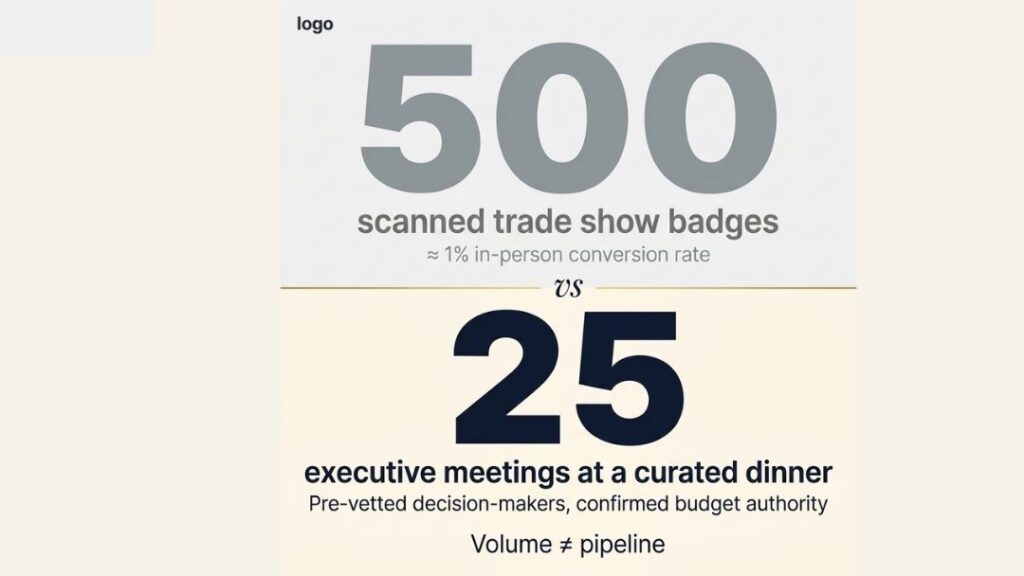
Five hundred scanned badges rarely convert the way twenty-five executive meetings do. Mid-market companies report just a 1% in-person conversion rate on trade show leads pulled straight off the show floor.
A curated dinner built around pre-vetted decision-makers produces a shorter list, but every name on it carries real budget authority.
| Metric | 500 Scanned Badges | 25 Executive Meetings |
| Follow-up burden | High, mostly cold | Low, mostly warm |
| Decision authority | Mixed, often unknown | Confirmed pre-event |
| Expected opportunity quality | Low to moderate | High |
Which Event Format Delivers Better ROI?
ROI is not about attendance figures, it is about business outcomes. Cost per lead at trade shows averages around $112, compared with $259 for a field sales call, and CEIR reports a $20.98 average return for every $1 spent on exhibiting.
Those numbers hold up until conversion rates enter the picture. Executive event ROI depends far more on deal size and close rate than on raw lead volume.
| Metric | Boutique Events | Trade Shows |
| Cost per opportunity | Lower, fewer wasted contacts | Higher, more unqualified volume |
| Sales cycle influence | Strong mid to late funnel | Strong top of funnel |
| Executive meetings | Direct, pre-confirmed | Rare, booth-dependent |
| Pipeline attribution | Easier to isolate | Harder, mixed sources |
| Expansion potential | High, relationship-driven | Lower, one-time contact |
The Hidden Costs of Trade Shows
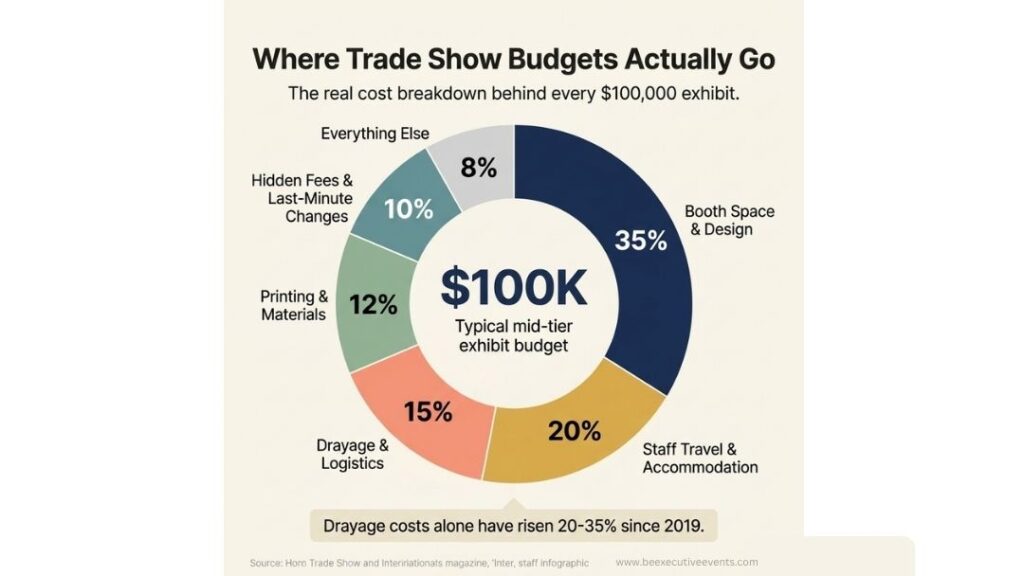
Booth space alone typically accounts for 30 to 40% of a total trade show budget, and hidden line items, printing, staff travel, electricity, last-minute changes, can add another 10 to 20% on top.
Drayage fees, the cost of moving materials from the loading dock to the booth, have climbed 20 to 35% since 2019. For a standard 20×20 exhibit, that alone can run $5,000 to $16,000 per show.
A full exhibitor program ranges anywhere from $15,000 for a basic setup to well over $250,000 for an enterprise island build.
Why Boutique Events Often Produce Higher-Value Conversations
Only 23% of B2B marketers currently use personalization tactics in their event marketing, according to Content Marketing Institute research, which leaves a wide gap for teams willing to invest in curated formats.
Over 90% of senior marketers say events deliver the most value in the mid to late funnel stage, and that value only shows up when the room holds the right seniority.
In my experience working with enterprise accounts, a well-run executive dinner tied to a live opportunity moves a deal forward faster than months of email sequences ever could.
How to Measure Event Success Beyond Attendance Numbers
A stronger scorecard tracks:
- Executive meetings booked
- Pipeline directly influenced
- Opportunities created within 90 days
- Expansion revenue from existing accounts
| KPI | 2026 Benchmark |
| Registration rate | 5 to 15% |
| Pipeline influence | 3 to 5x event cost |
| Overall event ROI | 300 to 500% |
When Should You Choose Boutique Events vs Trade Shows?
Neither format wins by default. This boutique events vs trade shows framework becomes practical once a team defines its primary goal.
| Business Goal | Recommended Format |
| Brand awareness | Trade show |
| Product launch | Trade show |
| ABM campaigns | Boutique event |
| Executive networking | Boutique event |
| Customer retention | Boutique event |
| Industry positioning | Either, depending on stage |
Choose Boutique Events If Your Goal Is Executive Relationship Building
Enterprise sales, account-based marketing, and customer expansion all benefit from small, curated formats.
Contact-level account targeting linked to an in-person dinner has been shown to lift booked meeting conversion by up to 74%, and ITSMA reports that 87% of marketers see stronger ROI from account-based programs than from broader campaigns.
An invite-only leadership dinner built around five target accounts is a common way to put that lift into practice.
Choose Trade Shows If Your Goal Is Market Visibility
Entering a new market, launching a flagship product, or building category-wide awareness still favors scale. A trade show puts a brand in front of an audience it has not earned yet, which matters most in the early stages of category entry.
The Strongest Event Strategies Combine Both Approaches
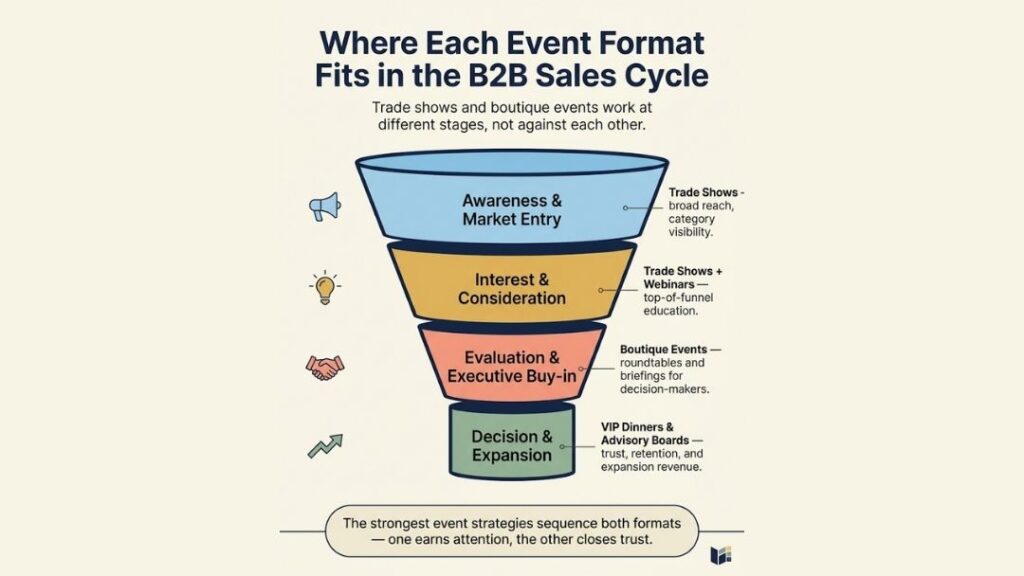
Boutique events and trade shows are not exclusive choices. A pre-show executive dinner the night before a major conference, followed by a VIP roundtable after the floor closes, lets a team capture broad visibility and deep relationship building on the same trip.
Why in-person meetings close more deals is less about picking one format and more about sequencing both correctly.
Frequently Asked Questions
Boutique events vs trade shows: which wins for B2B pipeline?
Neither format is universally better. Boutique events tend to produce higher-quality conversations and stronger executive access, while trade shows deliver broader reach. The right answer depends on the specific goal behind the event.
Do boutique events generate higher-quality leads?
Yes, in most cases. A curated guest list of pre-vetted decision-makers produces fewer contacts than a trade show floor, but each one typically carries real budget authority.
Are trade shows still worth the investment for B2B companies?
For awareness and category-entry goals, yes. CEIR reports a $20.98 average return for every $1 spent on trade show exhibiting, though conversion rates on those leads tend to run low.
How do you measure ROI for boutique events?
Track executive meetings booked, pipeline influenced, and opportunities created rather than attendance alone. Most boutique formats show measurable results within a single sales cycle.
Can boutique events support account-based marketing strategies?
Yes, boutique formats target the same small, high-value account lists that ABM programs use, which makes them a natural fit for late-stage account engagement.
Turn Executive Conversations Into Real Business Relationships
The boutique events vs trade shows comparison is not about picking a winner. It comes down to pairing format to objective, budget to expected return, and guest list to the stage of the relationship a team is trying to build.
Be Executive Events creates high-value formats where that kind of exchange happens by design.
With 250+ events delivered across Europe, North America, and Asia, and 10+ years of experience working with global enterprises, SaaS firms, and consultancies, BEE builds the environments where real executive relationships begin.
If your team wants to build rapport with senior decision-makers without the friction of cold outreach, a well-structured executive event is often the strongest starting point, one where the right leaders are already in the room and the conversation has a genuine reason to happen.
- Curated, invitation-only guest lists built around named target accounts
- End-to-end logistics, from venue selection to post-event ROI reporting
- Formats built for candid, peer-level executive conversation
Contact Be Executive Events today to explore how your next event can connect your team with the right people at the right level.