
Forty registrations. Twenty-two people through the door. Three of them senior, none from a named target account. Most demand-generation leaders have run that event, defended its cost in a QBR, and quietly concluded that events do not work for enterprise pipeline.
The diagnosis is usually wrong. B2B events that attract decision makers are not the ones with the biggest promotion budget; they are the ones whose format, capacity, agenda and invitation mechanics were designed around how a CxO actually decides where to spend an evening. Executive turnout is engineered upstream, weeks before the first invitation is sent.
What follows is what to build, how to invite, how to design the room, and how to prove it worked.
Who the Decision Makers Actually Are in B2B
In B2B, the decision maker is rarely one person. Purchases of any consequence are made by a buying group: an economic buyer who owns the budget, a technical evaluator who validates fit, an end-user champion who feels the problem daily, procurement, and increasingly a security or data-governance gatekeeper with veto power. Most of that group’s evaluation now happens online before any vendor conversation, which is precisely why face-to-face formats are being rebuilt around relationship value rather than information delivery, a shift traced in research on the future of B2B trade shows in Industrial Marketing Management.
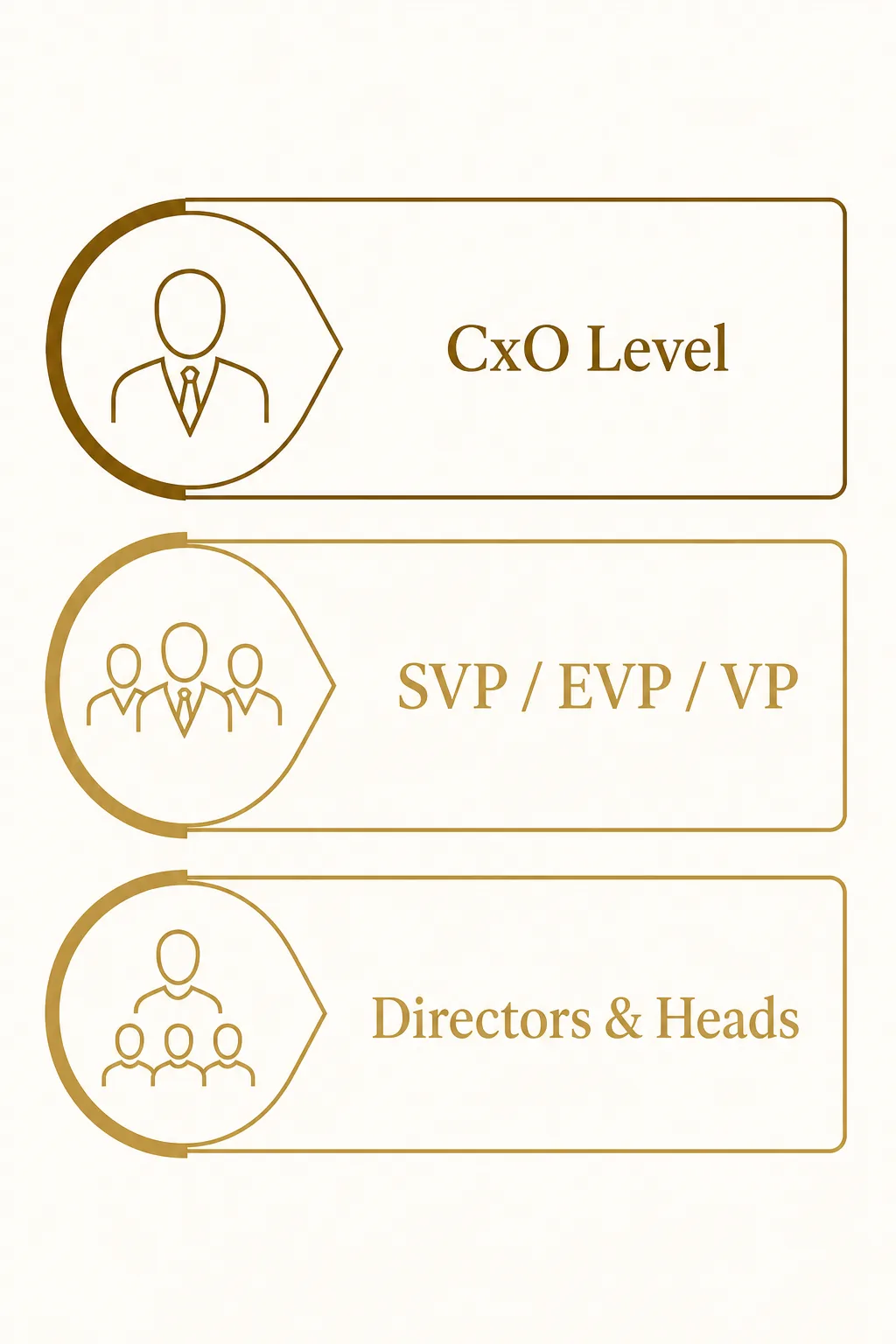
For a technology or SaaS go-to-market motion, the executive decision makers worth convening are concrete: CEO, CIO, CTO, CFO, CHRO, CDO, CPO and CAIO, alongside SVPs, EVPs and Directors leading Transformation, Innovation, Cybersecurity, Cloud, Data and AI. Which of those titles belong at your table depends entirely on the problem you are convening around, which is why C-suite event planning for technology companies starts with the buying group, not the guest list.
One operational point separates real executive events from senior-sounding ones: the title on a badge is not qualification. A “Director of Innovation” at a 40-person consultancy and a Director of Innovation at a 12,000-person insurer are different audiences. Pre-approval of every attendee against your own target-account list and title profile, before the event rather than in the post-event report, is what makes an audience genuinely executive.
What Counts as a B2B Event, and Which Formats Pull Executives
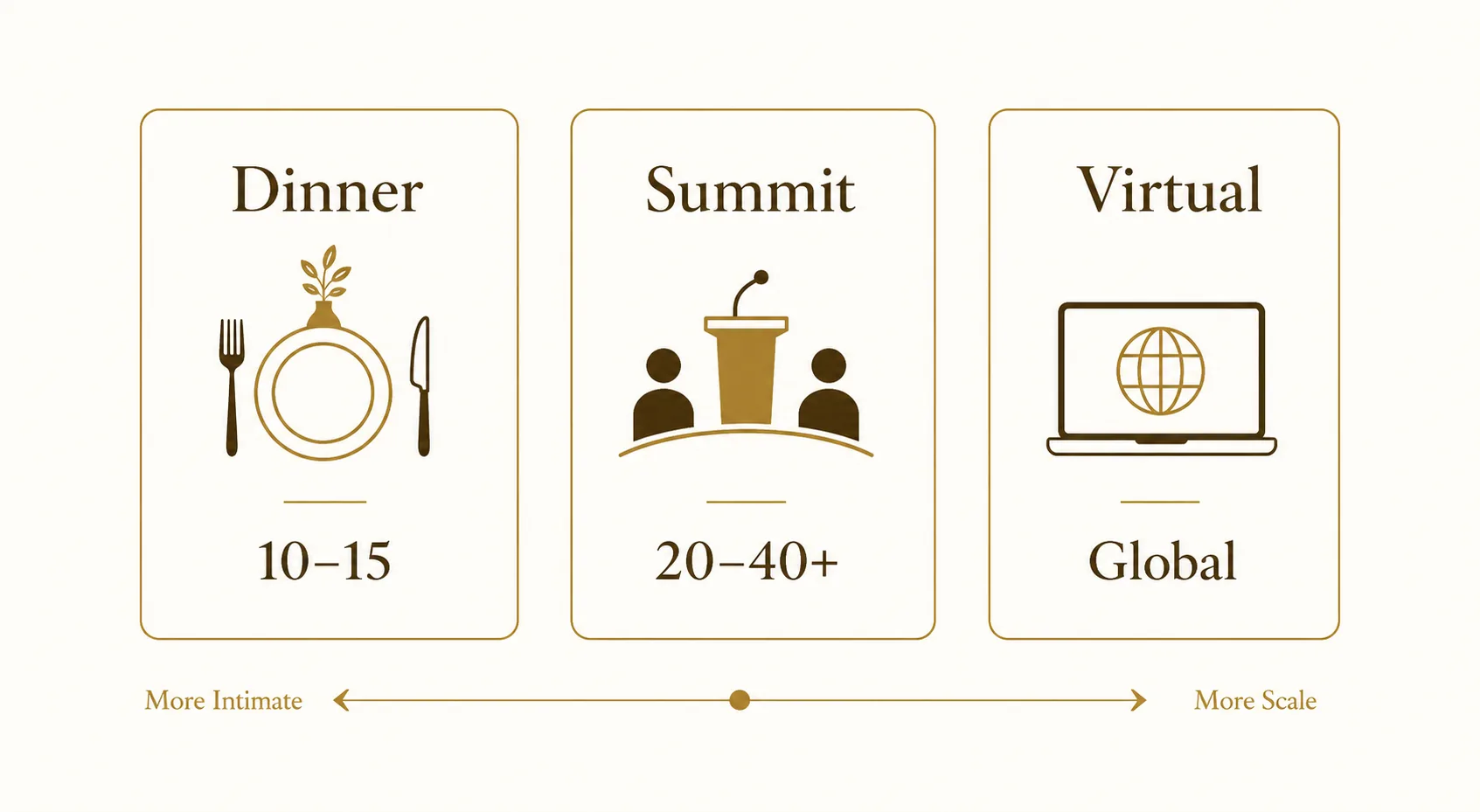
A B2B event is any convened gathering where organisations, rather than consumers, are the audience: roundtables, executive dinners, webinars, summits, user conferences, trade shows. Most guides list these neutrally. They are not equal. Ranked by their ability to pull senior attendance, the order is fairly stable.
Executive roundtables and networking dinners
A curated table of roughly 6 to 26 pre-approved executives, run under Chatham House conventions with a credible moderator, converts better than any other format. The reason is simple: a CIO gives up an evening for peers facing the same problem, not for a vendor deck. Peer density beats content volume. A networking dinner where eight of the twelve guests run comparable estates in comparable industries is worth more to an executive than a conference keynote, and they know it before they RSVP. Executive roundtables also self-select for candour, because nobody is performing for an audience of 300.
Virtual executive events and webinars
Virtual executive sessions carry the lowest friction for both host and guest, which makes them the most practical starting point and the easiest format to run consistently across UKI, DACH, BENELUX and NAMER without travel. The same analysis of digital channels absorbing the traditional information function of physical events explains why: what survives online is dialogue, not display. The trade-off is honest. A lower commitment threshold means agenda quality and moderator credibility carry the entire session. A 45-minute, time-boxed discussion with four named peer participants outperforms a 60-minute product walkthrough every time. Sponsorship packages for virtual events also work differently from in-person ones, since value sits in audience composition and content rights rather than signage and stand space.
Executive summits and multi-sponsor forums
Larger, multi-region, often multi-sponsor gatherings deliver reach and positioning at a higher investment level. They work best as an expansion of a relationship that has already proven audience fit, not as a first experiment.
Trade shows, user conferences and large-format events
Large-format events are excellent for brand presence and volume, and structurally poor for executive intimacy. An executive on a show floor is approached every ninety seconds and has no incentive to engage deeply. Academic work on trade show transformation points toward the same conclusion: relationship value is migrating to smaller, curated formats. The practical fix is the side event, a dinner or roundtable scheduled adjacent to a major industry week, when the executives you want are already in-market and travel friction is somebody else’s problem.
Best Practices for Inviting Senior Executives to Events and Peer Groups
This is where most executive event programmes fail, and it is almost entirely a craft problem rather than a budget problem.
Lead with the peer group, not the sponsor
The first line of the invitation should answer the only question an executive is asking: who else will be there, and what problem do we share? Confirmed titles, industries and company scale earn acceptances. Sponsor logos do not.
Make scarcity real
A capped table of twelve is a genuine constraint, and executives read capacity as a proxy for curation quality. Manufactured urgency is transparent to people who receive twenty invitations a week; a real limit is not.
Respect the executive’s calendar economics
Time-box everything and publish the end time. Early-morning or evening slots convert better than mid-afternoon. Never ask for a full day as a first engagement. An executive who leaves on time returns next quarter.
Run multi-touch, compliant outreach
Sequenced email and LinkedIn outreach supported by trusted B2B data providers is the workable mechanism, and it must stay GDPR-compliant throughout, with clear identification of the sender and a straightforward route to opt out. DACH audiences in particular apply stricter norms, and outreach that ignores them costs credibility with exactly the people you are trying to reach.
Confirm, re-confirm, and pre-approve
RSVP management, pre-event confirmation calls in the final week, and a replacement protocol for last-minute drops are unglamorous, and they determine seat quality more than anything else in the process. Every attendee should be signed off by the client before the event, not disclosed afterwards.
Time it against the seasonal reality
Late February through July, and September through the first half of December, are the productive delivery windows. August is effectively closed for in-person executive events across Europe. Late December to early January is a planning window, not a delivery window. Virtual formats bridge the quiet periods without wasting invitations.
Designing the Room: The 5 C’s of Event Planning
The 5 C’s of event planning are Concept, Coordination, Control, Culmination and Closeout: the five stages that take an event from idea to measurable outcome. Applied to a CxO roundtable rather than a generic conference, each one changes shape.
- Concept. Not a theme, a single strategic question the table is convened to answer. A data and analytics leadership event for executives shows the pattern: one problem senior leaders already own, framed sharply enough that attending feels like progress on it.
- Coordination. Moderator selection, venue research and booking, seating plan, running order. Seating is a strategic decision at a table of twelve.
- Control. Keeping the discussion off the pitch deck. The host earns the room by contributing, not presenting.
- Culmination. The live session, in person or virtual, where the design either holds or does not.
- Closeout. Post-event reporting, per-account observations, structured follow-up.
Content design, moderation and agenda flow belong to event production management, not to a marketing afterthought. Executive event management that stops at logistics reliably produces a well-catered room where nothing is said.
The 95-5 Rule and Why Executive Events Are a Long Game
The 95-5 rule holds that at any given moment only a small minority of potential B2B buyers are actively in-market, while the large majority will buy at some point in the future. Drawn from marketing-science work on category buying behaviour, it reframes what marketing to non-buyers is for: building the memory that decides who gets called when the buying window opens.
For executive events, the implication is direct. A dinner is not a closing mechanism. It is how you become the vendor a CIO remembers when a budget cycle opens fourteen months out. Judging a roundtable by same-quarter attribution measures the wrong thing and usually kills the programme before it compounds. Well-run executive events create the conditions for trust and pipeline; they do not guarantee deals, and any partner promising otherwise is selling something else.
Measuring Whether the Event Actually Worked
Show rate and lead volume are the wrong headline metrics for this format. A twelve-person table producing four target-account conversations outperforms 200 registrations. Use three tiers instead.
- Audience quality: share of attendees at target seniority, share from named target accounts, industry and region mix against the agreed profile.
- Engagement: how widely participation spread across the table, questions asked, meetings requested on the night.
- Progression: meetings booked post-event, accounts newly engaged, opportunities influenced. Influenced, not attributed.
The deliverable that makes this usable is a post-event report with full attendee detail, engagement observations, and recommended next steps per account. That report is what a field marketing lead takes to a CFO.
Build It In-House or Bring in an Executive Events Partner
Signals you can run it in-house
You hold existing executive relationships in the target region, you have an internal moderator with real peer credibility, and you have bandwidth for six to ten weeks of RSVP management per event.
Signals you need a partner
You are entering a new region where local language, networks and executive trust take years to build. You have no warm senior list. Your team is at capacity. Or you need pre-approved audience composition rather than best-effort turnout.
What “end to end” should include before you sign anything
Audience acquisition and targeting, venue research and booking, content and agenda design including moderator selection, onsite or virtual execution, and post-event reporting with follow-up support. Anything narrower is a venue-plus-invite service. Working with an executive events partner focused on CxO engagement should also cover the standalone case: if you already have an event on the calendar and only need curated senior registrations, audience acquisition can be commissioned on its own.
Related readingB2B Lead Success: How to Reach Key Decision Makers in 2026Read the guide →Frequently asked questions
What is an example of a B2B event that attracts decision makers?
How many executives should attend a roundtable?
Do virtual executive events attract senior attendees?
How far in advance should you invite senior executives?
What should a post-event report contain?
Which B2B marketing conferences in 2026 are worth building around?
Start With One Room
Executive turnout is decided long before the invitation goes out, in the choice of format, the size of the table, the sharpness of the question, and the discipline of the confirmation process. Those decisions are learnable, and they are testable on a small scale.
The practical first step is one virtual executive session, a single curated dinner or roundtable, or audience acquisition support for an event you already have scheduled. If you would like to talk through which of those fits your next quarter, start a conversation with BEE.